Get Full Government Meeting Transcripts, Videos, & Alerts Forever!
Get email alerts on the Justice Involved Youth topic
No spam. Unsubscribe anytime.
Experts and advocates debate ‘trusted adult’ model in Justice‑Involved Youth bill
Summary
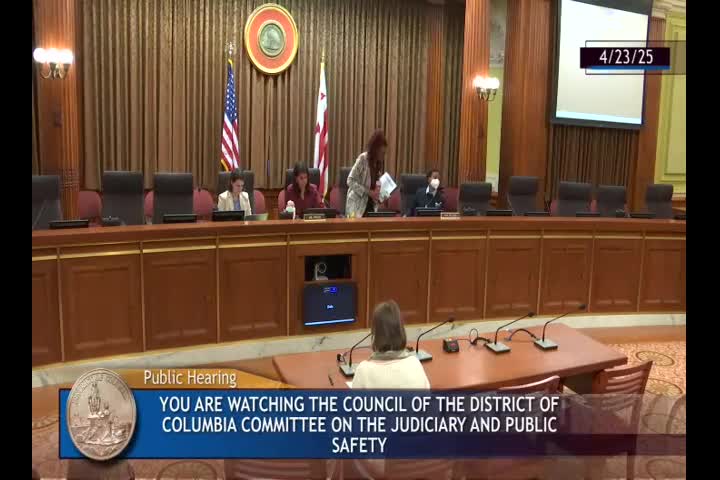
Witnesses split at an April 23 council committee hearing over a proposed pilot that would pair certain justice‑involved youth with a mandated “trusted adult” to provide case management and support.
The Justice Involved Youth and Community Act drew mixed testimony at the April 23 Committee on the Judiciary and Public Safety hearing. The bill would establish a pilot program to pair high‑risk youth who receive deferred dispositions, deferred prosecutions or consent decrees with a “trusted adult” who would provide case‑management supports intended to help youth meet the conditions of their agreements.
Whitney Lockheim, co‑founder and chief operating officer of Open City Advocates, told the committee that evidence‑based mentoring works only when mentors are voluntary advocates, not mandatory monitors. “Assigned alongside a probation officer with the power and responsibility to monitor compliance and punish noncompliance … is the opposite of the advocacy role described in best practices,” Lockheim said, arguing that a reporting role undermines trust and can be counterproductive.
Supporters from the health‑care sector and youth‑services providers said greater, consistent supports are needed. Eric Levy, chief medical officer at Health Services for Children with Special Needs, told the committee that continuity of medical and behavioral care is essential and that disenrollment from care while a youth is detained disrupts services; he urged trauma‑informed implementation and cross‑system coordination.
Magdalena Chungus (Policy Manager, Council for Court Excellence) said juvenile diversion programs generally show low rearrest rates — she cited program data indicating roughly 86 percent of participating youth were not rearrested — but recommended the district expand front‑end supports outside of prosecutorial conditions. Chungus warned that tying case‑management services to prosecution may pressure youth to plead guilty in order to access services.
Witnesses and council members discussed tradeoffs among accountability, voluntary services and the need to avoid creating additional surveillance that leads to revocation. Pinto said the bill is intended to increase supports so more youth can successfully meet conditions of diversion rather than be revoked to detention.
Committee members did not take a formal vote. Staff and council members said they would review testimony and related data, and suggested further work with service providers and juvenile‑justice experts to craft language that preserves mentoring’s voluntary, advocacy‑focused elements while improving youths’ access to services.