Get Full Government Meeting Transcripts, Videos, & Alerts Forever!
Get email alerts on the Safe Passage Training topic
No spam. Unsubscribe anytime.
Parents, educators and advocates back stronger Safe Passage training, urge standardization and school coordination
Summary
Parent leaders, educators and public‑health and safety groups told the D.C. Council’s Committee on the Judiciary and Public Safety April 23 that they support expanded Safe Passage training but want standard curricula, clear refresher schedules and stronger school coordination.
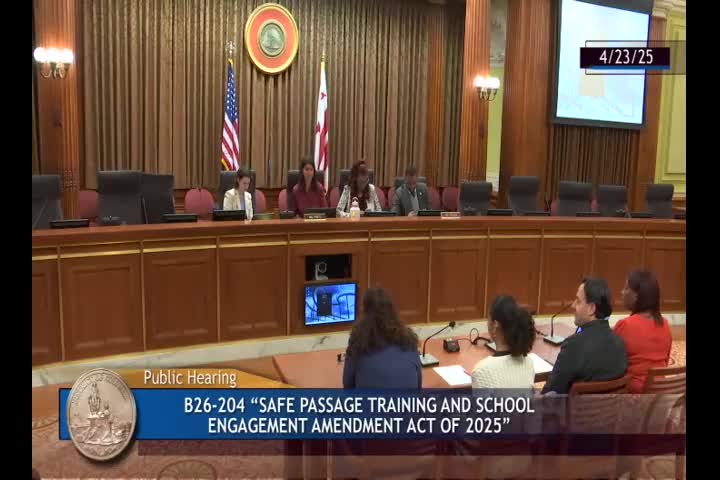
Council Member Brooke Pinto presented the Safe Passage Training and School Engagement Amendment Act of 2025 as part of her PeaceDC package and convened public witnesses April 23 to discuss training, coordination and program design.
Parent leaders and education advocates said they welcome the bill’s focus on de‑escalation, cultural competency and training for interactions with neurodivergent students, but asked the committee to standardize training across community‑based organizations and specify training frequency. “We support high quality uniform training in each of these areas,” Maya Martin Cadogan, founder and executive director of Parents Amplifying Voices in Education (PAVE), said, calling for calendarized dosage requirements and school co‑creation of training agendas.
School and charter leaders described operational problems the bill seeks to fix. Nicole Travers, Senior Director of School Support and Program Data at the D.C. Charter School Alliance, said improved coordination under the Deputy Mayor for Public Safety and Justice has yielded “responsive and strategic leadership,” but recommended standardized curricula developed with subject‑matter experts, plus an annual feedback mechanism for school leaders and CBOs.
Multiple witnesses proposed further changes: Caroline Pryor of EmpowerEd suggested piloting a small number of Safe Passage ambassadors as full‑time school‑based employees who could provide consistent restorative support inside and outside school. Speakers from KIPP DC and the DC Peace Team urged expanded on‑the‑ground presence during dismissal, clearer real‑time communication protocols for incidents, and periodic refresher trainings throughout the year so staff retain skills.
Children's National Hospital’s pediatric violence‑intervention program and KIPP DC voiced institutional support for training investments and for integrating Safe Passage with broader violence‑interruption and hospital‑based supports. The DC Peace Team recommended including community‑based unarmed civilian protection or “community safety” units among PeaceDC’s nonviolent conflict‑skill investments.
Committee members asked witnesses about balancing standardized citywide training with school‑by‑school differences; witnesses recommended a core, standardized curriculum supplemented by localized agendas co‑created with school leaders, and quarterly refreshers and annual feedback tools.
No formal vote occurred; the committee will consider the testimony alongside government witnesses scheduled to appear on the broader PeaceDC package.