Get Full Government Meeting Transcripts, Videos, & Alerts Forever!
Get email alerts on the Pretrial Detention topic
No spam. Unsubscribe anytime.
Public witnesses urge D.C. council to wait before making pretrial-detention expansion permanent
Summary
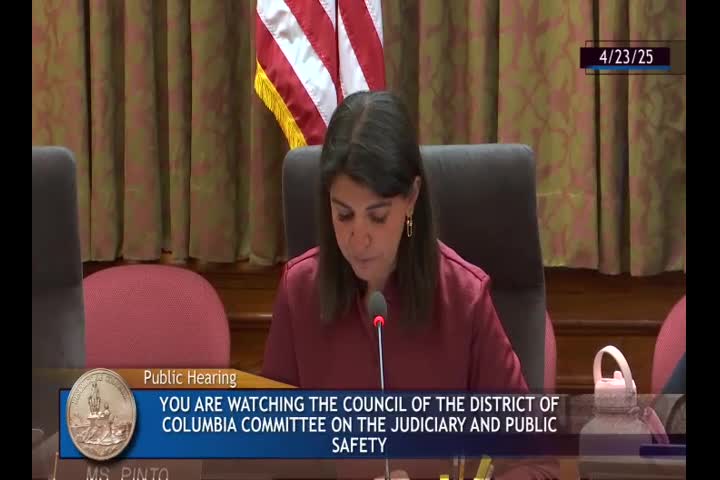
Council Member Brooke Pinto, chairwoman of the Committee on the Judiciary and Public Safety, opened a public hearing April 23 to discuss the Pretrial Detention Amendment Act of 2025 and said the committee will not move the bill until the Criminal Justice Coordinating Council's report is released on May 7.
Council Member Brooke Pinto, chairwoman of the Committee on the Judiciary and Public Safety, opened a public hearing April 23 to discuss portions of her PeaceDC package, including the Pretrial Detention Amendment Act of 2025. Pinto said the Criminal Justice Coordinating Council (CJCC) is producing a report on the emergency changes and that the committee will not move the bill before the CJCC report is released on May 7.
The bill would make permanent a rebuttable presumption allowing pretrial detention for people charged with crimes of violence — a policy the council put in place temporarily in 2023 under the Prioritizing Public Safety emergency measure and then in the Secure DC omnibus package. Pinto said the change is intended to give judges an additional tool in “the most egregious cases,” but vowed to await the CJCC data before further action.
The majority of public testimony opposed making the expansion permanent. Alicia Yoss, Supervising Policy Counsel at ACLU DC, told the committee, “Locking more people up before they are found guilty will not make us safer.” Yoss and other witnesses urged the council to allow the public time to review the CJCC report once it is published.
Advocates and nonprofit researchers presented data and personal observations they said showed the expansion has not produced measurable public-safety benefits while contributing to higher jail populations and harms to detained people and their families. Katie McConville, Policy Counsel at the Council for Court Excellence, cited agency data showing the average daily population of the D.C. Department of Corrections rose from 1,271 residents in January 2023 to 1,945 on April 11, 2025 — an increase she said is straining the central detention facility and staff.
Multiple witnesses reiterated earlier research that a large share of people released pretrial are not rearrested: “92 percent of people released pretrial are not rearrested, and only 1 percent are rearrested for a violent offense while awaiting trial,” McConville and others testified citing pretrial-services figures presented in their organizations' reports. Witnesses also pointed to at least six deaths in DC jail custody during 2024 and said the jail’s conditions and lengthier case-processing times increase the harms of detention.
Speakers representing other nonprofits and neighborhood groups — including Mary Zenger of DC Justice Lab, Jillian Burford and volunteers from Harriet’s Wildest Dreams, and CourtWatch DC observers — told the committee that the burdens of expanded detention fall disproportionately on Black people and on low-income residents. “Pretrial detention is punishment without conviction,” Laurel McLaren of CourtWatch DC said, and several witnesses warned that expanded detention increases risks of housing loss, job loss and longer-term recidivism.
Some witnesses and the chairwoman disagreed about whether judges already had adequate tools. Pinto said the 2023 emergency measures filled a gap by giving judges a rebuttable presumption in certain violent-offense cases; critics answered that judges can and should make individualized determinations without a default presumption favoring detention.
Several speakers, including Whitney Lockheim and others working with youth programs, urged investment in community resources, diversion and case-management services rather than more incarceration. Health- and youth-service providers also recommended expanding trauma-informed supports and community-based alternatives.
Direction from the committee at the hearing was procedural: Pinto reiterated that the CJCC report, due May 7, will be reviewed by the committee and that the public will have time to comment on the report before any permanent change is considered. No formal motion or vote occurred during the hearing.
The committee will hear government witnesses on the PCC plan on April 24 and has scheduled a separate government roundtable on a proposed merger of the District’s violence-interruption programs.