Get Full Government Meeting Transcripts, Videos, & Alerts Forever!
Get email alerts on the Municipal It topic
No spam. Unsubscribe anytime.
City adopts five‑year ICT plan; COIT warns funding shortfall for legacy replacement and urges new models
Summary
The city’s five‑year ICT plan was forwarded to the Board of Supervisors after COIT staff warned that project demand far outpaces available funding and urged renewed allocations and new funding models.
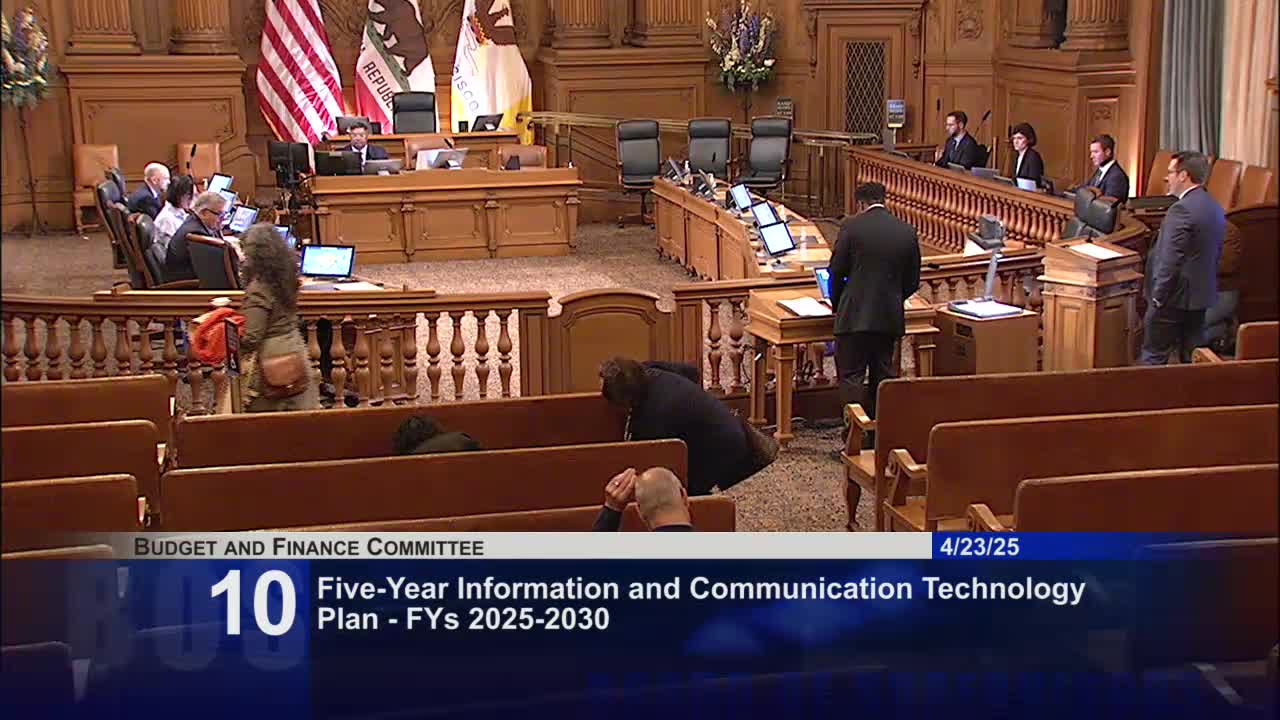
The Budget and Finance Committee on April 23 voted 3–0 to forward the city’s five‑year Information and Communications Technology (ICT) plan (FY 2025–26 through FY 2029–30) to the full Board of Supervisors. The Committee on Information Technology (COIT) described priorities and a projected funding gap for department IT projects.
COIT Director Eddie McCaffrey and technology portfolio manager Damond Daniels presented the plan, which establishes a vision and five priority initiatives: replacing legacy technologies, migrating data to the cloud, sharing data and systems across departments, shifting business services to SF.gov, and optimizing emerging technologies. COIT staff said department submissions indicate roughly $201.9 million in 5‑year project requests against a projected allocation of approximately $181.9 million, with an immediate two‑year near‑term need of about $95 million while projected available funding would support approximately $60 million if not reduced.
Why it matters: COIT warned that continued under‑funding will leave the city focused on replacing legacy systems with little capacity for broader modernization. The report recommends restoring the Kuwait allocation (a central IT funding pool) toward pre‑COVID levels by FY 2029–30 and considering funding models resilient to economic downturns.
Key committee discussion: Supervisors pressed staff on several points: a plan to move official city domains to sf.gov (security and timing), oversight of artificial‑intelligence tools and compliance with state inventories (reference to state directive 22(J) to inventory AI usage), and progress on the long‑running Justice system replacement project and the EPIC implementation at Zuckerberg San Francisco General (questions about departmental coordination and whether COIT wants formal presentations before projects come to the Budget & Finance Committee). COIT said digital and data services is leading the sf.gov migration, estimated state deadline 2029 for full domain migration, and that 60–70% of departments have made progress. COIT also said the director of emerging technologies is building an AI inventory and compliance process and the committee’s subcommittees will invite departments to present on major projects such as EPIC and Justice.
Committee action and next steps: Chair Connie Chan moved the resolution to the full Board with a positive recommendation; recorded vote: Dorsey aye, Gardeo aye, Chan aye. Committee members asked COIT to return with more detailed materials for the June budget process, requested presentations from departments on critical cross‑agency projects (Justice, EPIC) and indicated a role for COIT to surface implementation lessons and budgetary implications to the Board.
Background and budget context: COIT noted the five‑year projection for technology spending has decreased since February 2023 (from about $234.9 million projected then to $181.9 million now), while project demand continues to outpace secured funding. The ICT plan is intended to guide prioritization in the coming budget cycles.