Get Full Government Meeting Transcripts, Videos, & Alerts Forever!
Get email alerts on the State Of Environment 2024 topic
No spam. Unsubscribe anytime.
City releases 2024 State of the Environment report; urban forest resilience flagged as priority
Summary
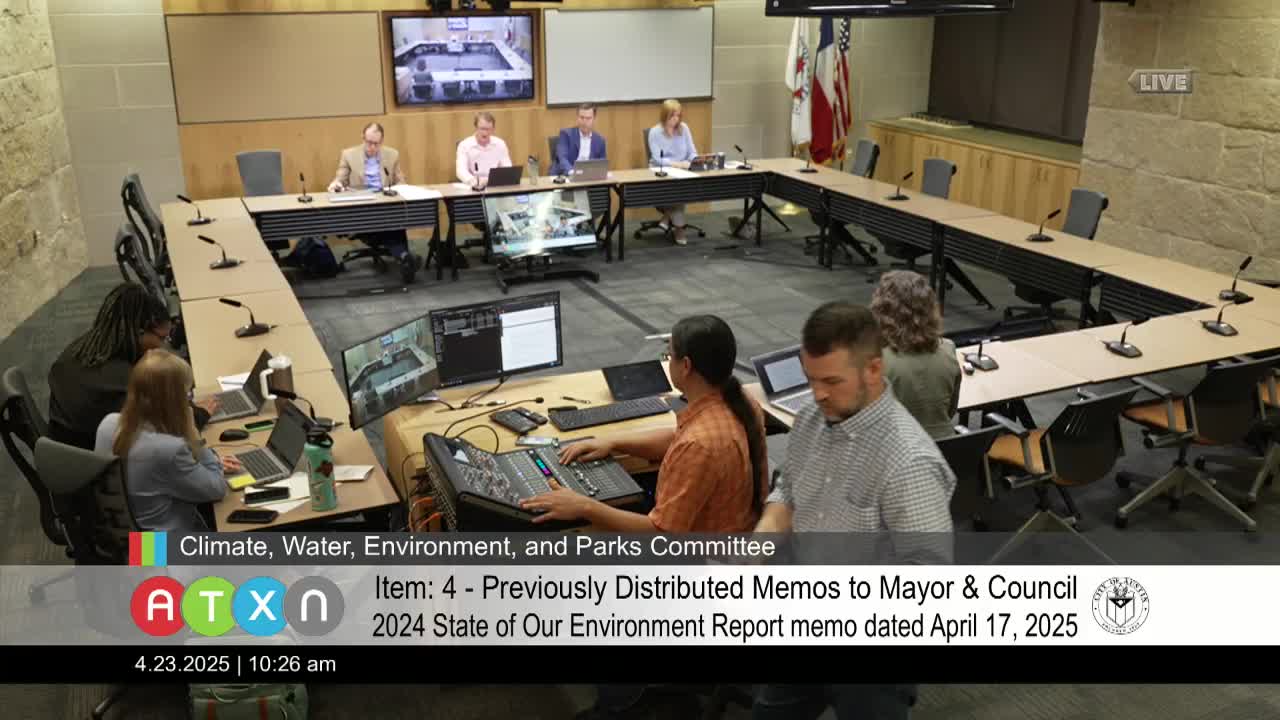
Interim Environmental Officer Liz Johnston presented the city’s legally required 2024 State of the Environment report, a cross-departmental compilation of air, water, urban forestry and open‑space data that the report’s authors say should inform departmental planning and long-term investments, with particular emphasis on urban forest resilience.
Liz Johnston, the city’s interim environmental officer, presented the 2024 State of the Environment report, a mandated annual compilation of environmental data and dashboards collected across multiple city departments. The report aggregates information on lakes, creeks and the aquifer; air quality and climate metrics; urban forestry and tree canopy; public open space; and Austin Water’s Wildlands program.
Johnston said the report is intended as a clearinghouse of citywide environmental data to support departmental decision-making and to give policymakers and the public a common reference for planning. The report includes a feature video about Austin Water’s Wildlands program, which the presentation highlighted as a multi-decade conservation effort that contributes to biodiversity and open-space goals.
Committee members asked how the report could be used to help set priorities for capital investments, bonds or climate-related projects. Johnston replied that the report’s datasets are produced by the respective departments and can inform prioritization exercises — for example, urban-forest and watershed data are used to identify locations for tree planting, creek restoration and open-space acquisition.
Notable data points discussed in the briefing included a steady tree canopy estimate at about 41% coverage and the city’s objective to increase canopy toward a 50% aspirational goal. Johnston and committee members discussed the need to build resilience in the urban forest given increasing heat, drought and flood stress under a changing climate and noted ongoing interdepartmental work on tree-planting programs and partnerships with community organizations.
Johnston thanked departmental staff for contributing data and singled out staff who worked on the Wildlands feature. The report will remain available through the Environmental Officer’s office and the linked dashboards for use by departments, neighborhood groups and the public.
No formal committee action was taken; Johnston invited members to provide suggestions for future report features and offered to follow up with staff on questions about tree species, pollinators and fruit-tree strategies requested by council members.