Get Full Government Meeting Transcripts, Videos, & Alerts Forever!
Get email alerts on the Student Devices topic
No spam. Unsubscribe anytime.
Committee hears bill to restrict student cell phone use in classrooms; proponents cite academic gains and discipline improvements
Summary
The House Education and Workforce Committee heard extensive testimony on House Bill 41‑41, a proposal to restrict student cell phone use during instructional time; proponents cited local data showing higher test indexes and fewer fights after school‑level bans, while a statewide school board association urged local control and exemptions.
The House Education and Workforce Committee took testimony on House Bill 41‑41, a measure introduced by Representative Mark Tisdale that would restrict student cell phone use during instructional time in Michigan schools. Sponsors and witnesses urged the committee to set statewide guardrails for classroom phone use, while one statewide school board association urged flexibility for local districts.
Tisdale framed the bill as a public‑health and instructional issue, citing recent national coverage and research on attention and adolescent mental health. He told the committee he had worked with superintendents and county officials and described other states’ actions as context for Michigan’s proposal.
Jennifer Wilson, a licensed counselor who said she has more than 20 years of experience in Michigan education and counseling, testified that unrestricted phone access “undermines students’ ability to thrive” and described effects she attributed to phone and social media use: “Loss of focus, engagement, connection, learning, social emotional well‑being.” Wilson told the committee the constant digital stimulus decreases executive functioning and can “short circuit” developing reasoning and self‑control in adolescents.
Casey Nocci, a seventh‑ and eighth‑grade teacher at Northville Christian Schools who described himself as the school’s volunteer “smartphone czar,” told the committee his school uses a no‑phone policy in which students check phones into the office and said his school’s survey data showed a gap between self‑perception and peer perception: “Eighty percent of our middle school students answered in the negative” to whether a smartphone negatively impacts them, and “80%” answered that it does have a negative impact on their friends, he said. Nocci said his school’s policy, which places phones in the office during the school day, produced an observable difference in classroom attention and social interaction.
Administrators from Traverse City West High School and Avondale Middle School described local policies that require students to store phones in pouches or cubbies during the day. Andy Wares, associate principal at Traverse City West, said the district uses pockets or envelopes for phones and that after implementation he “just don't see kids on their phones anymore,” which he said corresponded with fewer discipline incidents and improved course outcomes.
Avondale Schools provided numerical data. Dr. Katie Gomez, Avondale Middle School principal, told the committee that after implementing a pouch policy their school’s state index rose from 15.89 out of 100 to 73, growth index rose from 55 to 76, proficiency increased several points, and the school quality/student success index rose from 51 to 81. She also told the committee the school recorded a two‑thirds reduction in fights and that documented phone violations declined from roughly one or two per day to one or two per week.
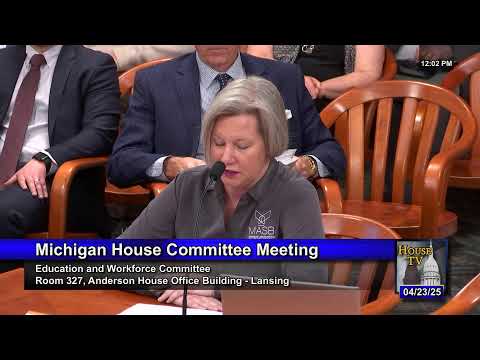
The Michigan Association of Secondary School Principals (MASSP) submitted testimony in support, saying consistent statewide rules would reduce variability across buildings and help parents and teachers know expectations. The Michigan Association of School Boards (MASB) submitted testimony in opposition, saying the bill is “far too prescriptive,” risks undermining instructional uses of devices, and lacks explicit exceptions for students with IEPs, 504 plans or medical needs. MASB suggested a model similar to Ohio’s approach — require districts to adopt a policy but leave details to local boards and districts.
Committee members asked sponsors and witnesses about exceptions for medically necessary devices, school‑issued devices such as Chromebooks, and how districts with limited internet or device funding would preserve digital literacy. Sponsors noted an H‑1 substitute under discussion would exempt medically necessary devices and school‑issued devices and that teachers would retain discretion to use devices for instruction.
Proponents told the committee they view the proposal as a way to change school culture and reduce distractions, citing discipline, achievement and social‑skills benefits they said followed local implementation. Opponents warned a one‑size‑fits‑all statewide prohibition could create unintended consequences in geographically or demographically diverse districts, and that local boards should retain authority to tailor policies.
What happens next: Committee members continued the discussion and flagged technical issues — exemptions for medical and school‑issued devices, funding and digital‑literacy concerns — that sponsors said they would refine in follow‑up language or an H‑1 substitute.