Get Full Government Meeting Transcripts, Videos, & Alerts Forever!
Get email alerts on the Hhs Omnibus topic
No spam. Unsubscribe anytime.
Taxes committee recommends HHS omnibus with restored provider tax, subsidy alternative to reinsurance
Summary
The Minnesota Senate Taxes Committee voted April 23 to recommend Senate File 2669, the HHS omnibus, to the Finance Committee after adopting amendments that restore the provider tax to 2% and clarify wholesale drug rebates are included in provider‑tax gross revenues.
The Minnesota Senate Taxes Committee voted to recommend Senate File 2669, the HHS omnibus finance and policy bill, to the Finance Committee on April 23 after adopting several amendments and a package of health‑sector funding changes.
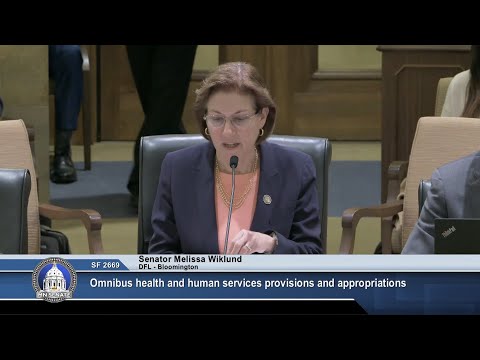
Senator Wicklund, sponsor of SF 2669, told the committee the bill prioritizes protecting access to care amid federal uncertainty and avoids cuts to core coverage. "We wished to strengthen access to health care ... we were not interested in simply meeting our targets through cuts," Wicklund said in opening remarks.
Major tax and funding items in the bill that drew committee attention:
- Provider tax: The bill restores the provider tax rate to 2 percent. Department of Revenue estimates discussed in committee show the provider tax rate increase would generate roughly $401.3 million over four years (revenue estimate used during the hearing). An amendment (A47) adopted in committee clarifies that rebates paid by wholesale drug distributors to customers are included in the gross revenues used to calculate the provider tax; the sponsor’s revenue estimate for that change showed about $60 million of additional revenue over four years.
- Reinsurance alternative / premium subsidy: The bill replaces the existing reinsurance program with a state subsidy for the individual market intended to reduce premiums by about 20 percent. The subsidy would be funded by an assessment on health insurance companies; sponsors said the assessment model mirrors how other states fund reinsurance programs. Committee discussion noted MNsure’s initial fiscal estimate that operationalizing a new subsidy could take until 2027, and members requested additional consultation on implementation and whether the subsidy would be taxable income for enrollees.
- EMS and hospital directed payments: SF 2669 includes directed payment provisions to raise provider reimbursement — a 15 percent increase for EMS and an additional 10 percent for rural EMS — and a hospital‑assessment funded directed payment to shore up hospital budgets.
- Other provisions: The bill funds food‑shelf and homelessness programs, an SSIS reallocation for child welfare systems work, fraud‑prevention activities at DHS, and changes to provider reimbursement policies intended to improve access to medications for a contract year.
Committee action on amendments
- A50 (technical, effective dates) was adopted.
- A47 (clarifying wholesaler rebates are part of gross revenues for the provider tax) passed on a roll call after revenue estimates showing an estimated $26.6 million first‑year impact and higher amounts in later years; senators expressed concern about taxing amounts that may be rebated to customers but ultimately adopted the change.
- A849, an amendment to restrict certain ocular injection procedures to ophthalmologists and surgeons, was offered and defeated after testimony from Shep Harris of the Minnesota Optometric Association. Harris said optometrists across the state support language already in SF 2669 and argued patient access issues have made the scope expansion necessary; he described workforce and training availability and warned of access gaps if scope is too restrictive.
Several members pressed the sponsor about unknowns in the bill: the timing and operability of the premium subsidy, whether the subsidy would be taxable income on personal tax returns, and the aggregate effect of provider/assessment changes and fee increases. Committee staff and a Department of Revenue representative noted the provider tax and A47 revenue estimates together total about $461.3 million over four years (provider tax ~$401.3M + A47 ~$60M); committee staff also cited roughly $70M in fee increases included elsewhere in the bill. Senator Wicklund said she would provide clearer consolidated figures for members before floor action and indicated the assessment‑funded subsidy requires federal approval in some designs and therefore carries implementation risk.
The committee’s recommendation advances SF 2669 to the Finance Committee for further review and floor‑level consideration.