Get Full Government Meeting Transcripts, Videos, & Alerts Forever!
Get email alerts on the Public Facilities District topic
No spam. Unsubscribe anytime.
Richland reviews Public Facilities District agreements, contingency fund and regional sales‑tax limits
Summary
Council workshop examined the legal and contractual ties between the city and the Richland Public Facilities District, including a sublease, contingent loan agreement, a contingency fund (about $398,000) and regional sales‑tax constraints that limit future PFD taxing capacity.
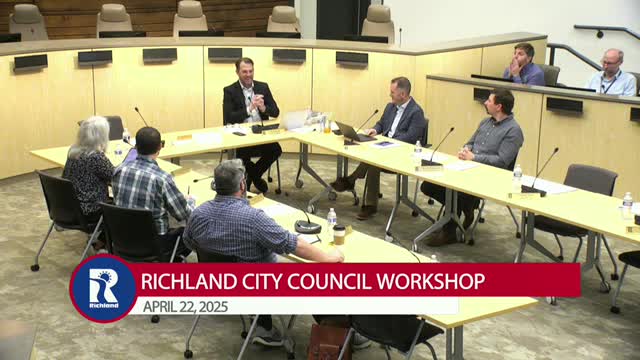
At a council workshop on April 22, 2025, city staff reviewed the legal and contractual relationships between the City of Richland and the Richland Public Facilities District (PFD), and explained how a regional PFD and state sales‑tax limits affect future financing options.
Joe Shushel, who presented the item, summarized the PFD’s formation and the active agreements that shape current obligations. “The first place you wanna look when when evaluating our our legal relationship as a city with the PFD is state law,” Shushel said, referring to the RCW chapter that governs public‑facilities districts.
Shushel listed four active agreements the city still has with the PFD: the 2011 Columbia Park West sublease (the underlying property is leased from the U.S. Army Corps of Engineers), a 2013 facility contingency fund agreement, a 2015 contingent loan agreement tied to PFD bond debt service, and a 2015 interlocal agreement that commits lodging‑tax receipts to the project.
Key details reported to council:
- Columbia Park West sublease: The sublease ties the PFD’s site term to the city’s recreational lease with the Army Corps; the presenter said the term extends to 2054 and annual rent on the sublease is $1. The sublease purpose is to construct and operate an interpretive center open to the public.
- Facility contingency fund: City finance presented the fund as meeting or exceeding its required minimum balance. Finance director Brandon Allen said: “The balance in that fund is kind of just shy of $400,000 — 398 thousand dollars and change.” Council asked about the minimum required balance; Allen said the minimum is formula‑based and the current balance is at or above that level.
- Contingent loan agreement: The 2015 agreement creates a city debt‑service loan contingency if the PFD cannot make payments on PFD‑issued bonds. Under that agreement, if the city were to loan money to cover missed PFD debt service it could collect interest and, depending on amounts, acquire small ownership interests; staff reported the contingency has never been activated because the PFD has remained current on payments.
- Interlocal financing agreement: A restated agreement commits $125,000 annually from city lodging taxes to the project; the term runs until the debt is retired or a stated calendar date in the agreement (the presenter said the restated term began in June 2015 and identified the date tied to the agreement’s stated term end in 2029). Staff noted the possibility of refinancing in the future, which would affect the timing of that agreement’s expiration.
Shushel noted statutory powers available to PFDs under state law (RCW chapter 35, PFD statutes), including the ability to issue bonds, charge a facility fee and receive the state share of sales tax (0.033 percent). He explained that PFDs may impose an additional sales‑tax rate of up to 0.2 percent subject to voter approval, but the statewide cap and overlapping jurisdictions complicate options. Allen and Shushel walked the council through hypothetical models showing how a regional PFD overlay and city PFD taxes could combine to exceed the 0.2 percent cap in some configurations; Pasco’s PFD has already used the full 0.2 percent in the region, a factor that limits options for a regional PFD tax increase.
Council discussion focused on oversight and coordination. Council members asked for clearer access to PFD financials; staff noted PFD packets are publicly posted and that the PFD provides quarterly financial reports to the city, and agreed to make quarterly materials more directly available to the council. The council also discussed regional coordination: state law authorizes city representation on the regional PFD and Richland currently sends two representatives though it is allowed three; several council members asked staff to return with options for council representation and with more detail on how overlapping PFD taxing authorities interact.
No formal actions or votes were taken; staff identified topics for follow‑up including clarifying the contingency‑fund minimum calculation, confirming interlocal term dates tied to the debt schedule, and returning options for council representation on the regional PFD.