Get Full Government Meeting Transcripts, Videos, & Alerts Forever!
Get email alerts on the Comprehensive Planning topic
No spam. Unsubscribe anytime.
Richland launches 'Future in Focus' to coordinate transportation, land‑use and parks planning
Summary
Council heard kickoff briefings on three linked planning efforts — a transportation system plan, a 20‑year comprehensive plan periodic update and a parks, recreation and open‑space plan — and discussed outreach, timelines and state requirements including recent housing and climate laws.
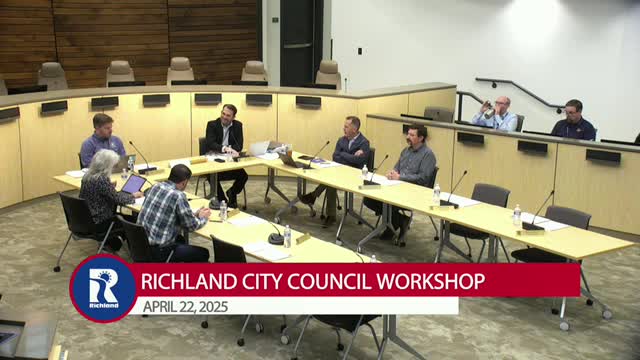
Richland City Council on April 22, 2025 received kickoff briefings for “Future in Focus,” a coordinated project to update the city’s transportation system plan, comprehensive land‑use plan and parks, recreation and open‑space plan.
The effort, city staff said, will align three separate planning processes so residents and stakeholders can engage across topics that overlap on growth, mobility and open space. “This is a project we’re calling Future in Focus,” City staff member Joe Shushel said as he opened the item.
The coordinated work matters because state law and new legislative requirements intersect with fast local growth. Planning manager Mike Stevens told the council that Richland has been receiving a larger share of county growth than previously estimated: “here in Richland, we’re at 37,” he said, referring to the share of incoming county residents projected to move into the city.
Consultants outlined scopes and schedules. Stephanie Herstein, principal with Transpo Group, said the transportation system plan update will inventory existing conditions, update travel‑demand modeling with the Ben Franklin Council of Governments, define 10‑ and 20‑year multimodal project lists, and recommend a project‑prioritization rubric and sustainable funding strategies. “For this update, the objective is to support your overall comprehensive plan and your vision. It's to meet the Growth Management Act requirements and the region requirements,” Herstein said.
Herstein described public engagement methods the consultant will use — online surveys, fact sheets, pop‑up events (for example at farmers markets) and public workshops — and said a project steering committee will include technical representatives such as WSDOT, Ben Franklin Transit and bicycle‑community members. She said the schedule anticipates final adoption in early 2026 and that Transpo will coordinate closely with the comprehensive plan team.
Stevens summarized the comprehensive plan periodic update requirements and some policy drivers the city will need to address, including a required 10‑year periodic review of assumptions and a 20‑year planning horizon; updates to the city’s critical areas rules; and changes from recent state law. He cited House Bill 1110 (often discussed as “missing middle” legislation) requiring cities of Richland’s size to allow two housing units per lot in residential zones and additional allowances for up to four units in specified locations or where an affordable unit is provided and preserved under a long‑term restriction. Stevens also described a regional climate study tied to House Bill 1181 and said the resulting climate element will be incorporated into the comp plan.
On parks and open space, Chris Waite, director of parks, introduced MIG consultants John Fines and Lauren Scott, who described a four‑phase process that will update the city’s parks inventory, analyze level‑of‑service and access gaps, evaluate tree canopy and stewardship needs, produce a prioritized capital project list and identify funding and maintenance costs. “We will document that and start to look at those needs,” Scott said, describing analysis required by the Washington Recreation and Conservation Office to keep the city eligible for some grants.
Council members pressed several topics. Council member Van Dyke asked how consultants would reach a broad cross section of residents; Herstein said combining online engagement with in‑person outreach at community events and targeted workshops helps reach different audiences. Council member Ryan Luxon raised a recurring concern about planned mixed‑use developments where residential phases are built but commercial components do not materialize; Stevens said staff is considering multi‑year windows for accepting comprehensive‑plan amendments so the council and community can let adopted plans stabilize before frequent amendments are considered.
The councils and consultants also discussed coordination between the three efforts to avoid engagement fatigue and to reuse input where topics overlap, for example trail and multimodal connections that affect both transportation and parks planning.
Next steps: staff said the city expects a public participation plan and a draft scope (for the comprehensive plan, a public‑participation plan will be brought to council as a resolution), finalization of the AHBL subconsultant contract for the comp plan transportation element, and staged public engagement through 2025 into early 2026 for adoption actions.