Get Full Government Meeting Transcripts, Videos, & Alerts Forever!
Get email alerts on the Municipal Finance Utilities topic
No spam. Unsubscribe anytime.
Kamas council continues discussion on water and sewer rate increases, targets July 1 implementation
Summary
Council members reviewed multiple rate scenarios after staff warned of a growing sewer fund deficit and potential rise in power costs for treatment. Council asked staff for additional modeling and legal input and set a goal of a July 1 effective date if a public hearing is completed.
The Kamas City Council continued deliberations on proposed increases to water and sewer rates on Monday and directed staff to return with final figures and legal options ahead of a planned public hearing. Council members set a tentative goal to make any approved rate changes effective July 1.
City public works staff explained the rationale for increases: aging infrastructure, planned spring source work and a long-running gap between sewer revenues and operating expenses. The staff presentation highlighted a current shortfall in the sewer fund and projected higher electricity and pumping costs when additional treatment or pumping begins.
Scott, the city public works representative, described a multi-year plan the department proposes to follow so the city can avoid or reduce reliance on loan funding for capital projects. “If we can get more water, then we need to increase the size and, you know, we could use impact fees for that,” Scott said, urging a phased plan that builds reserves for future pipeline and spring-source work.
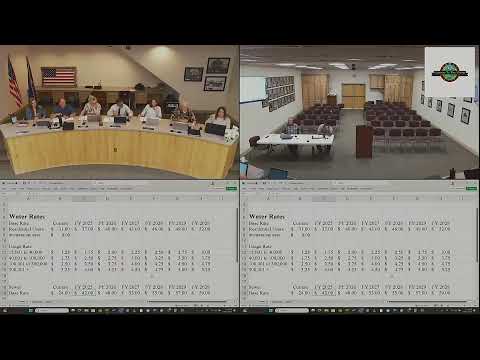
Council members debated the size and timing of increases. Options discussed included raising the water base rate from about $31 to $37 and increasing the sewer base from $24 to between $40 and $45 in stages; council members and staff also discussed adjusting usage-tier prices and overage rates (examples discussed: $1.75 → $2.50 → $3.50 → $4.00 per 1,000 gallons across tiers). Staff noted the city currently collects roughly $295,000 in sewer revenue while the sewer budget is about $482,000, leaving a roughly $187,000 deficit under today’s rates.
Several council members raised concern for residents on fixed incomes and asked the city attorney to draft possible relief options or eligibility criteria, such as limited assistance tied to Social Security income or similar objective standards. The council asked staff to consult City Attorney Joel about how to structure any program and to return proposed language in time for public notice.
Councilmembers also discussed other potential revenue sources to reduce the burden on regular ratepayers, including charging dump fees for out-of-city users at local dump stations and pursuing grant partnerships with nearby recycling/solid-waste programs.
The council asked staff to prepare revised rate tables and modeling for one more meeting before scheduling a public hearing. Members aimed to hold the public hearing and, if adopted, implement rates by July 1 to align with the city fiscal year and the start of the peak summer water season.
No formal rate ordinance or motion was adopted at Monday’s meeting; the council instructed staff to return with updated tables, legal feedback about senior/low-income relief and an implementation schedule for consideration at the next meeting.
Clarifying details: staff reported current sewer revenue approximately $295,000 and a sewer budget of about $482,000, implying a roughly $187,000 shortfall; proposed water-base adjustments mentioned included increases of roughly $6 monthly in some scenarios; staff suggested staged increases and revisiting rates annually to track energy and operational costs.