Get Full Government Meeting Transcripts, Videos, & Alerts Forever!
Get email alerts on the Microtrenching Fiber Optic topic
No spam. Unsubscribe anytime.
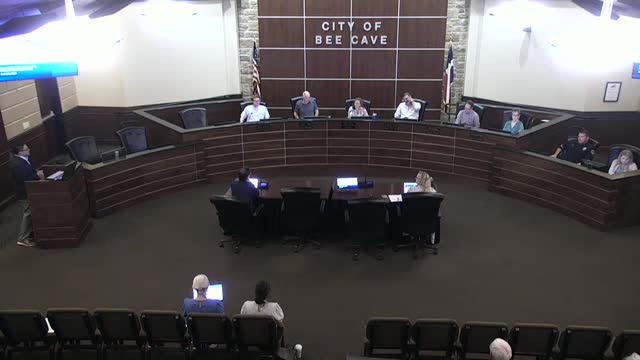
Bee Cave council tables microtrenching ordinance changes after staff briefing on Google Fiber installation method
Summary
After a detailed presentation on microtrenching by interim city engineer Giancarlo Patino and staff site visits with Google Fiber, the Bee Cave City Council agreed to gather additional data and return with a more detailed proposal rather than immediately amend the city's street-cut ordinance.
The Bee Cave City Council on April 22 discussed possible amendments to the city's street-cut ordinance to address microtrenching — a shallow trenching technique proposed by Google Fiber to install conduit for fiber-optic service — and decided to table action until staff returns with more data.
Interim City Engineer Giancarlo Patino described microtrenching as a technique that "cut[s] shallow trenches typically 1 and a half inch to 2 inches wide and up to 18 inches deep," usually placed along the seam where pavement meets the curb and gutter. Patino told council staff and Google Fiber personnel had conducted site visits to active installations and provided design details and photos from other Central Texas locations.
Patino said proponents report high installation rates — roughly 1,500 to 2,000 linear feet of conduit per day in ideal conditions — and that the method limits surface disruption during construction. He said microtrenching restoration typically uses a flowable fill (also called controlled low-strength material) poured into the trench and smoothed; restoration quality and long-term performance vary by site and materials.
Council members and residents raised concerns about long-term pavement integrity. Patino and others showed photographs from installations at one month, one year and three-year intervals; several council members and residents noted hairline cracks developing at the seam between the flowable fill and adjacent pavement. Patino cautioned that "the enemy of a pavement structure is water" and said cracks can allow water infiltration that may, over time, harm subgrade materials and contribute to pavement deterioration.
Council members asked about alternatives and trade-offs. Patino described other methods used for underground utilities — open trenching, directional boring (horizontal directional drill or HDD), and vibratory plowing — and said that backbone routes on TxDOT-owned pavement likely require directional boring because TxDOT does not allow microtrenching on its pavements. He also described the option of back-of-curb installation where rights-of-way permit, which could shift impacts out of the traveled way.
Members discussed financial and contractual protections. The city's existing non-exclusive license agreement with Google Fiber includes a repair clause (clause 2.6) requiring the licensee to restore damaged property "to a condition equal to or better than which existed prior to the damage." Council members asked staff to determine whether the microtrenching repair method and materials will meet that contractual standard over time and whether the city's current 1% franchise fee adequately covers longer-term monitoring and repairs; staff noted 1% is small and said council could consider a higher fee or other remedies.
Council also raised implementation options: limiting microtrenching to certain streets, imposing a moratorium on newer roadways, requiring additional conduits to anticipate future providers, or accepting microtrenching only on back-of-curb alignments. Staff said Google Fiber provided preliminary KMZ mapping showing proposed backbone and distribution alignments that included Bee Cave Parkway, SH 620 and connections to SH 71, but maps were preliminary.
Residents and HOA representatives spoke during the discussion. Resident Paula Boyd asked how service would be routed from the public right-of-way to individual homes and what surface impacts and backyard vaults might look like. Another resident, identified as Tom, urged caution given the potential cost to neighborhoods to repair failed streets.
After extended questioning and public comment, the council asked staff to gather more data — including pavement-condition assessments, cost estimates for increased franchise fees or required remediation, and a map of specific roads Google Fiber would need to trench — and to return with an ordinance amendment proposal and recommended contract language. Council members said they were generally supportive of expanding broadband access but did not want Bee Cave to be an unplanned test case for long-term pavement or drainage damage. The council did not vote to allow microtrenching; it tabled the ordinance amendment for a future meeting pending staff follow-up.
Next steps: Staff will present additional materials (pavement-assessment results, detailed proposed alignments, potential fee/reimbursement scenarios, and draft contract/remediation language) at a future council meeting for formal action.