Get Full Government Meeting Transcripts, Videos, & Alerts Forever!
Get email alerts on the Water And Wastewater Cip topic
No spam. Unsubscribe anytime.
City staff outlines $500M+ five-year water and wastewater capital plan; impact fee update proposed
Summary
City staff presented a proposed FY 2026 water and wastewater capital improvement plan that includes near-term plant commissioning, phased new treatment capacity at 3 Forks and Northlands, multiple large interceptors, and a proposed update to water and wastewater impact fees to be considered this summer.
At a Georgetown City Council workshop, city utilities staff presented the proposed FY 2026 capital improvement program for water and wastewater and outlined next steps for updating impact fees and advancing major plant and pipeline projects.
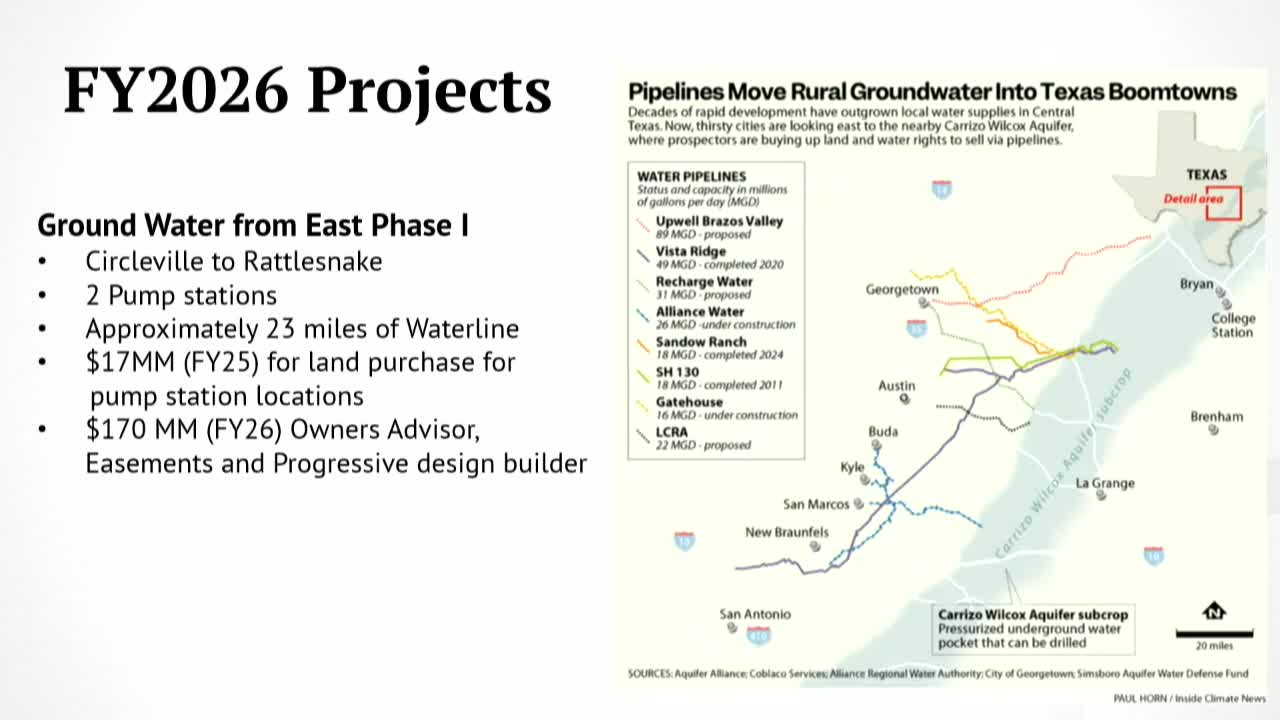
The briefing, led by Wes (staff member), described the near-term commissioning of the South Lake Water Treatment Plant, phased construction of new wastewater capacity at “3 Forks” and Northlands, and multiple off-site pipeline and pump-station projects. Wes said staff will convene an impact-fee advisory committee this summer and bring recommended fee updates to council in August so the city can respond to pending state legislation.
Why it matters: the plan contains large projects and multi-year phasing that will shape service capacity, developer obligations and rate decisions. Staff described more than $500 million proposed in FY 2026 projects and more than $1 billion in FY 2027 projections, with funding expected to come from a mix of impact fees, rates and cash. Changes to impact-fee law at the state level are a driving factor in the city’s proposed schedule.
Wes summarized current work and near-term milestones. “Phase 1, 22000000 gallons of the 44,000,000 gallon plant is scheduled to be online June 2,” he said, adding crews have pushed water through the plant, lab samples have passed and the Texas Commission on Environmental Quality review is pending. He told council that if TCEQ approval comes as expected, plant operations could begin in late May or early June.
Staff described the wastewater program as dominated by plant work, interceptors and phasing. A temporary 2,000,000-gallon package plant at Pecan Branch is being bid to provide interim treated capacity while the larger 3 Forks water reclamation facility is designed and built. Wes said staff currently envisions a phased 3 Forks build with a first permanent phase of 7,000,000 gallons per day and future expansions, noting the site is ultimately permitted for 21,000,000 gallons.
Other notable projects discussed included the Berry Creek interceptor (roughly halfway complete), the San Gabriel Park and Dove Springs plant rehabilitations, the Stonewall Ranch pump station coming online soon, and multiple elevated storage tanks and pump-station upgrades to serve higher-elevation development west of town. Staff also described work to address zebra mussels at a lake intake and a proposed pilot for PFAS filtration at the Park water treatment facility.
On funding and fees, staff said the city proposes to update water and wastewater impact fees and to establish an advisory committee that would meet in May–June and return projections in July. Wes said the update is being accelerated in part because pending state changes to impact-fee law could take effect Sept. 1. He gave an approximate current impact-fee baseline (staff comment): "water is approximately $11,000 per unit and wastewater is approximately $6,000 per unit," and warned the final values will be set through the update process.
Council members asked about phasing, buildout timing and the balance between building larger permanent plants versus temporary package plants. One council member urged staff to “be as aggressive as we can be on timing and capacity,” saying earlier-than-expected growth could result in more pressure for sewer service and annexation. Staff said they will prepare scenarios comparing a 1.5 million vs. 3.0 million gallon Northlands option and would return those to council when more data are available.
Staff also outlined proposed delivery methods for large projects. For the 3 Forks plant, they recommended a construction manager at risk (CMAR) procurement to allow early purchase of long‑lead items and speed delivery; staff said the industry response favors CMAR for large plant work.
What’s next: staff requested council consideration of forming the impact-fee advisory committee, return of fee-update materials in July, and formal presentations of specific budget and funding requests during the summer budget process. Staff also referenced an upcoming annual rate study that will incorporate these capital costs and return to council later in the budget cycle.
Ending: Council members said they supported annexation and capacity planning that keeps service in the city’s control, and pressed staff to return with cost scenarios, clarified funding sources and updated growth projections as the city refines the FY 2026 budget.