Get Full Government Meeting Transcripts, Videos, & Alerts Forever!
Get email alerts on the Taxation Marijuana topic
No spam. Unsubscribe anytime.
Finance committee discusses resolution urging state to allow New Castle County retail marijuana tax
Summary
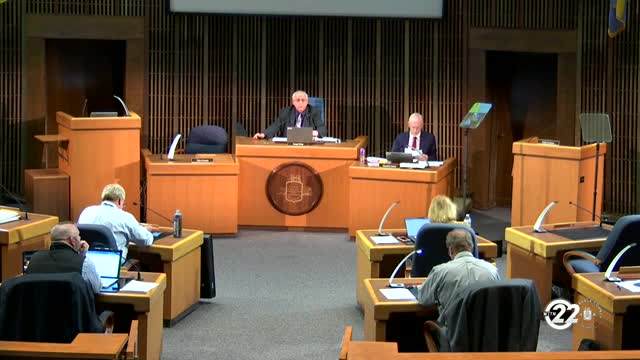
At its April 22, 2025 Finance Committee meeting, New Castle County Councilman Koneko introduced Resolution 25-070 urging the Delaware General Assembly to authorize New Castle County to levy a local tax on retail marijuana products.
At its April 22, 2025 Finance Committee meeting, New Castle County Councilman Koneko introduced Resolution 25-070 urging the Delaware General Assembly to authorize New Castle County to levy a local tax on retail marijuana products.
The resolution, co-sponsored by Councilwoman Kilpatrick, asks the state to allow the county to impose a local tax of up to 5 percent on retail marijuana sales. "We just got a fiscal note in from Ms. Flor talking about how this could raise in the up to maybe $6,500,000 for our county if we did a 5% tax," Councilman Koneko said.
Councilwoman Kilpatrick told the committee the resolution would direct any local revenue toward public safety and toward programs that support economic and workforce development, such as youth job training at the Hope Center. "It would be obviously to public safety because those are the group we believed would take the biggest hit on having to answer calls," Kilpatrick said.
Supporters said the request is intended only to secure authority from the General Assembly to negotiate a local rate if the state grants counties the power to tax. "All this resolution does is give us the ability to go down to Dover and say and speak on behalf of county council and say, this is what we want to do," Koneko said. He said the resolution language is written to permit negotiation below the 5 percent cap.
Several council members raised practical concerns. Councilman Carter described the situation as an "unfunded mandate" for counties and urged the General Assembly to work with counties on costs counties will incur to regulate and respond to retail marijuana. Councilman Hollins called new revenue streams "a blessing" given current federal and state funding pressures.
Industry and public-comment speakers told the committee they opposed an extra local tax. Emily Wilkins, vice president of First State Compassion, which operates a medical marijuana business in New Castle County, said the industry already faces a 15 percent state tax and that an additional local levy would push consumers to the illicit market or across state lines. "We vehemently oppose this extra tax," Wilkins said.
Councilman Street, speaking during public comment, said he opposed legalization and said he feared the local retail industry would increase calls for police response. "It's gonna require a whole lot more attention for our police department, and we need to be compensated for it," Street said, while also saying he had "mixed emotions" about supporting the measure.
Committee members also discussed how neighboring jurisdictions are handling retail marijuana taxation; Koneko cited examples mentioned in the meeting that range from Montana (up to 20 percent) to Washington (up to 37 percent). Participants noted that the state law currently imposes a state-level tax on retail marijuana and that any local levy would be in addition to existing state tax rates.
The resolution was introduced and discussed in committee and will be used to inform the council's advocacy to the General Assembly; no committee roll-call vote on the resolution is recorded in the meeting transcript. Committee members indicated the item will be scheduled for a separate council meeting when it comes up for a formal vote.