Get Full Government Meeting Transcripts, Videos, & Alerts Forever!
Get email alerts on the Tax Foreclosure Takings topic
No spam. Unsubscribe anytime.
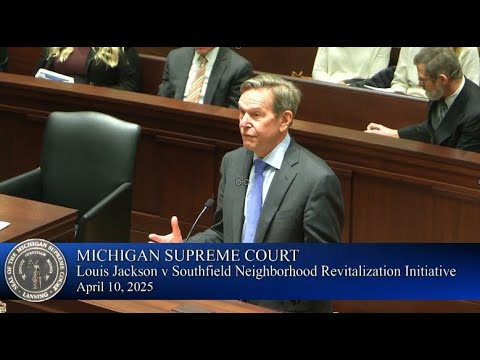
Michigan Supreme Court hears arguments in Jackson v. Southfield over tax-foreclosure takings and retroactivity of MCL 211.78m/78t
Summary
At a Michigan Supreme Court mini-oral argument, parties disputed whether two 2020 amendments to Michigan's tax-foreclosure statutes (MCL 211.78m and 211.78t) apply retroactively and when a constitutional taking occurs for purposes of just compensation.
The Michigan Supreme Court heard oral argument on an application for leave to appeal in Jackson v. Southfield Neighborhood Revitalization Initiative, a dispute over whether homeowners who lost property to tax foreclosure are entitled to surplus proceeds and interest under changes to Michigan law. Counsel for Oakland County, plaintiffs' counsel and two amici debated whether MCL 211.78m and MCL 211.78t can be applied retroactively and when a Fifth Amendment taking occurs.
The question at the heart of the argument was whether the statutes the Legislature amended in December 2020 — cited in the proceedings as MCL 211.78m and 211.78t — can be applied to foreclosures that became final before the amendments. William Horton, counsel for Oakland County, asked the court to deny leave, saying the parties and amici agree the amended sections cannot be applied retroactively to the facts of this case. "Short version is that, Southfield claimed the property from Oakland County, for the minimum bid, which was what was permissible under the statute at the time," Horton told the court. "If you were to apply 78m retroactively against Southfield, it would unconstitutionally violate their rights that they exercised at the time."
Amicus Ted Sites, representing the Michigan Association of County Treasurers, said recent federal-appellate authority supports the constitutionality of Michigan's tax-foreclosure process going forward. "Recently, in fact, about 10 days ago, the Sixth Circuit Court of Appeals issued a decision authored by Chief Judge Sutton in the Howard v. Macomb County case, which upholds the constitutionality of our process," Sites said, arguing that the ruling limits takings claims going forward where the statutory process for surplus proceeds is available.
Scott Smith, counsel for the plaintiffs, said federal precedent and prior Michigan decisions require the court to enforce a property owner's right to just compensation when the government effectively retains surplus equity. "What we're at is these Jackson-type cases ... are really the offspring of Raffaeli and Tyler," Smith said, urging the court to treat surplus-equity claims as part of the Fifth Amendment's protection against taking without just compensation. He argued the Legislature intended the 2020 amendments to be retroactive in some respects and invoked the need for interest on any award: "the Supreme Court has repeatedly held that just compensation must also include interest on that amount from the time of the taking," Christina Martin of the Pacific Legal Foundation added for the plaintiffs' side.
Parties and amici disputed when the taking occurs. Some counsel and a line of federal cases treat the taking as occurring when foreclosure becomes final (the parties noted April 1 in Michigan's statutory foreclosure calendar); others frame the taking at the moment surplus proceeds could be calculated, for example after an auction. Christina Martin argued the taking could be viewed as occurring when the county "skipped the auction and deeded the property over to the city," which, she said, would support joint and several liability and interest awards.
Counsel for Oakland County also told the court he is bound by federal precedent (Hall v. Meissner and related Sixth Circuit law) on federal takings claims and said his preferred remedy would be to return the remaining plaintiffs to the trial court to implement federal precedent on valuation or to settle. He asked the court to deny leave to appeal and allow lower-court proceedings to continue.
No ruling was made from the bench. At the close of argument, the court announced, "The case will be submitted," indicating the justices will decide on the application and any further relief in a subsequent opinion.
Background and significance: the dispute arises from tax-foreclosure sales where a governmental unit acquired title or where a municipality exercised a right of first refusal. The parties and amici invoked a series of cases — including Hall v. Meissner, Lawton v. United States, and Sixth Circuit decisions such as Howard v. Macomb County — and discussed how those precedents interact with Michigan statutory amendments in 2020. Counsel noted that several plaintiffs in the case previously settled (five of nine), and that some remaining claims date back about eight years, producing arguments over interest and remedies for alleged past takings.
The court's forthcoming decision could clarify whether the 2020 amendments can be applied to earlier foreclosures, when a taking occurs for purposes of calculating just compensation and interest, and whether counties or municipalities may be required to pay surplus-equity remedies or seek contribution or unjust-enrichment claims against other governmental actors.