Get Full Government Meeting Transcripts, Videos, & Alerts Forever!
Get email alerts on the Judicial Rulings Liga Jurisdiction topic
No spam. Unsubscribe anytime.
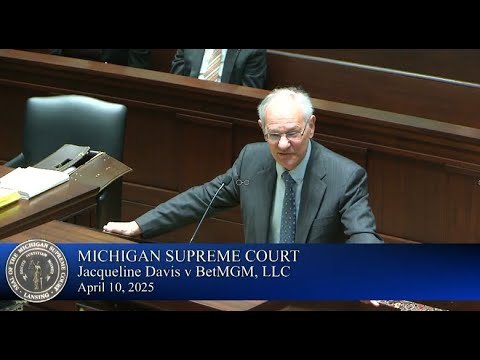
Michigan Supreme Court hears arguments in Davis v. BetMGM over gaming-board jurisdiction and preemption
Summary
At oral argument, lawyers for Jacqueline Davis and BetMGM disputed whether the Lawful Internet Gaming Act preempts common-law claims and whether the Michigan Gaming Control Board has exclusive authority to resolve internet-gaming patron disputes; the court took the case under advisement.
The Michigan Supreme Court heard argument in Jacqueline Davis v. BetMGM LLC over whether the Lawful Internet Gaming Act (LIGA) preempts common-law claims and whether the Michigan Gaming Control Board (MGCB) has exclusive authority to resolve disputes arising from internet gambling.
The questions before the court, counsel and justices said, determine whether patrons may bring conversion, fraud or related common-law claims in circuit court after a gaming platform voids a wager as the result of an alleged malfunction, or whether the MGCB — and not the courts — has the exclusive authority to adjudicate those disputes.
Plaintiff-appellant counsel Mark Ronzago argued that LIGA contains an express preemption clause in Section 4.3 and that the clause eliminates any inference of broader implied preemption; he said the plaintiff’s common-law claims are consistent with the statute and therefore not preempted. Ronzago also pointed to the parties’ terms-of-service, arguing the contract includes a forum clause pointing to Michigan courts and that the MGCB did not actually provide a hearing or remedy for Davis. He told the court that "Section 4.3 is an express preemption provision" and said copies of three MGCB letters indicated the board had told the parties, "We do not resolve disputes between casinos and players. We don't do that," a point he said supported the view that Davis did not get an administrative remedy.
BetMGM’s counsel, Norman Akers, told the justices that "Our position is that the Michigan Gaming Control Board, the MGCB, has the exclusive authority to adjudicate miss Davis's complaints here." Akers said courts and appellate panels over the past two decades have treated MGCB jurisdiction over internet gaming disputes as exclusive in closely related contexts. He cited statutory and regulatory provisions (as argued to the court) — including provisions the parties referenced as MCL 432.304(1), MCL 432.305 and MGCB rules that grant the board power to order corrective action — and stressed that BetMGM had authority under its rules and contract to void wagers when a malfunction occurred. Akers said Davis pursued the MGCB process and the board concluded there was a malfunction; he added the plaintiff did not challenge the board’s fact-finding in a way that would show the administrative remedy was inadequate.
Both sides disputed the legal consequences of the record before the MGCB. Ronzago told the court the board never provided a full adjudicative hearing or meaningful remedy to Davis and that the court should not permit a private party’s common-law claim to be displaced by an administrative process that the board itself declined to apply to the player. Akers replied that the board’s investigatory and corrective powers — along with contract terms that allow a platform to void wagers for malfunction — demonstrate an adequate, exclusive remedy and that allowing duplicative common-law suits would undercut the board’s technical expertise and regulatory role.
During argument the justices pressed both lawyers on doctrinal questions and on practical consequences. The bench asked about cases the parties referenced (including Kraft, Pappas, Parigi, McEntee and others cited in argument) and about what it would mean in practice if courts permitted differing jury or arbitral findings to contradict technical determinations by the MGCB. Counsel discussed contract terms the transcript cites as paragraph 28 (choice-of-law), paragraph 29 (forum language the plaintiff’s counsel said references Michigan courts), paragraph 30 (patron-dispute and arbitration provisions) and a clause that permits platforms to void wagers in the event of a malfunction. Counsel also debated whether the MGCB’s amicus brief — which the parties agreed is mixed on exclusivity — controls the court’s analysis.
The parties agreed the case raises core issues about (1) the scope of LIGA’s express preemption clause and whether it bars only inconsistent laws or also some common-law causes of action, and (2) whether the statute and MGCB rules create exclusive administrative jurisdiction for patron disputes tied to internet gaming functions and malfunctions. Neither side asked the court to issue an immediate injunction; both presented legal arguments for how the court should decide the proper forum and the effect of the statute’s text and prior appellate decisions.
The Supreme Court took the case under advisement and announced it would issue a decision after reviewing briefs and oral argument. The justices did not announce a decision from the bench.