Get Full Government Meeting Transcripts, Videos, & Alerts Forever!
Get email alerts on the Payment Fees topic
No spam. Unsubscribe anytime.
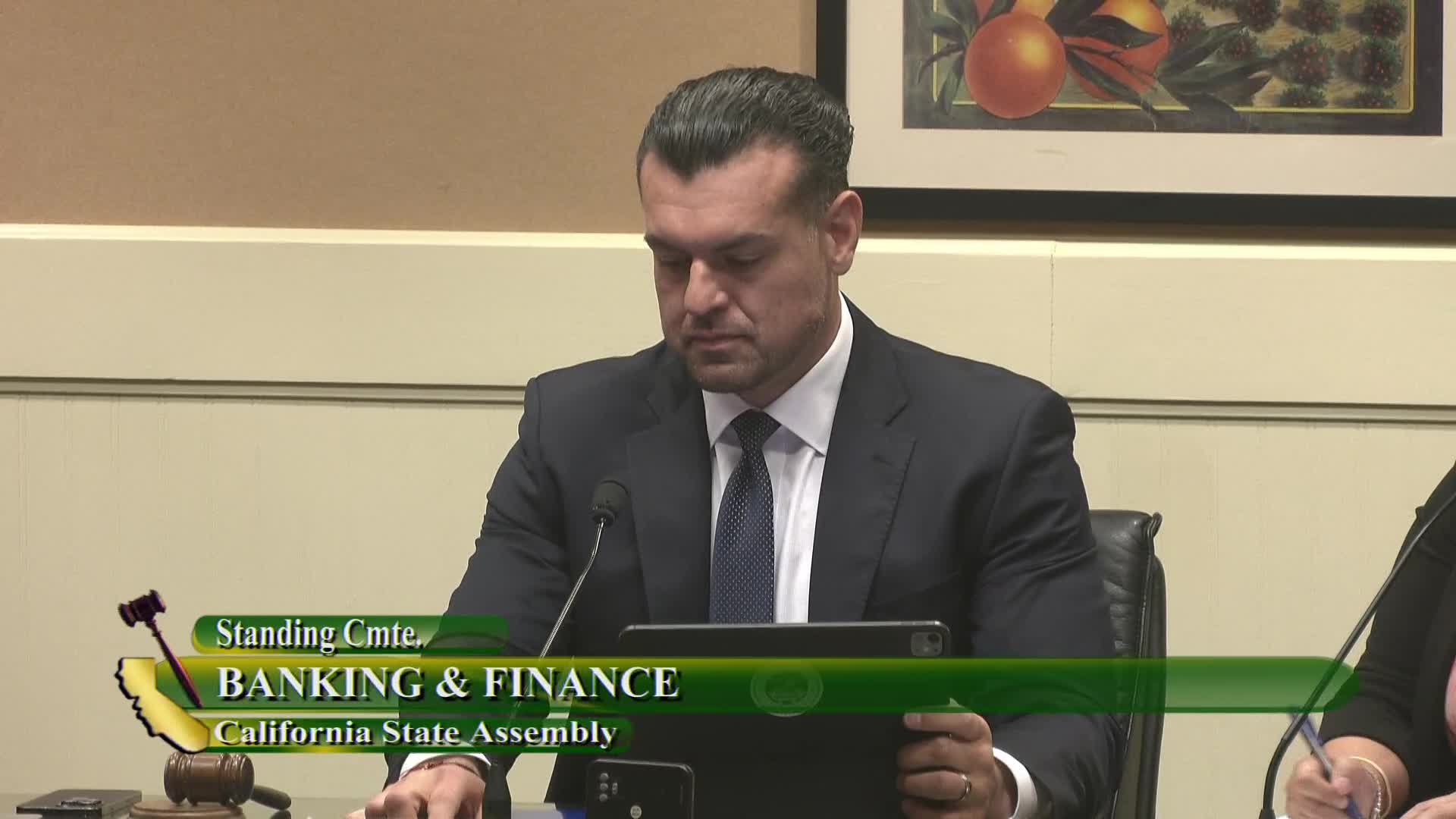
Committee debates Ortega bill to bar swipe fees on sales-tax portion of card purchases; initial vote fails, reconsideration approved
Summary
Assemblymember Ortega introduced AB 10 65 to the Assembly Committee on Banking and Finance, seeking to bar swipe or interchange fees on the sales-tax portion of card transactions.
Assemblymember Ortega introduced AB 10 65 before the Assembly Committee on Banking and Finance, asking the panel to prohibit credit-card swipe fees on the sales-tax portion of card transactions.
Ortega told the committee the bill targets fees that “double dip” on taxes that merchants collect on the state's behalf, arguing the measure would provide relief to small businesses. Jasmine Thundel, a Sacramento restaurant owner, testified she pays "$6,000, 6 to 7 thousand dollars every month" in processing fees and urged lawmakers to pass the bill.
Dan Swanson, a payments-policy attorney and former counsel to U.S. Senate staff, described the bill as a targeted reform that would stop Visa and Mastercard from applying interchange fee formulas to the tax portion of purchases. "Visa and Mastercard fix interchange fee rates on behalf of all their banks," Swanson said, adding that the change would give relief to restaurants and other Main Street merchants.
Opponents — including Robert Wilson of the California Credit Union League and Jason Lane of the California Bankers Association — warned of legal and technical obstacles. Robert Wilson said AB 10 65 would "disproportionately impact credit unions and state chartered banks" and highlighted litigation over a similar Illinois law. Jason Lane testified that the payments networks and the International Organization for Standardization (ISO) control message fields needed to separate a tax amount and that adding such fields could require international consensus and long lead times.
Committee members pressed both sides on legal preemption, technical feasibility, and likely effects on small banks and credit unions. Vice Chair Chen asked whether the Illinois litigation suggested the same federal-preemption risks could appear in California; witnesses said litigation was possible and would likely focus on national-bank preemption under the National Bank Act and the Federal Credit Union Act. Proponents argued the bill’s central target is Visa and Mastercard, which set fee schedules that other issuers follow, and that some states and other countries have adopted similar limits.
After extended questioning and public testimony from a broad set of merchant advocates and industry groups, the committee called the roll on the bill. The initial roll call produced six "no" votes and the motion failed. The author then asked for reconsideration; the committee subsequently voted to grant reconsideration, with seven members voting in favor of reconsideration. The transcript does not show a final passage vote after reconsideration during this hearing.
Why it matters: Supporters said AB 10 65 would lower costs for businesses that collect sales taxes on behalf of local governments and help small merchants cope with rising prices and tariffs. Opponents warned the bill risks litigation, could impose technical costs on payment networks and smaller issuers, and might shift costs in ways that could have downstream impacts on consumers or credit-union members.
The committee record shows sharp disagreement over whether states can legally and practically require networks to bifurcate the tax portion of card transactions, and members signaled continuing interest in amendments or compromise language before final floor action.
Votes and procedural outcome: The initial committee vote on AB 10 65 resulted in six "no" votes and the motion failed. A subsequent roll call approved reconsideration by a 7‑vote margin; the committee did not record a final passage in this hearing.