Get Full Government Meeting Transcripts, Videos, & Alerts Forever!
Get email alerts on the Climate Action Plan topic
No spam. Unsubscribe anytime.
Encinitas staff present draft Climate Action Plan update setting 2030 and 2045 emission targets
Summary
City staff presented a draft Climate Action Plan (CAP) update that uses a 2016 emissions baseline and proposes targets of about 40% below 2016 greenhouse gas emissions by 2030 and 85% below by 2045; commissioners asked for more detail and public speakers objected to the plan's scientific basis.
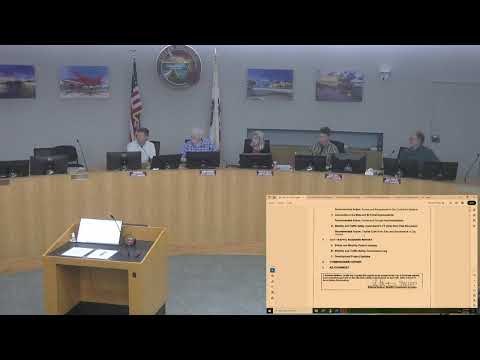
City of Encinitas sustainability staff presented a draft update to the city's Climate Action Plan on the Mobility and Traffic Safety Commission agenda, outlining new community greenhouse-gas targets and proposed measures to reduce emissions.
Ryan Lampkin, the city's sustainability analyst, said the draft CAP uses a 2016 community emissions inventory as the baseline and shows roughly 381,000 metric tons of CO2-equivalent for that year, with on‑road transportation identified as the largest single source. The draft proposes a target of 40% below the 2016 baseline by 2030 and 85% below the 2016 baseline by 2045, and it advances seven high‑level strategies including building decarbonization, expanded renewable energy, water efficiency, and a suite of transportation measures such as active‑transportation investments, a microtransit (on‑demand) study, transportation‑demand management requirements for large developments, and added EV charging infrastructure.
Lampkin said the plan aligns with state legislative drivers described in the presentation—SB 32 and a cited AB (as presented at the meeting) setting long‑term carbon‑neutrality goals—and that the CAP update is intended to better position the city to compete for federal and state funding and to pursue a Vision Zero community designation. He added that a cost‑benefit analysis will be included before the plan goes to City Council and that implementation depends on cross‑departmental staffing and budgeting.
Commissioners asked for clearer performance metrics in the document. Commissioner Glenn Johnson asked whether specific vehicle‑miles‑traveled reduction targets were included; Lampkin replied the performance metrics and estimated greenhouse‑gas reductions for each measure are included in chapter 3 of the draft plan. Commissioner Paul Templin requested a link to the draft and staff agreed to provide one. Several commissioners said they would review the draft in detail and invite staff back for follow‑up presentations on particular measures.
During public comment, a speaker who identified himself as a member of a group critical of mainstream climate science read a statement urging the commission not to spend city funds on the CAP and contending there is no climate emergency. City staff and several commissioners responded that the CAP update is a planning document guided by the body of federal, state and international science; the staff presentation focused on city‑level measures rather than scientific debate.
The commission did not vote on the draft CAP at the meeting. Staff asked the commission for clarifying comments that could be included in the public record before the plan proceeds toward City Council review.
Ending
Staff said a full cost‑benefit analysis and implementation schedule will be prepared before the CAP is presented to City Council; commissioners and the public were directed to submit written comments to the city's CAP email address for inclusion in the public record.