Get email alerts on the Land Use Policy topic
No spam. Unsubscribe anytime.
Developer seeks more flexible phasing for mixed‑use projects; commissioners ask for guidance, examples and risk analysis
Summary
A zoning text amendment to Section 417 would replace the mixed‑use district’s fixed 25/75 phasing rule with an applicant‑proposed phasing schedule; proponents argue flexibility is needed to reflect market realities while commissioners requested clearer guardrails and comparative examples.
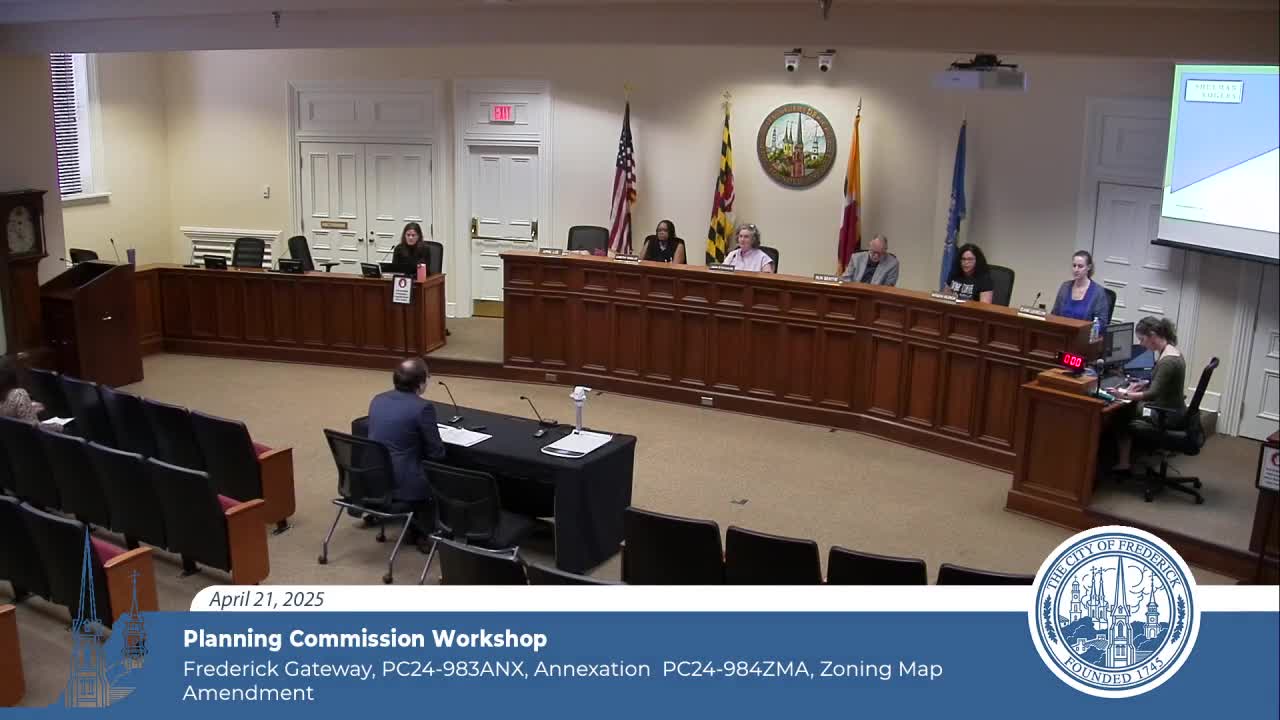
A zoning text amendment (ZTA) to Section 417 (Mixed Use district phasing) was presented at the Planning Commission workshop on April 21. The applicant, represented by attorney Philip Hummel of Schulman Rogers on behalf of a developer client, proposed replacing the code’s fixed phasing schedule with a flexible approach that would allow applicants to propose a project‑specific phasing schedule for mixed‑use master plans. The proposal would also permit director‑level modifications for previously approved MU projects so long as changes did not affect Adequate Public Facilities (APFO) certificates.
Hummel and his submission argued the existing one‑size‑fits‑all phasing requirement—in which at least 25% of approved commercial floor area must be built before permits are issued for more than 75% of approved residential units (and the equivalent reciprocal rule for residential first)—undermines the MU district’s intended flexibility and can stall housing construction where commercial demand lags. He cited the Ren Quarter example, where residential construction has advanced while nonresidential components have underperformed commercially; the fixed phasing schedule, he suggested, can prevent feasible residential construction from proceeding.
Commissioners and staff engaged in extended discussion. Several commissioners welcomed the idea of streamlining and adapting phasing to market realities but raised concerns about removing explicit percentages and leaving too much discretion to either staff or the reviewing authority. Commissioners requested comparative examples from other jurisdictions (Montgomery County, Gaithersburg, Rockville and Frederick County were cited) that allow applicant‑proposed phasing schedules and asked staff and the applicant to provide both (a) a redline showing exact proposed LMC language for the amendment and (b) case studies or empirical examples of intended and unintended consequences from other jurisdictions.
Staff said the proposed approach is consistent with the MU district’s flexibility and the 2020 Comprehensive Plan guidance to permit responsive processes. Staff recommended the commission seek concrete examples and draft redline text to clarify the thresholds and criteria that would govern flexibility and when a planning commission or council review is required versus a staff‑level modification.
Next steps: staff and the applicant will prepare redline language, provide comparative jurisdiction language and examples, and provide a supplementary memorandum demonstrating scenarios and guardrails for modifications before the text amendment proceeds to public hearing.
AI generated
The text on this page is AI generated. Summaries, highlights, analysis, and video transcripts are all produced from the original source material.
AI can make mistakes, so if you spot one, and we will fix it for everyone.
Note: the source content is unaltered by us. Any content source we link to, be it a video, an audio recording, or a document, is presented exactly as its publisher released it. That publisher is usually a government body, sometimes an individual official or another organisation.