Get Full Government Meeting Transcripts, Videos, & Alerts Forever!
Get email alerts on the Ceqa Training topic
No spam. Unsubscribe anytime.
Deputy city attorney briefs commission on CEQA basics, exemptions and EIR process
Summary
Deputy City Attorney Ashlyn Lutz provided CEQA training to the Planning Commission, describing exemptions, initial studies, and the paths that lead to a Negative Declaration, a Mitigated Negative Declaration, or an Environmental Impact Report.
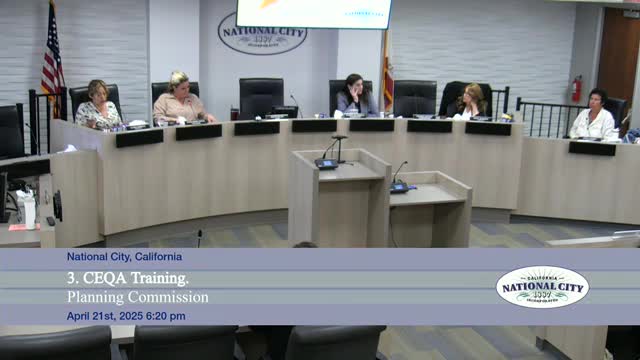
Deputy City Attorney Ashlyn Lutz gave a high‑level training on the California Environmental Quality Act (CEQA) at the Planning Commission's April 21 meeting, outlining CEQA's purpose, common exemptions, and the environmental review process developers and staff must follow.
Lutz reviewed CEQA's legal sources (Public Resources Code and the State CEQA Guidelines in Title 14, California Code of Regulations) and reminded commissioners of the central rule: "An agency by law must not make a discretionary decision that may adversely affect the physical environment before the agency has complied with CEQA." She described the three typical CEQA pathways after an initial study: a Negative Declaration, a Mitigated Negative Declaration (MND), or an Environmental Impact Report (EIR), and noted public review timelines for each.
The deputy city attorney highlighted commonly used categorical exemptions in National City, including Class 32 (infill projects under five acres), Class 1 (existing facilities / negligible expansion), and Class 3 (small new construction or conversion). She cautioned that mitigation measures required by a project will generally remove exemption status and trigger higher levels of review.
Commissioners asked for concrete examples. Lutz said a recent general plan amendment in the city required an EIR and that other projects may trigger further review if an initial study identifies potentially significant impacts (for example, discovery of threatened species or substantial traffic impacts). When asked whether the commission can require additional study, Lutz said commissioners may disagree with staff's CEQA evaluation and continue an item to request more information or studies.
Commissioner Burrell raised a question about a previously denied project (the Sweetwater Road gas station) and whether opposition that raised environmental concerns would now force a higher review. Lutz responded that because the project had been denied, there is no active project to evaluate under CEQA; if a new or revised application is filed, CEQA review would be determined for that future proposal.
Ending: Lutz said she would be available for follow‑up questions and that staff and legal counsel would support commissioners when review levels or findings of fact and statements of overriding considerations are under consideration.