Get Full Government Meeting Transcripts, Videos, & Alerts Forever!
Get email alerts on the Land Use Zoning topic
No spam. Unsubscribe anytime.
Planning Commission continues debate on lowering DMU North minimum FAR to study impacts on housing and affordable units
Summary
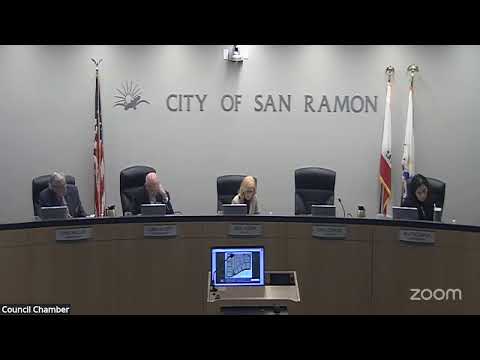
The San Ramon Planning Commission continued its public hearing on a proposed amendment to the Downtown Mixed Use North (DMU North) minimum sitewide floor area ratio (FAR), voting to continue the item to March 18, 2025.
The San Ramon Planning Commission continued its public hearing on a proposed amendment to the Downtown Mixed Use North (DMU North) minimum sitewide floor area ratio (FAR), voting to continue the item to March 18, 2025. The proposal from Sunset Development would lower the FAR minimum from 1.25 to 0.5; no final action was taken at the March 4 hearing.
The item was the second public hearing on a set of related applications that include General Plan Amendment GPA 2024-00001, a zoning text amendment (TA 2024-3) and environmental review (ENV 2025-001) that examine whether the DMU North minimum sitewide FAR should be reduced. City staff told the commission the housing-element policies and density ranges would not change; staff also said the proposed amendment is consistent with the General Plan EIR and that the environmental review finds no new or more severe impacts beyond those already analyzed in the General Plan EIR.
Sunset Development’s representative, Stephanie Hill, said the FAR reduction is intended to allow an alternate approach to meeting the city’s inclusionary housing requirements. “The FAR reduction is the first element of our broader plan to deliver affordable housing in Bishop Ranch,” Hill said, describing a strategy that would concentrate larger amounts of deeply affordable rental housing in standalone buildings developed by professional affordable housing operators. Hill cited Eden Housing as a partner for one of the proposed standalone affordable projects and said the approach could yield a greater number of lower-cost rental units than onsite inclusionary units spread across market-rate buildings.
Commissioners and staff summarized three recurring issues from earlier study sessions: alignment with the city’s housing policies; background on how the 1.25 minimum was adopted; and the likely benefits and tradeoffs of lowering a minimum sitewide FAR. Staff explained the 1.25 minimum was adopted following study sessions in 2022–2023 to promote redevelopment intensity in the city core, and that changing the minimum could allow a wider variety of building types but also could reduce residential square footage or building heights compared with what a higher minimum might encourage.
Members of the public offered both technical and policy perspectives. Jim Blickenstaff urged attention to design, parks and neighborhood “desirability” when increasing density. Another commenter, Chagarag Kathroni, asked whether the FAR reduction would apply citywide or only to particular parcels and requested a financial impact analysis if the change were not approved.
Commissioners pressed applicants and staff for clarifications. Staff reiterated that the city’s housing element does not establish minimum sitewide FARs and that density ranges (20–60 dwelling units per acre for DMU North) would remain unchanged. Commissioners noted that developers have used the state density-bonus law to obtain waivers from the city’s FAR and parking standards, and several commissioners asked staff to analyze alternatives to the applicant’s requested 0.5 FAR—specifically asking for the effects of a 0.75 minimum (and noting other mixed-use zones use a 0.7 minimum) so the commission could compare outcomes.
After extended discussion, the commission voted to continue the public hearing to March 18 so staff can return with additional analysis, including an alternative FAR level (suggested 0.75) and related implementation issues. The motion to continue passed 5–0.
Next steps: staff will prepare supplemental analysis for the March 18 meeting that examines alternatives (including a 0.75 minimum FAR), the scope of the amendment limited to DMU North, the interplay with the city’s inclusionary housing ordinance and state density-bonus provisions, and any potential effects on the housing element’s realistic development capacity. Commissioners said they want the continued hearing to remain focused on the FAR amendment (DMU North) rather than broader development-agreement concepts Sunset sketched in its presentation.
Why this matters: the FAR minimum affects project design, the mix of housing types that can be financially viable, and whether affordable units are built onsite or consolidated into standalone rental communities. Staff said changes could influence how projects meet the city’s inclusionary requirements and whether developers must use state density-bonus provisions to overcome local development standards.
What was not decided: no change to the FAR or zoning was adopted. Sunset’s broader concept for off-site standalone affordable housing and a development-agreement-style implementation will require separate follow-up and additional approvals if and when specific project applications are filed.
Actions at a glance: the Planning Commission continued the DMU North general plan and zoning text amendment public hearing to March 18, 2025 (motion carried 5–0).