Get Full Government Meeting Transcripts, Videos, & Alerts Forever!
Get email alerts on the Wildfire Mitigation topic
No spam. Unsubscribe anytime.
San Ramon engineer briefs council on GAD wildfire prevention, reserves and maintenance
Summary
City district engineer Shane Shee summarized the role, funding and wildfire-prevention work of two Geologic Hazard Abatement Districts (GADs), described maintenance schedules and responded to council questions about grazing, tree management and recent landslide repairs.
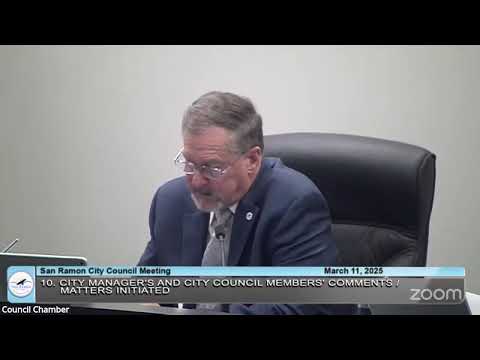
Shane Shee, district engineer for San Ramon, told the City Council on March 11 that the city manages two Geologic Hazard Abatement Districts — the Dougherty Valley GAD and the Northwest San Ramon GAD — and that both are engaged in routine and large-scale maintenance to reduce geologic and wildfire risk.
Shee said the Dougherty Valley GAD (formed in 1990, renamed 2017) will ultimately own about 2,900 acres of open space and currently comprises roughly 12,000 assessment units; Northwest San Ramon GAD, formed in 2017, will eventually include about 192 acres and roughly 363 assessment units. He said the Dougherty Valley GAD maintains a reserve fund of about $40 million and Northwest San Ramon GAD about $2 million to cover deferred maintenance and large repairs.
Shee described annual activities the GADs perform to reduce fire risk, including spring weed abatement and firebreak mowing ahead of the June 1 deadline used by the fire district, maintenance of drainage features and fire-access roads, and targeted repairs such as the Cammy Court landslide project, which he said cost about $5 million. He also explained the city uses grazing (primarily cattle) to reduce fuel loads and preserve habitat, and that grazing is contracted at low cost to the GADs.
The engineer addressed how regulatory constraints shape work in open-space parcels. Many GAD lands are covered by conservation easements that require preserving habitat and native plantings; Shee said that limits removing vegetation simply to clear views or reduce perceived risk and that unauthorized removal of vegetation can violate the easement and be treated as vandalism.
Shee fielded council questions on wildlife displacement during mowing and grazing, stormwater bioretention and sediment removal, nonnative species monitoring, use of drones and other technologies for landslide monitoring, and coordination with the fire district. He said most wildlife flee disturbance, that stormwater ponds collect sediments which the city tests and removes as needed, and that conservation-easement holders monitor nonnative plant incursions and submit annual reports. Shee said the city’s engineers and contractors perform regular visual monitoring of potential landslide sites; drone mapping has been used on some projects to model damage and support funding requests.
Shee described the Cal Fire hazard-zone mapping in draft form and said roughly 12–31% of city land is in Cal Fire’s mapped high-to-moderate hazard categories, mainly in open-space areas rather than residential neighborhoods. He noted recent state-level actions — including a 2025 executive order discussed during the presentation and the 2020 legislative item referenced as AB 3074 — that have focused attention on ember-zone clearance but that the executive order’s immediate requirements apply to “very high” hazard areas, which San Ramon does not have within city limits under current Cal Fire data. He reiterated there is no new local requirement to impose a five-foot ember-clearance around homes beyond existing standards, but the city will continue coordination with the fire district as state guidance evolves.
Council members and staff agreed to post the presentation and to explore distributing the material to residents; Shee’s contact information is listed on property tax bills for GAD questions. The item concluded as a staff presentation and discussion; no formal council action was recorded on the GAD presentation itself.