Get Full Government Meeting Transcripts, Videos, & Alerts Forever!
Get email alerts on the Battery Energy Storage Bess topic
No spam. Unsubscribe anytime.
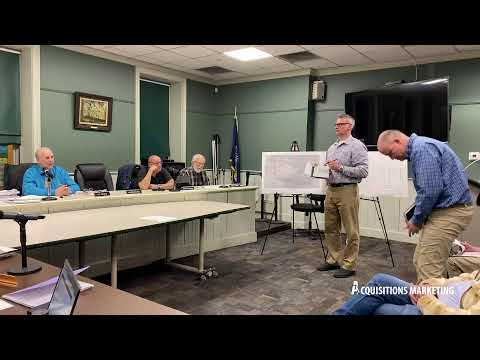
Planning board declares lead agency for 114 Hartley Road battery energy storage proposal; board seeks fire‑safety, hazard and operations details
Summary
New Leaf Energy presented an amended site‑plan and special permit concept for a two‑pad, 5 MW (each) battery energy storage system at 114 Hartley Road. The planning board declared its intent to serve as lead agency for SEQRA and asked the applicant to provide hazard mitigation, emergency response, alarm and cooling system details, decommission
The Town of Goshen Planning Board received an initial presentation on an amended site plan and special permit application for a tier‑2 battery energy storage system (BESS) proposed at 114 Hartley Road.
Project overview: The applicant’s development team (represented by Travis Rosiek from Craig Manning and Eric Nolan and Zachary Long from New Leaf Energy) described two 5‑megawatt battery units (four‑hour duration) to be sited on a 31.2‑acre parcel currently used for construction‑storage operations. The development would use existing site access and infrastructure where possible and locate two equipment pads (each roughly 89 by 99 feet) inside fenced, gated enclosures; some new pad concrete and gravel surfacing is proposed where equipment will sit.
Board action: The planning board voted to declare its intent to act as lead agency for SEQRA for the project. Board members also directed the applicant to provide a detailed hazard mitigation analysis, an emergency response plan, equipment‑pad and fire‑suppression details, alarm/system behavior and monitoring plans, noise and alarm procedures, and decommissioning estimates broken out by pad.
Fire‑safety and hazardous materials: Board members and staff asked for specifics about battery chemistry, fire‑suppression options (including whether a water spray or other suppression system would be used), remote monitoring and alarm protocols, sensors (LEL/smoke) and how failed sensors would be detected or replaced. The applicant said they will submit a full hazard‑mitigation analysis listing materials and suppression systems and will coordinate with the fire department. The applicant noted that ESRG (an industry fire‑safety consultancy) and a member of the governor’s interagency task force on battery safety will be engaged to advise on emergency response and code‑related items.
Emergency access and operations: The applicant said existing TAM Enterprises access would be used; the board asked that Knox Box locations, turning templates for fire apparatus and agreements for emergency gate access be incorporated in revised plans. The board also asked for a clear point‑of‑disconnect or sectionalizing detail that would let emergency responders isolate the BESS from the distribution system if necessary.
Environmental and community issues: Board members requested the distance to the nearest residence (the applicant noted the closest residence is more than 700 feet away and separated by vegetated property and O&R infrastructure), potential off‑site impacts from thermal events or smoke, expected cooling arrangements for the battery units, and confirmation that any suppression chemicals would be documented in the hazard analysis.
Next steps: The applicant will submit revised site plans and a detailed hazard/emergency operations package; staff circulated SEQRA notices and the board declared its intent to serve as lead agency at the meeting. The applicant indicated an intent to submit revised materials in advance of the board’s next meetings so technical reviews and referrals (including to the fire department) can proceed.
Speakers quoted are attributed to the meeting transcript.