Get Full Government Meeting Transcripts, Videos, & Alerts Forever!
Get email alerts on the City Budget topic
No spam. Unsubscribe anytime.
San Francisco budget office flags $817.5 million two‑year shortfall; mayor asks for structural cuts
Summary
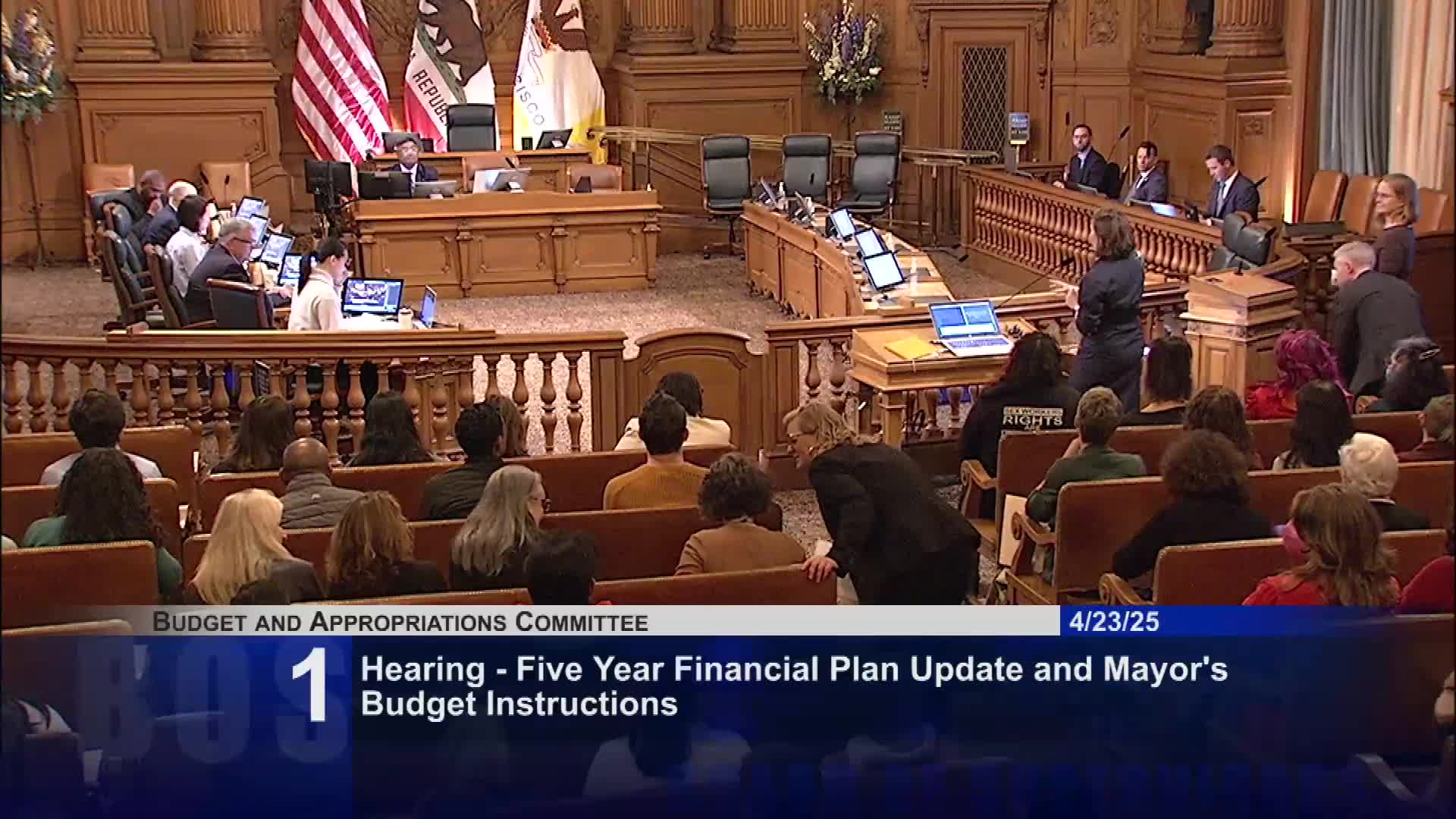
The Budget and Appropriation Committee on April 23 heard a March update to the city and county’s five‑year financial plan that shows an $817,500,000 shortfall over the next two fiscal years and a structural deficit projection of about $1,300,000,000 if current policies remain unchanged.
The Budget and Appropriation Committee on April 23 heard a March update to the city and county’s five‑year financial plan that shows an $817,500,000 shortfall over the next two fiscal years and a structural deficit projection of about $1,300,000,000 if current policies remain unchanged.
Mayor’s Budget Director Sophia Kittler summarized the update to Chair Supervisor Connie Chan and the committee, saying the March revisions improve the December outlook by roughly $58,500,000 but still leave “very large structural shortfalls” that will require policy interventions. “This is not a deficit that will solve itself,” Kittler said. “It requires significant policy intervention to rectify.”
The update is a status‑quo forecast prepared jointly by the Mayor’s Budget Office, the Controller’s office and the Budget and Legislative Analyst. It assumes no new federal or state actions and projects revenue changes driven by several specific factors: a positive shift in property tax revenue due to state changes to school funding formulas that return more ERAF dollars to the city; a marked rise in business tax receipts based on early business filings; and weaker hotel and sales tax collections. Kittler and other presenters also described a downward revision to FEMA reimbursements for COVID‑related costs, which the presentation set at $80,000,000 annually for forecasting purposes.
Why it matters: the city must present a balanced budget by June 1 and the administration has instructed budget staff to look beyond the two‑year shortfall and focus on reducing the longer‑term structural deficit. That instruction includes considering expenditure controls, vacancy management, contracting and grant prioritization, and potential revenue options. Kittler said the mayor wants the budget office to aim to reduce the structural gap by roughly a third in the upcoming budget cycle.
Key revenue and risk items described at the hearing
- Business taxes: the city’s filings for tax year 2024 are showing about a 14% increase in worldwide sales among filers, generating a material upward revision to business tax projections, Kittler said. That increase reflects the subset of firms that have filed so far and apportionment to San Francisco.
- Property tax / ERAF: state revisions to school district and community college funding formulas mean less ERAF diversion and therefore more local funds returning to the city, though assessment appeal activity partially offsets some gains.
- Hotel and sales tax: both categories were revised downward for the current year and will grow off a lower base; hotel tax in particular has shown a flattening recovery.
- FEMA reimbursements: the city took a conservative approach to FEMA COVID reimbursements, leveling forecasts at current‑year expectations ($80 million) amid audit and eligibility uncertainty.
- Retirement contributions: the forecast retains the retirement system’s assumed 7.2% annual investment return; Kittler and committee members noted market volatility could force higher contribution rates and that it is prudent to monitor and coordinate with the retirement board.
Committee discussion and next steps
Supervisors pressed several operational and policy questions: whether the city will increase reserves to mitigate retirement or federal funding risk, how the city coordinates with the retirement board, and which mayoral policy choices are being considered. Kittler outlined the four primary “levers” the mayor’s office is evaluating: federal grants and revenue certainty, grants/contracting prioritization, vacancy and personnel management, and fees/revenue measures where appropriate.
Public comment: there were no speakers during the public comment period for this item.
Formal procedural action: the committee voted to “hear and file” the five‑year outlook update. The motion was made by Chair Chan and seconded by Supervisor Walton; the roll call recorded five ayes (Vice Chair Matt Dorsey; Member Ingardio; Member Walton; Member Chen; Chair Chan), and the motion passed.
What happens next: the administration must present a balanced budget by June 1. The May state budget revision (the governor’s May revise) and continued federal economic developments were cited by staff as key near‑term factors that could affect the city’s revenue outlook.
Ending: committee members and staff agreed to continue coordination with the retirement board and to maintain public briefings during the budget process as the office develops options to narrow the structural gap.