Get Full Government Meeting Transcripts, Videos, & Alerts Forever!
Get email alerts on the Agriculture Budget topic
No spam. Unsubscribe anytime.
Senate subcommittee hears CDFA budget requests for cybersecurity, new Turlock lab operations and Farm to School expansion
Summary
The California Department of Food and Agriculture outlined proposed 2025–26 budget increases including cybersecurity remediation, operating funds for a new Turlock animal health lab, $24.9 million for Farm to School grants, and an expenditure plan for Proposition 4 climate bond programs; the subcommittee held each item open for further review.
Arma Cozina, deputy secretary for administration and finance at the California Department of Food and Agriculture, briefed Senate Budget and Fiscal Review Subcommittee No. 4 on the department's proposed 2025–26 budget and several budget change proposals.
CDFA told the subcommittee the governor's budget proposes about $775 million and 2,075.2 positions for the department, funded from a mix of general fund, industry assessments, federal, bond and other funds. CDFA said federal funds are roughly 20% of its budget and that federal cooperative agreements—primarily with USDA and FDA—fund much of produce safety work.
Why it matters: the requests touch public health, agricultural emergency response capacity and climate programs that affect schools, producers and local food systems. Members pressed CDFA and Department of Finance on contingency planning if federal cooperative funding declines and on how requested general fund dollars fit into the state's constrained budget outlook.
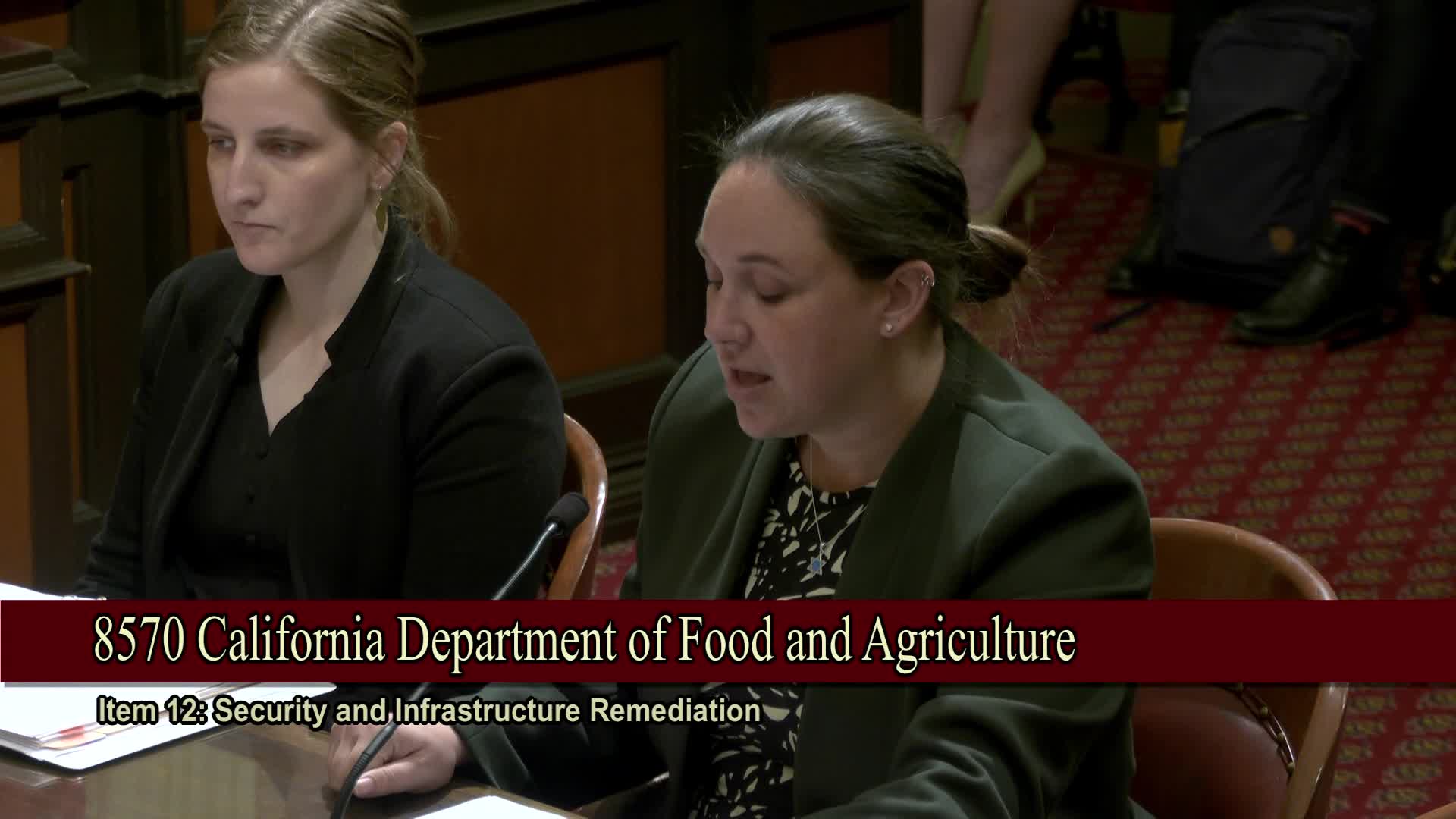
Security and infrastructure remediation CDFA requested $2.478 million in 2025–26 and ongoing positions and funding to implement permanent fixes after a March 2024 cybersecurity incident that exposed private data. The request would fund application upgrades, security assessments, and monitoring. CDFA said a temporary fix implemented with the Department of Technology remains in place but is not durable. Lawmakers and staff flagged statewide IT workforce shortages and departmental caps on indirect rates written into Food and Agricultural Code as complicating factors. The subcommittee held the item open for additional review and fiscal scrutiny.
Turlock North Valley Animal Health Laboratory (Turlock lab) CDFA requested $1.61 million in 2025–26 and $3.3 million ongoing to operate the new Turlock North Valley Animal Health Laboratory, a 41,000‑square‑foot facility (current facility noted at ~5,100 square feet). CDFA said the lab will expand capacity beyond avian diagnostics to large‑mammal necropsies and other testing important to the state's largest dairy‑producing region. Lawmakers asked whether the department could use its special fund for operations; CDFA responded that Food and Agricultural Code restricts the use of certain ag funds and that the department believes the new lab primarily benefits statewide public health rather than a fee‑paying subset of producers, so general fund support was most appropriate. The subcommittee held the item open to review funding options further.
Farm to School grant expansion CDFA requested $24.9 million one‑time general fund in 2025–26 for the California Farm to School grant program: $20 million for the Farm to School Incubator Grant Program, $3 million for climate‑smart technical assistance, and $1.9 million for network capacity and outreach. CDFA said the program has reached an estimated 49% of California schoolchildren through prior rounds and that 80% of schools served in the most recent cycle were Title I. The Legislative Analyst's Office recommended weighing the general fund request against other priorities and suggested using Proposition 98 school funding for activities that go directly to schools; LAO also recommended rejecting the $3 million climate‑smart technical assistance because LAO said it does not clearly expand procurement of local foods to schools.
Climate bond (Proposition 4) expenditure plan CDFA proposed a $131.8 million appropriation in 2025–26 for nine programs identified in the climate bond (most programs are climate‑smart agriculture grants and one is fairground resiliency for extreme heat). CDFA outlined three timelines: immediate implementation for programs that can use existing grant infrastructure (including SWEEP and Healthy Soils), accelerated implementation for two new farmers' market programs (year‑round certified farmers markets and certified mobile farmers markets), and a phased approach for newer programs that require stakeholder engagement (tribal food sovereignty, regional equipment sharing). CDFA detailed proposed allocations including $37.6 million for SWEEP, $35.9 million for Healthy Soils, $18.8 million proposed for Urban Agriculture, and other targeted grants. The LAO found the plan reasonable in structure but suggested legislative guidance for new programs and asked the administration to provide details and priorities for programs it proposes to phase in or leave for future allocation. Members pressed CDFA and Finance on why several equity‑focused programs had small or no allocations in the near term; Finance said additional legislative guidance and program design work would inform later appropriations. The subcommittee held the Prop 4 items open for further deliberation.
What happened next Committee members repeatedly held CDFA items open, citing general fund constraints, statutory limits on certain assessment funds, and the need for more program‑level detail—particularly around equity and rollout timelines. CDFA and Finance agreed to provide additional follow‑up information requested by members.
Speakers from the transcript: Arma Cozina (Deputy Secretary for Administration & Finance, CDFA); Natalie Kraut Greenberg (Division Director, CDFA); Rachel O'Brien (Deputy Secretary/Legislative Affairs, CDFA); Aaron Carson (Department of Finance); Frank Jimenez (Legislative Analyst's Office); Senator Cabaldon (chair); Senator Nilo; Senator Smallwood Cuevas.
Authorities referenced: Food Safety Modernization Act (other); Food and Agricultural Code (code); Proposition 4 (2024 climate bond) (other).