Get Full Government Meeting Transcripts, Videos, & Alerts Forever!
Get email alerts on the State Hospitals Budget topic
No spam. Unsubscribe anytime.
State hospitals seek $3.4 billion budget; department cites staffing, caseload shifts and ETP results
Summary
The Department of State Hospitals outlined its 2025–26 budget request, operational changes tied to vacancy reductions, caseload updates including IST and Coleman referrals, and early outcomes from the Enhanced Treatment Program (ETP). Officials said staffing shortages remain the principal barrier to expanding programs.
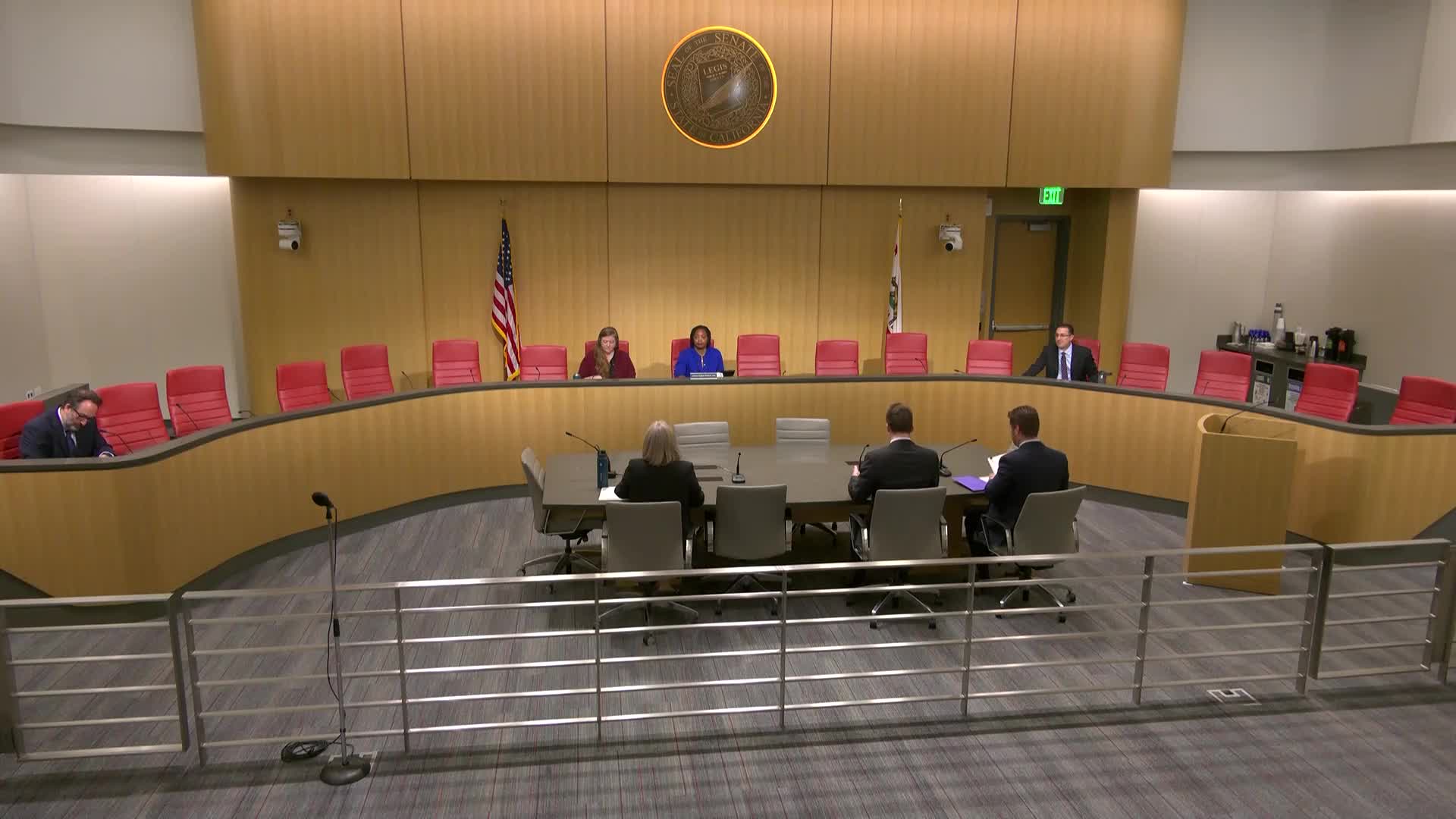
The Department of State Hospitals told the California State Senate Budget Subcommittee No. 3 on May 1 that the Governor’s 2025–26 budget for the department proposes $3,400,000,000 and 38 new positions to maintain operations and pursue capital improvements.
The department's director, Stephanie Clendenin, said the budget request also reflects proposed vacancy reductions and state operations cuts intended to produce one-time and ongoing savings without reducing care at most facilities. Clendenin said the vacancy reductions, pursuant to control section 4.12, would eliminate 71.1 vacant positions and save $20,400,000, and state operations reductions pursuant to control section 4.05 would reduce the budget by $8,800,000. "The vacant position reductions are not anticipated to have any significant impact since the majority of these positions include positions associated with closed patient units," Clendenin said.
Why it matters: DSH runs the state forensic and civil hospital system that serves patients with the most complex behavioral health treatment needs, including those found incompetent to stand trial (IST) or committed under Lanterman-Petris-Short (LPS) procedures. Funding and staffing decisions affect capacity for inpatient care, community-based services, and programs that interface with the California Department of Corrections and Rehabilitation (CDCR).
Caseload and program updates Brent Hauser, Chief Deputy Director of Operations, said the department projects a patient census of 8,527 by the end of 2025–26, an increase of 204 patients from the current-year projection. Hauser described a Metropolitan campus project that added forensic beds and said DSH is requesting $21,700,000 ongoing to cover increased patient-driven operating expenses (utilities, pharmaceuticals, food, outside hospitalization).
The department described several targeted staffing requests: three positions for handling increased referral intake from CDCR for Coleman-related referrals (the unit that receives referrals of incarcerated persons who need inpatient mental health treatment), 23 positions to support IST reevaluation services (one new for data/outcomes monitoring and 22 conversions of limited-term positions to permanent), and other position authorities tied to community restoration and diversion programs. Chris Edens, chief deputy director, noted substantial onetime savings in the current and future years tied to the timing of community-based program activations and maximizing prior-year multi-year appropriations.
Clendenin and Edens credited changes that increased DSH responsiveness to IST referrals. "The average time to initiating treatment for all IST individuals in February 2025 was just five days," Edens said, and since November 2024 "100 percent of all IST individuals who did not have extenuating circumstances beyond DSH's control received services within the final court compliance benchmark of 28 days." The department said those results were reported to the court in the Stiavelli case and to the special master overseeing compliance.
Enhanced Treatment Program outcomes Dr. Kate Warburton, the department’s statewide medical director, described outcomes from the Enhanced Treatment Program (ETP), a pilot created by statute to treat patients at highest risk of physical violence. The ETP model adds specialized staffing and environmental controls to manage aggression with least-restrictive practices. Warburton reported preliminary data showing reductions in aggressive incidents and injuries after ETP admission: aggressive incidents toward staff fell 71 percent and toward other patients 94 percent; serious staff injuries decreased 68 percent; and serious injuries to patients due to peer aggression were eliminated in the ETP cohort. She cautioned the program has seen increases in self-injurious behaviors for some patients and that referral screening has been adjusted to better identify patients at risk for self-harm.
Staffing remains the largest implementation barrier Multiple committee members asked about barriers to program start-up. "Mostly the barriers are having trained, qualified staff—being able to find sufficient staff," Edens said. Clendenin and Hauser described ongoing workforce initiatives: expanded residency and fellowship partnerships (UC, Stanford, Kaiser and community partners), rapid-hire events, marketing campaigns for hard-to-fill classifications, and coordination with CalHR on compensation differentials and retention bonuses.
What’s next DSH officials said they will continue to implement community forensic partnerships, advance capital outlay projects, and monitor utilization of the Coleman bed allocation with CDCR. Clendenin and Hauser indicated the department will provide additional updates on program activations and the May revise to the Legislature.
Sources: Testimony of Stephanie Clendenin, Brent Hauser, Chris Edens, and Kate Warburton; Legislative Analyst Office and Department of Finance representatives available for questions.