Get Full Government Meeting Transcripts, Videos, & Alerts Forever!
Get email alerts on the Housing And Homelessness topic
No spam. Unsubscribe anytime.
Housing Department briefs Technology Commission on HUD grants, seeks input for annual action plan
Summary
Grants manager Rocio Peña Martinez told the Technology Commission the City of Austin’s HUD formula grants (CDBG, HOME, HOPWA, ESG) fund housing and services for low‑ and moderate‑income households and solicited commissioner feedback on priorities, including digital access and a homeless management information system.
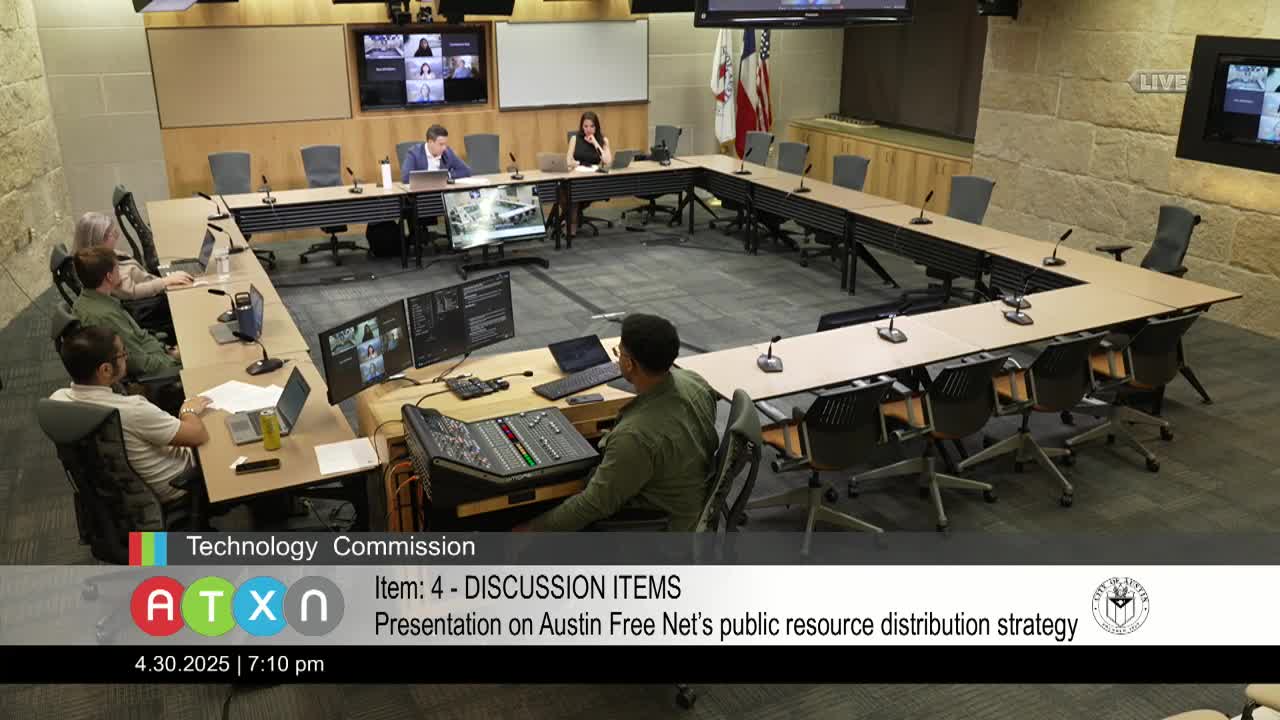
Rocio Peña Martinez, grants program manager in the City of Austin Housing Department, briefed the Technology Commission on the city’s annual HUD action plan and requested commissioner input for the consolidated HUD application on April 30.
Peña Martinez said the City of Austin applies annually for four HUD formula grants—Community Development Block Grant (CDBG), HOME Investment Partnerships Program (HOME), Housing Opportunities for Persons With AIDS (HOPWA) and Emergency Solutions Grants (ESG). The grants are intended to support housing and related services for very low‑ to moderate‑income households. The consolidated planning process covers a five‑year cycle and the annual action plan is the yearly step that makes funds available, she said.
Using the department’s end‑of‑year report, Peña Martinez reviewed last fiscal year’s funding and outcomes and said the city typically receives an average of roughly $14 million annually across the formula grants. She noted the majority of CDBG and HOME funds serve extremely low‑income households (below 30% of the area median family income) and that HUD reporting limits what demographic data can be published for privacy reasons; race/ethnicity and household income brackets are among the data points the department reports.
Peña Martinez described four priority areas from the consolidated plan and the kinds of projects the funds typically support, including the creation or preservation of affordable units, acquisition of facilities, tenant services to help households remain stably housed, and specialized services funded under HOPWA and ESG. She said the department pairs HUD funds with other local, state and federal funding sources when feasible.
Commissioners asked for clarification about two items: a planned homeless management information system (HMIS) and whether internet access or affordability is funded by HUD formula grants. Peña Martinez said the HMIS funding request is intended to centralize service‑provider information and reduce the need for providers to use multiple portals; she said the department has budgeted for that system but would verify specific amounts and report back. On connectivity, Peña Martinez said the HUD formula grants currently in the action plan do not directly fund internet access for eligible households; the housing authority may have mechanisms to provide access for its residents but that is not funded directly in the action plan as presented.
Peña Martinez described departmental steps taken in response to prior community feedback, including establishing a policy and data team, producing a public housing hub, publishing a feedback report from last year’s community needs assessment and launching an “evergreen” survey to collect input year‑round rather than only during formal assessments.
The department expects to submit its action plan to HUD in August and typically receives notification of award availability the following spring, Peña Martinez said. She invited commissioners to provide written input and asked the commission to recommend topics or contacts for further briefings, specifically for the HMIS project; commissioners indicated interest in a future presentation from the project team.
Ending: The presentation was informational. Commissioners requested verification of HMIS budget figures and asked staff to return with additional detail on the HMIS project and on whether other local programs can directly subsidize internet access for households.