Get Full Government Meeting Transcripts, Videos, & Alerts Forever!
Get email alerts on the Sea Level Flood Projects topic
No spam. Unsubscribe anytime.
Several Miami flood-prevention and seawall projects flagged as at-risk for grant and bond deadlines
Summary
Project managers identified numerous sea level rise, pump station and seawall projects with grant expirations or schedule concerns; staff said environmental clearances, procurement setbacks and cost escalation are the main causes of delay.
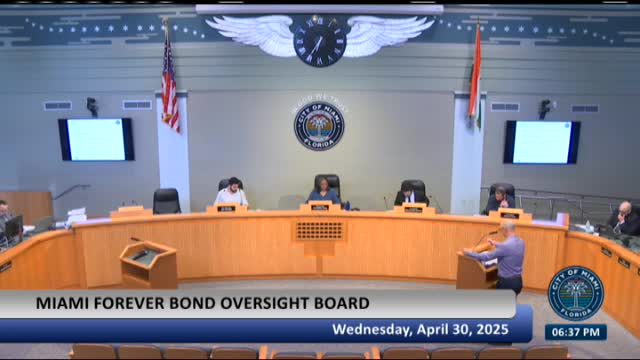
Resiliency and Public Works and Office of Capital Improvements staff briefed the Capital Improvements Oversight Board on multiple sea level rise and flood-prevention projects that staff categorized as “concern” due to schedule, permitting, procurement or funding risks.
Jerry Marquez, chief project manager for Resiliency and Public Works (RPW), reviewed a list of at-risk projects and said several have federal or state grants that expire in 2026–2027. “We may have to request an extension on our grant and then see where the drawdown is,” Marquez said about a Brickell and Coconut Grove seawalls item. He noted the Edgewater flood-improvement project and East Little Havana flood improvements have completion estimates beyond the Miami Forever bond expenditure window.
Clara Sedan of Resilience and Public Works said environmental-clearance delays have affected projects such as East Little Havana, and that staff are prioritizing which awards (grants vs. bond dollars) to expend first. “For the ones that we have the opportunity to use the bond dollars first, we will do that,” Sedan said. Staff reported many projects must secure Army Corps, South Florida Water Management District, and local building permits, which take additional time.
Marquez listed common causes of delay: grant timing (letters of intent executed September 2023 for many grants), environmental-clearance processes that in some cases have taken six months to a year, construction-cost increases (sometimes 50%–90%), and limited qualified contractors, which has led to re-advertising projects when negotiations fail.
Staff singled out projects and deadlines discussed in the meeting (excerpted): Edgewater (federal grant expiring Sept. 2026; estimated finish May 2028), East Little Havana (federal grant expiring May 2027; environmental clearance expected in mid-May per staff), Brickell & Coconut Grove seawalls (federal grant expiring Sept. 2026), Bridal Bay Drive drainage (state grant expiring June 2027; bidding stage), Morningside seawalls (federal grant expiring Sept. 2026; design with 100% plans but complex permitting), East Flagami pump station (procurement re-advertising required), Shore Crest seawalls (federal grant expiring Sept. 2026; finish July 2027 in staff schedule), and Wynwood (federal grant expiring May 2027; environmental clearance required).
Staff said contingency options include requesting grant extensions from the grantor agencies, documenting permitting and environmental delays to justify extensions with bond counsel, and reallocating bond funds to shovel-ready projects if necessary. The board asked staff to prepare a focused follow-up report for projects with extended timelines and to add a short “reason for concern” column next to each project for future meetings.
Ending: Staff said an independent engineering firm is updating project schedules and staff will bring detailed, project-level status reports for the flagged flood-prevention items to the next oversight meeting.