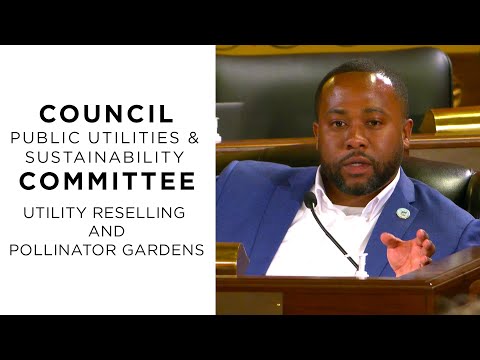
Columbus committee debates defining pollinator gardens in code; residents push broader exemptions
Loading...
Summary
Columbus City Council committee held an extended hearing on draft code changes to exempt native pollinator gardens from 'noxious weed' enforcement. Residents who'd received violation notices urged broader protections; city staff proposed a 50% front-yard limit and other criteria to balance neighbors' concerns.
Columbus City Council’s Public Utilities & Sustainability Committee held an extended public hearing on proposed code language to recognize and exempt pollinator gardens from noxious-weeds enforcement.
Supporters said codifying pollinator gardens would protect habitat for declining pollinator species, improve food production for community gardens and reduce stormwater runoff; several residents who received city violation notices urged broader exemptions to prevent prosecution. City code staff proposed draft language that would exempt clearly maintained native or dormant native plantings that meet setback, vision-clearance and invasive-species criteria, with a 50% cap on the front-yard area for taller pollinator plantings.
Councilmember Shayla Weiss framed the hearing as an early-stage, consultative session. “This is the art of the possible,” Weiss said, noting the intent to reduce court conflicts and provide clarity for residents who wish to plant pollinator habitat.
Karima Samadi, a policy analyst at Columbus Public Health, told the committee that pollinators support roughly 35% of global food crops and stressed the city’s local-food goals. “Supporting pollinators makes every community garden, backyard vegetable plot and urban farm more productive,” Samadi said, noting there are “over 350 community gardens in Columbus and Franklin County.”
Residents who had faced code enforcement took the podium to describe encounters with the city violations process. Ken Kiesel, a Clintonville resident with a zoology degree, said he converted a steep front slope to deep-rooted native plants and added common milkweed to create a monarch habitat; he described a court pretrial in which an attorney representing Judge Mingo’s court questioned the authority of city guidance and said inspectors “are not botanists.” Kellen Callinger Yoke recounted receiving a violation notice that threatened a fine or jail time for what she described as an intentional, well-maintained native planting and said the appeals committee told her it could only enforce existing code and could not make it “make sense.”
Tony Celebrizzi, deputy director of Building and Zoning Services, presented draft language the department prepared for section 709.03 (noxious weeds). The draft lists six exemption criteria, including: plantings composed of live or dormant Ohio-native species that do not create a health hazard; no plants listed on the city/state noxious-weed list; maintenance of vision clearance at intersections/driveways; a buffer from neighboring property lines; and a limit that pollinator plantings not exceed 50% of the front yard (side and rear yards could be 100% under the draft).
City staff said the 50% guideline is intended to reduce the volume of neighbor complaints that prompt enforcement visits; they also proposed allowing dormant native plants to remain over winter without enforcement action. Several conservation organizations—Franklin Park Conservatory, Friends of the Lower Olentangy Watershed (FLOW), Franklin County Pollinator Pathway—and educators urged the council to simplify the draft and avoid arbitrary percentage limits that could hamper habitat leaders and small-lot homeowners.
Franklin Park Conservatory’s Jenny Pope said well-designed native-plant gardens can be indistinguishable from ornamental plantings and pledged the conservatory’s help with public education. FLOW’s Laura Fay said about 38% of the watershed is turfgrass and argued that reducing turf would improve water infiltration, lower summer watering needs and support urban forest and climate goals. Craig Tuthman of Franklin County Pollinator Pathway urged removing overly complex limitations and examining other city code sections (solid-waste, vision clearance, rodents) to ensure consistency.
Residents and community advocates asked for clearer registration or a voluntary certification so exemplary, well-maintained native gardens would not be subject to complaints and court action. Some speakers urged removing arbitrary numeric limits that disproportionately affect small-yard neighborhoods like Franklinton; others asked the council to coordinate training for code inspectors and outreach to homeowners’ associations to reduce conflict between private covenants and city code.
No vote was taken. Councilmember Weiss said the committee will collect written feedback and meet with departments to refine draft language; staff indicated additional meetings and outreach before any ordinance would be finalized.