Get Full Government Meeting Transcripts, Videos, & Alerts Forever!
Get email alerts on the Drive Through Regulation topic
No spam. Unsubscribe anytime.
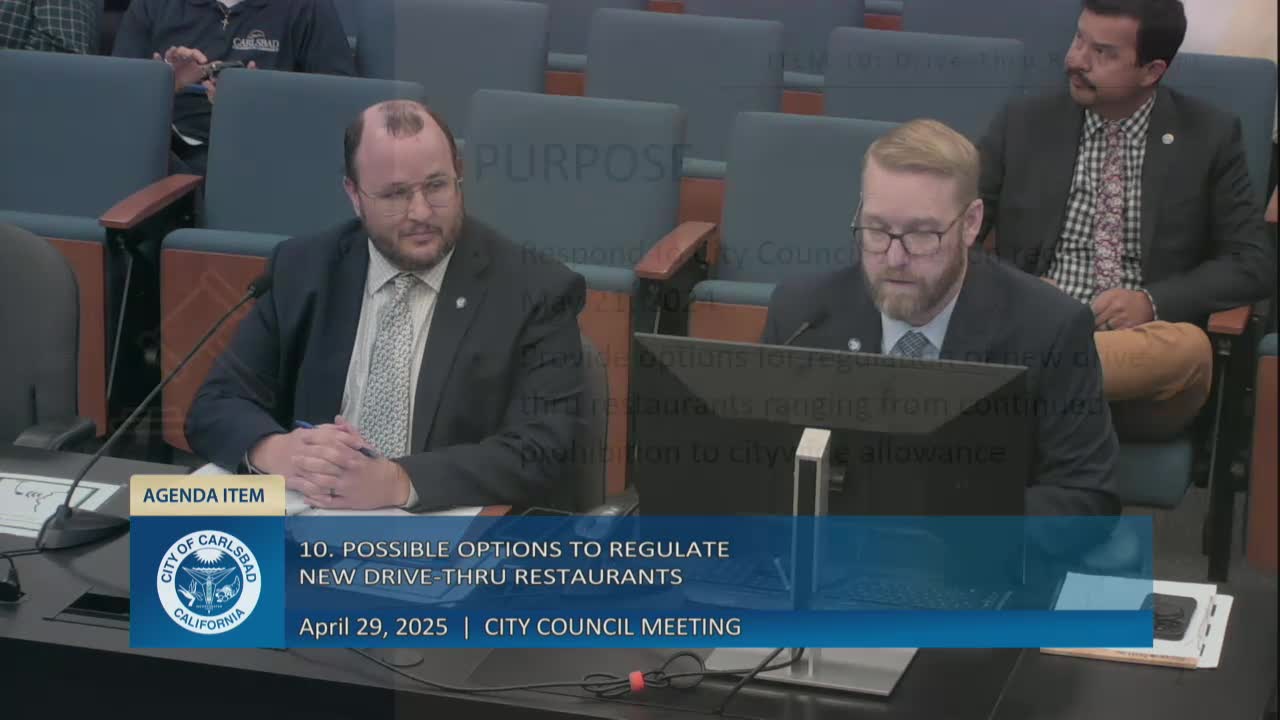
Carlsbad keeps citywide ban on new drive‑through restaurants but opens door to case‑by‑case code changes
Summary
After extensive public testimony split between economic and environmental arguments, the council voted 3–2 to retain the citywide prohibition on new drive‑through restaurants while allowing privately‑initiated zoning amendments to be considered by the council on a site‑specific basis.
The City Council voted to maintain its citywide prohibition on new drive‑through restaurants but approved a process under which private applicants may request zoning code amendments for council consideration on a case‑by‑case basis.
Why it matters: Drive‑through restaurants were banned in Carlsbad in 1998 following community concerns about traffic, aesthetics and environmental impacts. Pressure to revisit that ban has risen in recent years from landlords and some business groups that contend the prohibition limits local economic opportunities and forces residents to drive outside the city for certain quick‑service options. Opponents warned that allowing drive‑throughs harms pedestrian safety, increases idling and emissions, and changes community character.
Options considered and council action
- Option 1 — No change: retain full prohibition citywide. Supporters said the ban protects community character, reduces vehicle idling and traffic conflicts and aligns with climate and public‑health goals.
- Option 2 — Case‑by‑case private proposals: retain the prohibition but allow privately initiated code amendments (zoning code changes or rezones) to be brought to council for consideration. Applicants would pay costs for environmental review and fees; staff recommended that conditional use permits and site‑specific environmental review be used to consider impacts.
- Options 3–5 — progressively broader lifting of the prohibition (shopping‑center only; restaurant zones; all commercial zones). Staff provided analysis of impacts and implementation considerations for each option.
Council decision and rationale
The council voted 3–2 for Option 2. Proponents of keeping the prohibition cited community feedback and environmental concerns; proponents of allowing drive‑throughs argued for economic opportunity, convenience and that modern curbside and delivery options complicate the original rationale for the ban. Option 2 was presented as a compromise that keeps the default prohibition but permits the council to evaluate individual proposals — with applicants responsible for the cost and environmental analysis.
Implementation notes
- Applicants seeking a code amendment or rezoning to allow a drive‑through will be responsible for environmental review (and costs) and must follow standard public noticing and hearing processes. Staff recommended using conditional use permits/site‑specific environmental review to analyze traffic, queueing, pedestrian conflict, greenhouse gas impacts and site design.