Get Full Government Meeting Transcripts, Videos, & Alerts Forever!
Get email alerts on the Human Resources Budget topic
No spam. Unsubscribe anytime.
Cochise County HR presents budget details on background checks, counseling and applicant system
Summary
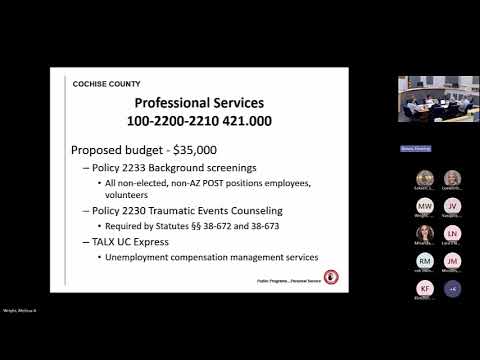
Human resources staff reviewed line-item spending including a $35,000 professional-services budget for background checks and counseling, a $21,853 contract for the NEOGOV applicant-tracking system, a $2,525 background-check integration, and a proposed $60,000 countywide unemployment budget; no formal votes were taken.
Cochise County human resources staff reviewed key line items in the department's operating budget during a county meeting, detailing costs for background screenings, traumatic-event counseling for public-safety employees, the NEOGOV applicant-tracking system and unemployment-administration services. The presentation included specific usage figures and a proposal to continue current vendor contracts; the board did not take formal votes on those items during the session.
The discussion matters because those line items fund routine hiring protections, statutorily required counseling for law enforcement and detention staff, and systems that handle sensitive employee data. Changes to the budget or to intergovernmental agreements for court-related HR services could affect county payroll operations and the courts' personnel administration.
Human resources staff said professional services is one of the largest non-wage budget lines and proposed continuing a $35,000 allocation that covers background screenings, traumatic-event counseling for law enforcement and related vendor services. "Our motto is making the county better," the HR presenter said, describing the department's cross-trained staff and its approach to confidential background screening and candidate onboarding.
Staff provided use and cost figures. Background-screening activity was reported as 46 screenings last fiscal year and 36 so far in the current fiscal year. The presenter said the county performs criminal background checks, verifies Social Security numbers and runs I-9 employment-eligibility verification; credit checks are performed for select finance-related positions only. The presenter said the county performs an individualized assessment when a screening returns a caution, taking into account the nature of the conduct, how long ago it occurred and the position being filled.
Traumatic-event counseling for law enforcement and dispatchers, which the presenter said is required by state statute for those employee groups, was billed from the professional-services line. Staff reported four counseling sessions used last fiscal year and nine so far in the current fiscal year, and described a provider that specializes in law enforcement. "We have a specific provider we utilize that specializes in law enforcement," the presenter said.
On applicant tracking and candidate onboarding, HR described an NEOGOV subscription for applicant posting and tracking that the county has used since about 2016. The presenter gave the NEOGOV Insight cost for March through March at $21,853 and said the county also subscribes to national posting exposure at $3,272 per year. The presentation noted a $2,525 annual fee for an integration that sends candidate information directly to the background-screening vendor, which HR said reduces staff handling of personally identifying information.
Unemployment administration was another major non-wage item highlighted. HR proposed $60,000 for countywide unemployment expenses (including court employees). Year-to-date unemployment charges paid were reported as $10,600. The county's unemployment representative, identified in the meeting as Pete and who handles unemployment claims and hearings for the county, said the vendor bills $2,250 per quarter for unemployment-administration services and provides hearing representation when employees appeal unemployment rulings.
Board members asked about recurring background screenings, the scope of credit checks and how HR calculates the cost of providing services to the courts through intergovernmental agreements. HR said promotions or position changes after a year typically trigger a new screening; random drug testing is limited to safety-sensitive positions such as commercial drivers, law enforcement and detention staff. HR also said court personnel make up about 22% of the county's employee population and that the county currently pays unemployment charges for court employees.
The presentation included operational notes about internal reporting and investigations: HR said employees may bypass supervisors and report fraud, abuse or intimidation directly to HR or county administration and that confidential investigations are opened and handled by HR and designated team members.
No formal motions or votes on budget numbers were recorded during the segment. Board members asked staff to continue examining intergovernmental-service arrangements and cost-allocation approaches so the county can better quantify and recoup the value of services when departments use shared HR resources.
The county's HR staff closed the segment by inviting additional questions and said they will follow up on data requests and possible intergovernmental agreement (IGA) terms; the meeting moved on to other agenda items afterward.