Get Full Government Meeting Transcripts, Videos, & Alerts Forever!
Get email alerts on the Economic Development Objective 6 topic
No spam. Unsubscribe anytime.
Tacoma committee reviews plan to support jobs as downtown office market softens
Summary
The Economic Development Committee discussed Objective 6 of the city's strategic plan on April 29, 2025, focusing on aligning the plan with the University of Washington Tacoma master plan, the Tideflats subarea plan, and shifting market conditions that are increasing office vacancy and raising demand for industrial and manufacturing space.
The Tacoma City Council Economic Development Committee met April 29, 2025, to review Objective 6 of the city's draft economic development strategic plan, a section focused on supporting employment-generating activities and maintaining office and industrial inventory. Presenters from the Community and Economic Development Department outlined recent accomplishments, market trends and next steps for aligning the plan with University of Washington Tacoma (UWT) priorities and a new Tideflats subarea plan.
Committee members were told the University of Washington Tacoma has a revised campus master plan that prioritizes expanding enrollment rather than the campus footprint and aims toward a 10,000-student target, including roughly 500 units of on-campus housing. Debbie Bingham of the Community and Economic Development Department said, "the new chancellor is really about expanding the camp not the size of the footprint of campus, but the student body of the campus, kind of getting to that 10,000 student goal that they've been aiming for, as well as adding student housing." Bingham also noted recent campus construction, including Milgard Hall's use of mass timber.
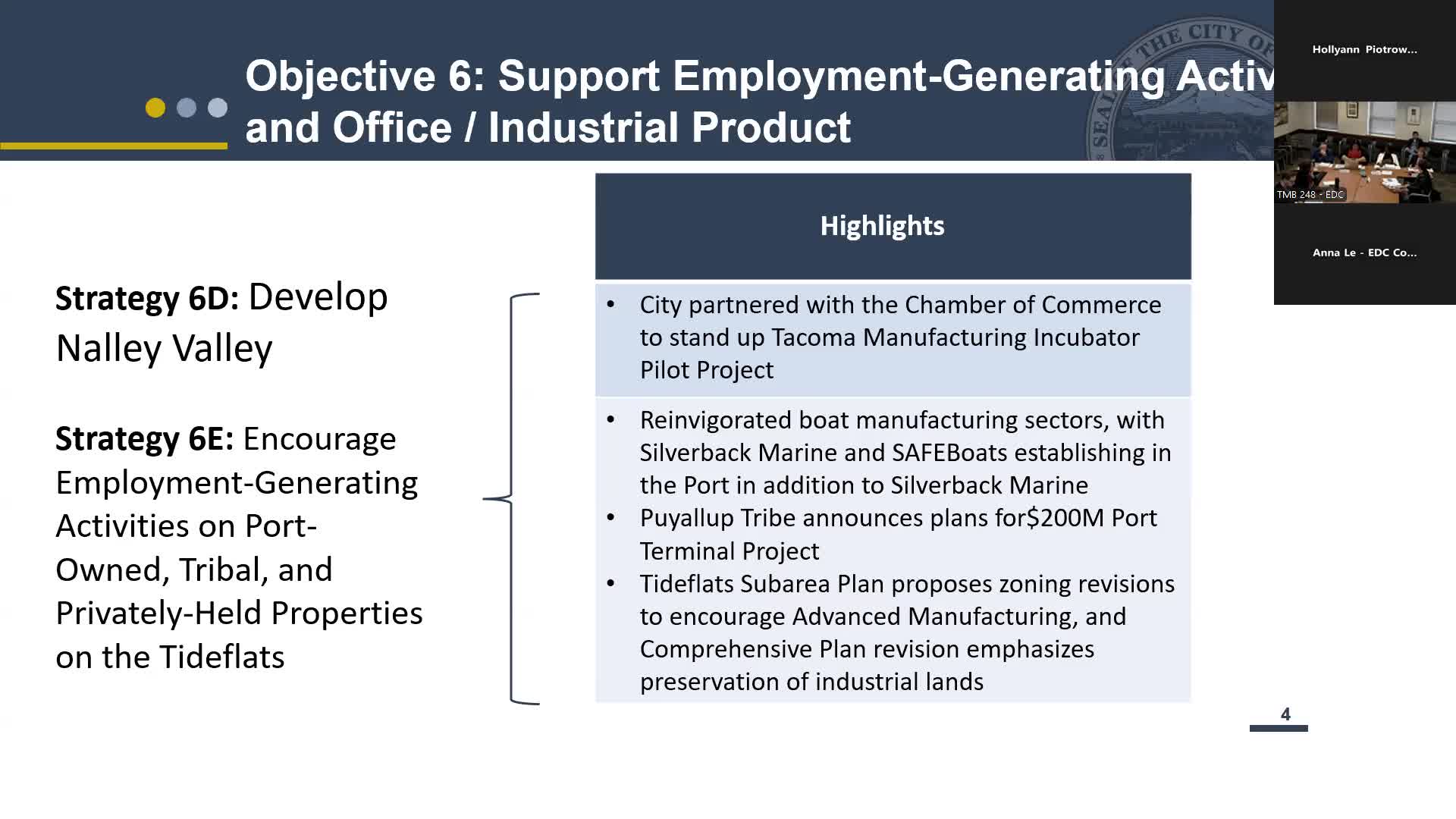
Paul Baker, also with Community and Economic Development, described work to maintain a property inventory and other tactics to help employers and developers find appropriate sites, including the Invest Pierce County site for searchable property listings. Baker summarized local industrial activity on the tideflats and Nalley Valley and said the city has supported a manufacturing incubator pilot in Nalley Valley. He reported recent manufacturing activity at the port area, saying, "we've seen a lot of success in terms of reinvigorating manufacturing there. The boat building sector, kind of lynchpins are silverback marine and, that should say Motive Power Marine, and then the return of safe boats a few years ago."
Committee members and staff discussed whether the plan's earlier emphasis on adding new class A office stock still made sense after the pandemic. Staff noted class definitions used locally (class A = newest/highest quality; class B = mid-market; class C = older stock) and cited vacancy trend data discussed at the meeting: downtown office vacancy rose from about 9.8% in 2018 to roughly 23.3% in Q3 2024. Several members urged a stronger emphasis on adaptive reuse, mixed-use conversions and preparing smaller, affordable commercial spaces for startups and nonprofits rather than prioritizing new large office construction.
The committee reviewed Strategy 6.d (Nalley Valley development) and Strategy 6.e (encouraging employment-generating activity on port-owned, tribal and private properties on the Tideflats). Staff said the Tideflats subarea plan identifies more than 106 actions, about 20 of which are specific to economic development, and that the plan is expected to go to council in late summer or early fall. Staff also mentioned a tribal announcement of an approximately $200,000,000 port project and emphasized coordination with port and tribal partners.
Members asked whether a 2019 state bill (HB 1746) intended to let cities implement targeted sales and property-tax incentives for office development remains usable. Staff said the law's current structure makes the incentive difficult to use in practice because local benefits are limited unless other jurisdictions join the tax waiver. Only one developer has recently asked about the incentive; staff recommended further research and possible legislative outreach to clarify or amend the law.
Discussion also covered workforce and housing opportunities tied to Joint Base Lewis-McChord (JBLM). Committee members suggested exploring federal support for housing and services that could benefit service members and military families and noted the potential for base-linked workforce and entrepreneur partnerships.
Several council members and staff supported a relationship-driven approach: building ongoing engagement with large property owners, brokers and developers; converting subarea plan visualizations into "sales tools" that help secure private investment; and embedding the city's green economic development strategy into the economic development plan. Staff and members emphasized permitting predictability, consistency and transparency as non-monetary incentives that could materially reduce developer risk.
No formal action was taken on revisions to the strategic plan during the meeting. The committee adopted a procedural motion to approve the minutes of the June 11, 2024 meeting before the presentations. Staff said the May 27 planning session is canceled and that the committee's final strategic-plan work session and a City Events and Recognition Committee interview session are scheduled for June 10.
Why this matters: committee members said aligning the city's strategy with UWT's master plan, the Tideflats subarea plan, and regional partners could accelerate job creation and better position city assets (downtown, Nalley Valley, the port) for public- and private-sector investment. The group signaled a policy shift toward reuse and industrial/manufacturing support while preserving tools to assist developers where appropriate.