Get Full Government Meeting Transcripts, Videos, & Alerts Forever!
Get email alerts on the Transportation topic
No spam. Unsubscribe anytime.
Minn. House approves $transportation omnibus after close votes on EV fee and greenhouse-gas rules
Summary
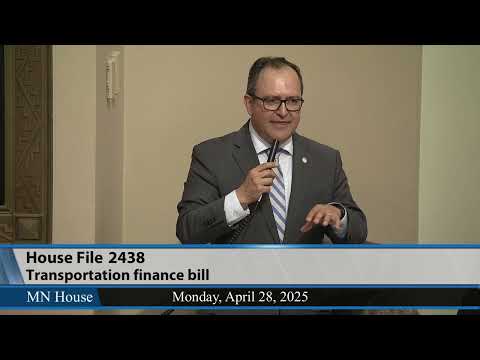
St. Paul — The Minnesota House passed its transportation omnibus, House File 2438, after several hours of debate and multiple floor amendments, approving the bill as amended by a final roll call of 85 yeas to 49 nays.
St. Paul — The Minnesota House passed its transportation omnibus, House File 2438, after several hours of debate and multiple floor amendments, approving the bill as amended by a final roll call of 85 yeas to 49 nays.
The bill funds roads, bridges and multiple transit programs while reallocating existing transportation money rather than adding new general-fund dollars, the bill’s author, Representative Dave Kosnick, said. “This transportation bill … makes our transportation system smarter, safer and more sustainable,” Kosnick said on the House floor while explaining the omnibus.
Supporters said the measure protects certain transit programs and directs money to projects across Greater Minnesota and the Twin Cities, including funding for the Duluth air traffic control tower and a large appropriation the bill’s backers said would support the Blatnik Bridge. Opponents repeatedly focused on two elements: a proposed surcharge increase for electric vehicles and a multi-year delay in implementation of the state’s greenhouse-gas/vehicle-miles-traveled (VMT) mitigation law passed in 2023.
Representative Igo’s colleagues, including Representative Cagle, emphasized local projects and continuity. “We did have to reduce the appropriation to Greater Minnesota transit, but we were able to come in under the governor’s recommendation,” Cagle said, listing local road, bridge and resilience investments included in the bill.
Amendments and close votes
- A31 (Hansen R.), Washington Avenue Bridge: The House adopted the A31 amendment to change the funding source and reduce the appropriation for the Washington Avenue bridge project in Hennepin County from $15 million to $9 million. Representative Rachel Hansen told colleagues a preliminary fiscal note showed a cost of $9 million and urged support; the amendment was adopted without a recorded roll call.
- A22 (Kraft), EV surcharge: Representative Kristin Kraft proposed reducing the proposed EV annual surcharge from $200 to $100, saying $200 would make Minnesota an outlier and arguing EV owners already contribute via higher up-front sales tax on the vehicle. That amendment failed on a roll call tie, 67-67.
- A26 (Kraft), greenhouse-gas/VMT implementation: Kraft later moved an amendment to remove a roughly three-and-a-half-year delay in the state's greenhouse-gas/VMT law. Kraft argued the law reduces congestion and saves lives by discouraging induced demand and that delaying it would forfeit benefits. The amendment was defeated on a 67-67 roll call.
- A38 (Jones), Greater Minnesota transit funding: Representative Jones offered an amendment to restore portions of Greater Minnesota transit funding that the bill reduced. Jones said rural transit provides dial-a-ride and other essential services and warned cuts would harm seniors and people who do not drive. The amendment failed on a roll call, 65-68.
Supporters and opponents voiced practical and fiscal concerns. Representative Kosnick said MnDOT and stakeholders needed additional time to finalize technical implementation questions about mitigation offsets and that the bill’s small change to the VMT implementation date would help. “It simply changes on line … strikes out 02/1927, and inserts 02/1928,” Kosnick said while explaining the statutory change in the draft language on the floor.
Representative Kraft and other proponents of immediacy argued the VMT mitigation framework is ready and called the delay politically and fiscally unwise. “What the data has shown over the years is that adding lanes doesn't reduce congestion,” Kraft said in floor remarks urging a vote to retain the program’s effective date.
What’s in the bill
Kosnick and co-sponsors described the package as a reprioritization of existing transportation revenues rather than new general-fund spending. The bill funds local road and bridge programs, an ongoing local road wetland replacement program, bus-rapid-transit and regional transit bond authority for the MET Council, resiliency pavement programs, and targeted projects across Greater Minnesota and the metro area. The bill also includes language changing the implementation date of the greenhouse-gas mitigation provisions enacted in 2023.
Opponents warned the VMT mitigation offsets could increase project costs substantially. Representative Kosnick noted testimony from MnDOT and local engineers that offsets could raise costs “between 5 to 30%,” with some witnesses estimating larger increases under certain scenarios. Proponents of the law said offsets and the VMT framework are designed to reduce future congestion and greenhouse gases and to encourage multimodal planning.
Final outcome and next steps
After rejecting several floor amendments, the House passed House File 2438 as amended. The bill will proceed to conference and additional negotiation with the Senate. The House clerk recorded the final passage as “There being 85 ayes and 49 nays. The bill is passed as amended and its title is agreed to.”
Members on both sides said they expect further work in conference committee on transit funding, greenhouse-gas implementation details, and local project eligibility.
Ending
Sponsors said the bill redirects funds to “ready-to-go” projects and aims to reduce pressure on the state’s bonding capacity; critics said it pauses an already-enacted climate planning tool and risks raising costs on major projects. The next step is conference committee negotiations with the Senate, where some contested provisions may be revised further.