Get Full Government Meeting Transcripts, Videos, & Alerts Forever!
Get email alerts on the Education Budget topic
No spam. Unsubscribe anytime.
PGCPS presents FY26 operating budget amid state aid changes; county council presses for clarity on fund balance and charter allocations
Summary
Prince George’s County Public Schools presented its FY2026 operating budget update to the County Council committee, noting higher state aid in updated figures, flat enrollment, substantial mandatory cost increases and uncertainty from expiring federal COVID grants.
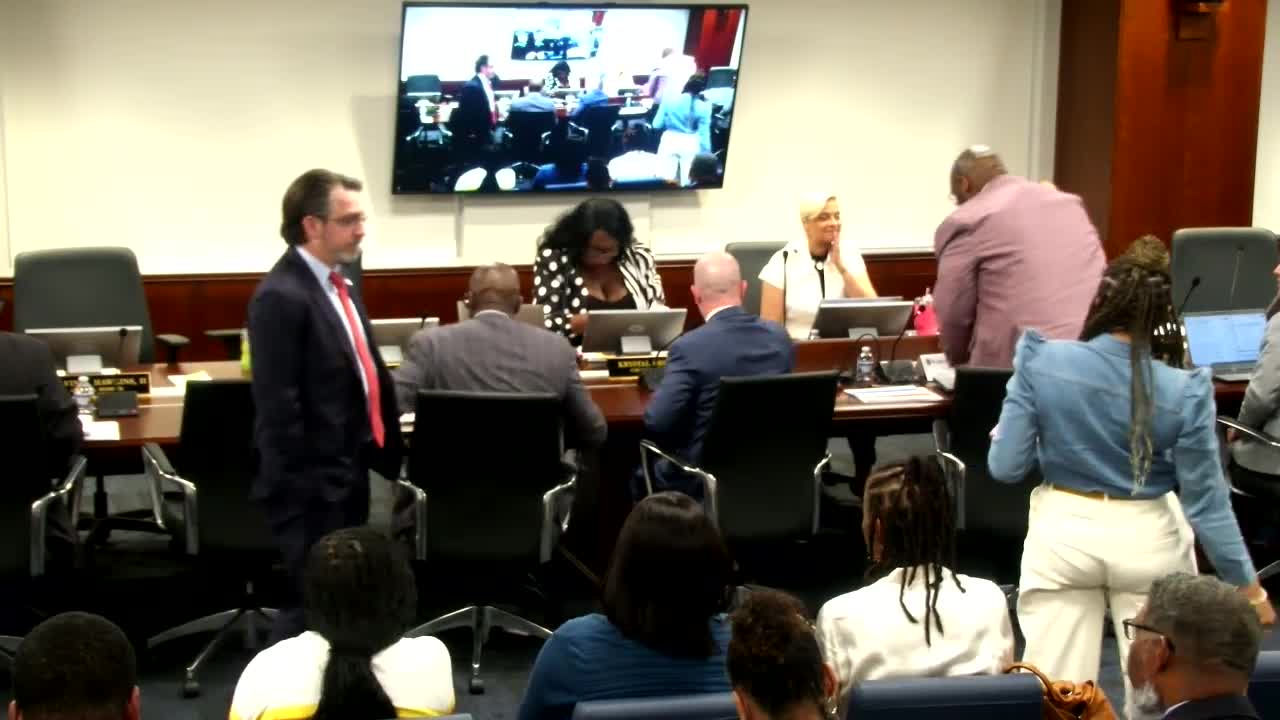
Prince George’s County Public Schools (PGCPS) officials presented the proposed FY2026 operating budget to the county council’s Education, Workforce and Development Committee and described a budget shaped by changes in state aid, flat overall enrollment and substantial uncertainty from expiring federal grants.
"We have to work collectively to to serve the students and and families of Prince George's County," Superintendent House told the committee, introducing finance staff and priority areas for next year.
Chief Financial Officer Lisa Howe outlined the high-level revenue picture and key expenditure drivers. She said the district’s requested unrestricted revenue had been updated after the governor released state aid numbers, producing a roughly $17 million higher state-aid line driven by a slightly larger count in multilingual learners and students with disabilities. Howe also stressed the largest year-over-year change is on the federal side — she said federal (COVID-era) relief grants are expiring and will reduce federal revenue in FY26 unless reimbursed or replaced. “The largest decrease or change that you see here is on the federal side, and that's primarily due to the expiration of our COVID relief grants,” Howe said.
Howe reported the district anticipates a FY2026 use of fund balance (drawdown) and described the existing fund balance as already committed in part to prior year purchase orders and the district’s multi-year stabilization strategy. She said PGCPS had used fund balance intentionally during the rollout of the Blueprint for Maryland’s Future and that while fund balance appears large on paper, unobligated reserves will be materially reduced if current plans and known obligations persist.
Howe and the superintendent walked through mandatory cost increases (compensation and benefit costs, an increased retirement admin fee, pension/other post-employment benefit obligations), one-time and recurring investments (ERP replacement year-one costs and digital-system transitions), and nonrecurring reductions (COVID grants). The office reported a remaining budget gap that reconciliation adjustments would continue to close and said the district was pursuing central reductions and revised assumptions to narrow a projected deficit.
The committee focused heavily on transparency and risk. Council members asked for a multi-year breakdown of fund balance sources and historic underspending by function. Councilmember Denoga asked for a multi-year report showing what line items historically contributed to fund balance growth; Howe agreed to provide a 3–4 year look and explained that salary lapse and vacancies historically account for a sizeable portion of year-end underspending.
Council members also questioned transportation and school capital spending, field renovations (Parkdale and Duval), and student-level outcomes that drive funding. Superintendent House and staff said Parkdale High School field work is complete and Duval’s field is playable while stadium and bleacher work remains scheduled as a multi-phase capital project; bleacher installation was described as expected in a later spring construction season.
A major portion of the hearing was the charter-school funding discussion. PGCPS staff described last year’s transition of charter funding from a legacy allocation to the Blueprint formula, the state-level process for standardizing charter allocations, and a State Board of Education ruling that rejected a flat 2% administrative withholding in favor of negotiated central-service agreements between LEAs and charter operators. PGCPS staff said they calculated that under the new approach seven of the county’s ten charter schools would have received less funding in 2025 relative to 2024 under the pure blueprint allocation; the district provided a one-year "hold harmless" subsidy in FY2025 to keep affected charters’ funding flat during the transition.
PGCPS said the district is now seeking to define and document mandatory central services (for which the district will continue to be responsible) and optional central services that charters may choose to buy back. Staff reported that under current preliminary calculations the average charter-share central services fee is about 6% (above the legacy 2%), that teacher retirement costs previously subsidized by the district are being accounted for at the school level, and that charter transportation allocations represent a roughly $400-per-student transportation component in FY2026 (excluding special education placements). PGCPS emphasized that special education costs (the district’s SPED overage) remain a material district-level expense and that the State Board ruling treats SPED overage funding as district-level obligations not to be assigned to school allocations.
Council members expressed concern about the effects on charter sustainability: several members said they had received constituent complaints that the new allocations and central-service charges threaten charter viability. Council member Olsen and others asked for a school-level, year-by-year accounting (per-pupil and total dollar figures) for each charter so the council could assess impacts and consider whether to fund transitional supports in the county budget. PGCPS agreed to supply those data and to continue working with charters in the state-led working group to negotiate central-service terms.
The hearing included a discussion of audit findings for PGCPS operations. Board and district leaders described steps to remediate Office of Legislative Audits findings: process revisions in transportation, updated payroll controls and electronic logging, enhanced vendor and route oversight, quarterly corrective-action monitoring and public posting of progress updates. The superintendent and board staff said divisions producing repeated findings were required to submit corrective plans, and that progress monitoring and public reporting would continue.
Ending: Committee members requested follow-up materials, including a school-level multi-year fund-balance origin report, per-school per-pupil historical allocations (including charters), details on the district’s planned ERP rollout costs, and a breakdown of placements and recapture assumptions for federal grants. PGCPS agreed to provide the requested data for the committee’s FY2026 reconciliation work.