Get Full Government Meeting Transcripts, Videos, & Alerts Forever!
Get email alerts on the Housing Policy topic
No spam. Unsubscribe anytime.
Commission reviews draft change to downtown "diverse housing" transfer rules; seeks council clarification
Summary
The Planning Commission received a public hearing April 23 on proposed ordinance 15‑46, which would prevent developments that receive city economic incentives from transferring excess "diverse housing" unit credits to other projects. Commissioners asked for clearer examples and expect council discussion before acting.
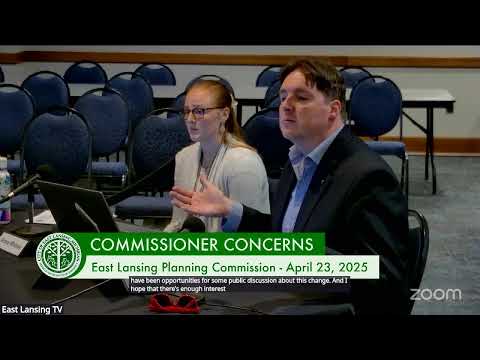
The East Lansing Planning Commission held a public hearing April 23 on proposed ordinance 15‑46, an amendment to section 50‑94 of the zoning ordinance that would change how "diverse housing" unit credits may be transferred among downtown projects.
Planning staff explained that the city's existing downtown (B‑3) diverse housing requirement generally requires at least 25 percent of units in qualifying multi‑family projects to meet certain housing types—owner‑occupied 55+ units, income‑restricted units or other unit types approved to add housing diversity. The current code allows a project that exceeds the 25 percent requirement to transfer its excess credits to another downtown development. The proposed amendment would prohibit such transfers for any development "constructed and occupied in excess of the 25% requirement ... with the granting of any economic development benefits by the city, including but not limited to payment in lieu of taxes or other tax abatement."
Planning staff framed the amendment as a narrow change to prevent projects that receive city incentives from transferring away the housing diversity that those incentives helped create. "The proposed amendment ... would change this requirement, but only by saying ... if this development is receiving public financing or public incentives, that project can no longer transfer its credits away," staff said.
Commissioners asked for a clearer statement of the problem the amendment intends to solve and sought examples. Staff cited the historical example often referenced in city files: the pair of downtown projects Newman Lofts and Landmark, where one development provided senior units and the other accommodated more student housing, and credits were transferred historically. Commissioners raised concerns that the draft language could unintentionally impede the delivery of diverse housing by making transfers legally impossible in some financing arrangements, and suggested that contractual conditions of approval or sequencing requirements (for example, building the affordable component before market units) might address the risk without changing the ordinance.
Several commissioners said they expected Council Member Meadows—the sponsor of the amendment—to explain his intent at a future meeting and preferred further clarification before the commission acts. Staff noted Council Member Meadows could not attend April 23 because of a concurrent council meeting and anticipated he would appear at the May 14 Planning Commission meeting to discuss the change.
No members of the public spoke during the hearing. The commission closed the public hearing and left the ordinance on the agenda for additional discussion and possible action at a later meeting after receiving clarifying information and examples from council or staff.