Get Full Government Meeting Transcripts, Videos, & Alerts Forever!
Get email alerts on the Workplace Safety Heat topic
No spam. Unsubscribe anytime.
Committee advances bill to create rebuttable presumption for heat‑related farmworker injuries
Summary
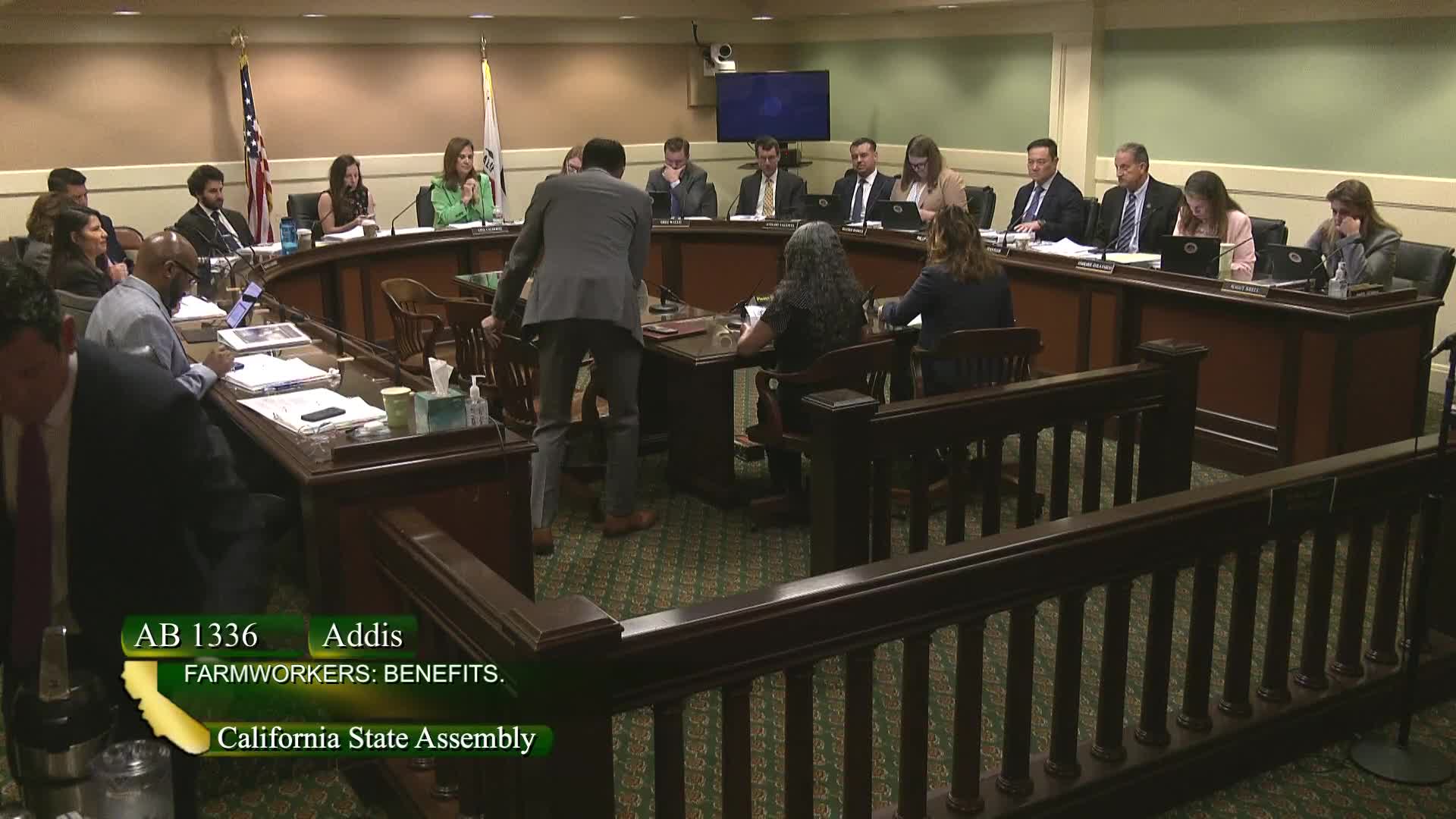
AB 13 36 would create a rebuttable presumption that a heat‑related injury arose out of employment when an agricultural employer failed to comply with California heat‑illness prevention standards; the committee passed the bill to Appropriations amid divided votes and vocal support from labor groups.
Assemblymember Queta L. Addis’s AB 13 36 was passed to the Committee on Appropriations after supporters described heat illness among farmworkers as a growing public‑health and workplace safety problem worsened by climate change.
The bill creates a rebuttable presumption in the workers' compensation system: if a farmworker suffers a heat‑related illness and shows the employer failed to comply with required heat‑illness prevention regulations, the injury is presumed to have arisen out of employment unless the employer rebuts that presumption. Supporters said the presumption would encourage employer compliance with existing Cal/OSHA standards (access to drinking water, shade, and preventative cool‑down rest breaks) and help workers obtain benefits more quickly in cases where causation is medically difficult to prove.
United Farm Workers President Teresa Romero testified in support, as did labor and community groups. Assemblymember Addis and witnesses cited specific heat records—King City’s 116°F and Napa’s 114°F in 2022—and Department of Public Health data that occupational heat‑related illness rates climbed in recent years. Witnesses also pointed to Cal/OSHA inspection findings: among more than 4,000 inspections, roughly 47% had compliance issues, and farmworker heat‑related suspected and confirmed deaths rose about 130% between 2018 and 2019, according to testimony.
Opponents including the California Coalition on Workers' Compensation, the American Property Casualty Insurance Association and Western Growers argued the measure improperly uses workers' compensation law to enforce Cal/OSHA standards and raised questions about which body would make timeliness and causation determinations. Jason Schmelzer said the bill lacks detail about adjudication and timing and cautioned about statutory deadlines for presumptions.
The committee passed the bill to Appropriations. The hearing log later records the final vote as 12 in favor and 4 opposed (with not‑voting members noted), reflecting the divided views on using workers' compensation presumptions to drive compliance.