Get Full Government Meeting Transcripts, Videos, & Alerts Forever!
Get email alerts on the Health Data Privacy topic
No spam. Unsubscribe anytime.
Assembly committee advances bill to shield health data and expand protections for gender‑affirming care
Summary
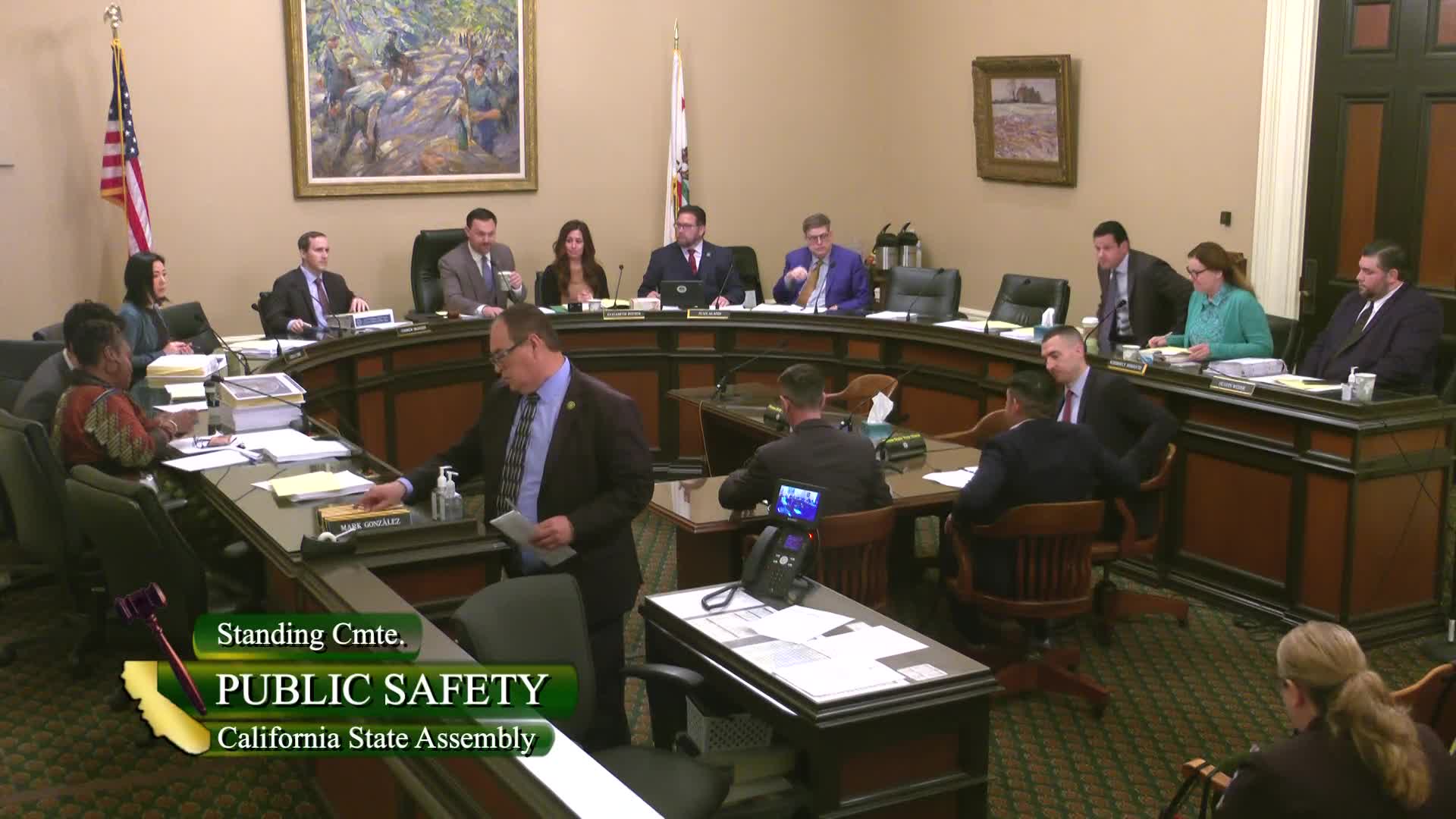
The Assembly Public Safety Committee on Thursday advanced Assembly Bill 82, a measure that backers say is intended to protect patients, families and health professionals who access or provide gender‑affirming and other legally permitted health services. The committee recommended the bill be passed to the Judiciary Committee.
The Assembly Public Safety Committee on Thursday advanced Assembly Bill 82, a measure that backers say is intended to protect patients, families and health professionals who access or provide gender‑affirming and other legally permitted health services. The committee recommended the bill be passed to the Judiciary Committee.
AB 82, authored by Assemblymember Alex Ward, would prohibit reporting certain prescriptions to California's prescription drug monitoring program (CURES), extend parts of the state's Safe at Home program to health professionals who provide gender‑affirming care, expand protections to reduce criminal exposure for families ensuring access to such care, and broaden state anti‑doxing and confidentiality protections to cover both patients and providers of gender‑affirming services.
Supporters told the committee the changes respond to a coordinated national effort to use health‑system data and public records to target patients and providers. "This bill will help protect families like mine by making sure information about personal health care is protected," said Renee Bayardo, a parent and alliance board member who testified as a cosponsor. "Medical decisions like the ones contemplated in this bill are private matters that should be kept in confidence between children, parents, and their physician." Craig Pulsipher of Equality California, also a cosponsor, said rising harassment and threats have prompted providers to remove personal information from the internet or to consider stopping care: "AB 82 is an important step forward to build on existing protections for reproductive health care and protect transgender patients, their families, and those who care for them."
The bill would specifically bar reporting of testosterone and mifepristone/mifeprostone prescriptions to CURES, California's prescription drug monitoring program, and would prohibit certain cross‑state sharing of that prescription data for tracking purposes. Ward said the intention is to stop "hostile out‑of‑state actors" from using prescription databases to target patients and caregivers.
Opponents urged the committee to reject or substantially rewrite the measure, offering a range of constitutional and public‑safety concerns. Meg Madden Raider, representing an advocacy group listed in the hearing, said AB 82 could create a process enabling fraud and harm, and warned it would make controlled‑substance monitoring useless for an entire category of prescriptions. "This bill creates a dangerous shadow system," she said, asserting it would "effectively conceal" individuals from parents or authorities in custody disputes and hamper accountability for medical care.
Committee members pressed both sides on details including how the measure interacts with existing protections for reproductive care and whether the proposed safe‑at‑home expansion would require additional implementation resources. Ward said the bill is targeted at privacy and public‑safety risks created by hostile actors using health data to intimidate or harass patients and providers. "No one's private health data should be tracked and shared for others to target them," he said in closing, and asked for the committee's "aye" vote.
After public testimony from a mix of organizational supporters and opposition speakers, the committee voted to pass AB 82 to the Judiciary Committee. The official roll call in the hearing transcript records multiple "aye" votes; the committee chair recorded the measure as "passed to the Judiciary Committee." The bill will receive further analysis and possible amendment in the next committee.
The text of AB 82, as presented at the hearing, lists five primary protections: (1) a prohibition on reporting testosterone and mifepristone to CURES; (2) extending Safe at Home eligibility to health professionals providing gender‑affirming care; (3) protections intended to mitigate criminalization of families seeking care for loved ones; (4) expansion of the FACE Act's anti‑doxing protections to include providers and patients of gender‑affirming services; and (5) expanded confidentiality protections for exchange of health information related to gender‑affirming care.
The bill drew cosponsors including Equality California, Planned Parenthood Affiliates of California and the Alliance for Trans Youth Rights. Opponents included groups and individuals who raised constitutional and implementation questions; the hearing record shows both testimonial support and sharp opposition during public comment.
Next steps: AB 82 will be scheduled for Judiciary Committee consideration. If it advances, the committee analysis and any amendments will clarify implementation details such as how the bill interacts with CURES reporting rules, limits of the Safe at Home expansion, and judicial or administrative processes for enforcing confidentiality and anti‑doxing provisions. The bill's authors and cosponsors told the committee they are prepared to work through those implementation details in subsequent hearings.