Get Full Government Meeting Transcripts, Videos, & Alerts Forever!
Get email alerts on the Privacy Surveillance Law topic
No spam. Unsubscribe anytime.
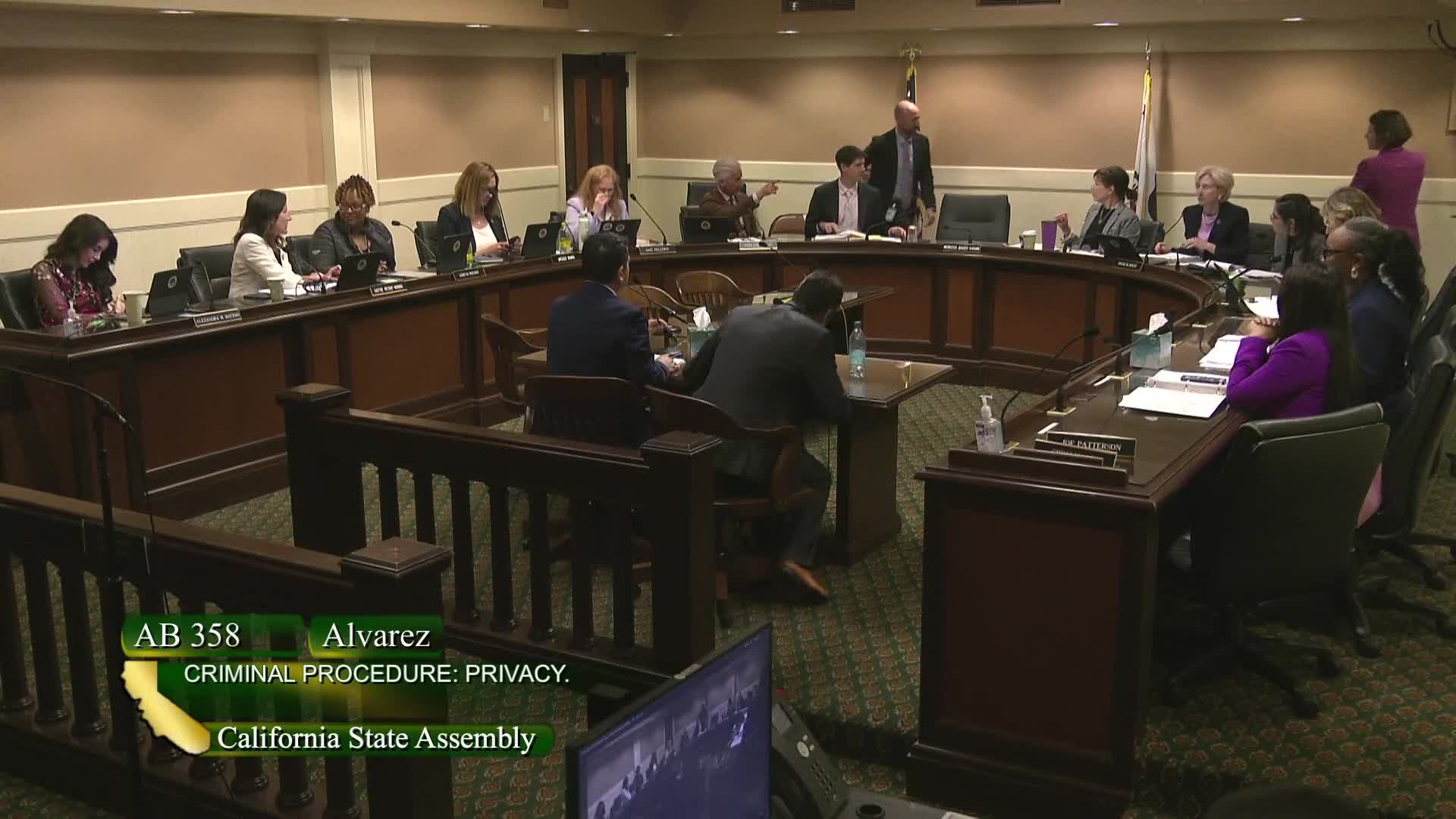
Committee advances AB 358 to let survivors consent to on‑site searches of spying devices, prosecutors and civil‑liberty groups clash
Summary
AB 358, an amendment to California’s electronic‑privacy law to let victims consent to immediate inspection of tracking or spy devices found in their homes or belongings, passed to the Appropriations Committee after debate over Fourth Amendment and oversight safeguards.
Assemblymember Alvarez’s AB 358 would narrow a statutory restriction in the California Electronic Communications Privacy Act (CalECPA) to permit law enforcement to access tracking or surveillance devices left in a victim’s private space when the victim consents. Sponsors said the change is narrowly tailored to devices whose sole purpose is surveillance, excluding general‑purpose phones or laptops, and intended to empower survivors and speed investigations.
Joel Madero, a San Diego deputy district attorney who runs a high‑tech investigative unit, told the committee that in a stalking case investigators were blocked by warrant rules and that the delay to secure a warrant hindered evidence collection. “Obtaining a warrant can create a delay that gives perpetrators time to hide their tracks and continue to cause harm,” he said, explaining the bill’s rationale.
Opponents, including the Electronic Frontier Foundation and the ACLU of Northern California, argued the bill creates an unnecessary loophole that would weaken CalECPA’s warrant protections and remove retroactive judicial oversight. Becca Kramer Mauder of EFF said the statute’s existing exigent‑circumstances exception already allows warrantless access in emergencies and that AB 358 would permit law enforcement to circumvent warrant requirements in non‑emergency settings. ACLU staff attorney Jake Snow warned that Faraday bags and established investigative techniques already mitigate remote‑wipe risks and argued that judges should determine whether a device is subject to a search.
Several committee members balanced privacy concerns against survivor safety. One member said practitioners report that obtaining a warrant can take “hours to days,” during which devices or cloud evidence could be lost; another stressed the constitutional role of warrants and public records to ensure accountability. The author said the bill was amended to narrow scope to devices intended only for surveillance and reiterated that the change would apply only when a victim consents.
The committee voted to send AB 358 to Appropriations. The committee record shows the motion carried with recorded ayes and the roll left open for absent members.