Get Full Government Meeting Transcripts, Videos, & Alerts Forever!
Get email alerts on the Youth Mental Health Social Media topic
No spam. Unsubscribe anytime.
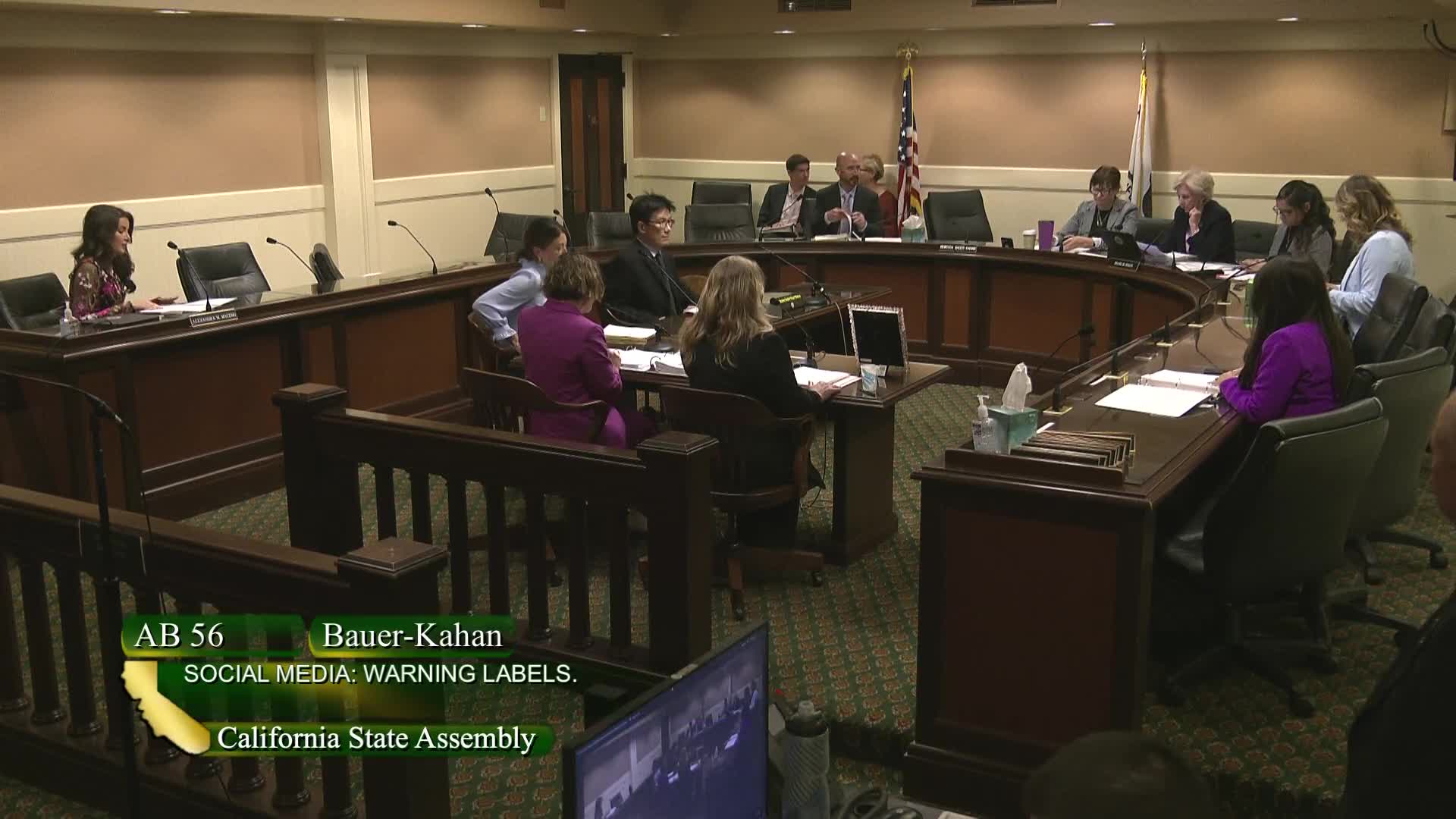
Assembly committee advances AB 56 after emotional testimony calling for social‑media warnings for youth
Summary
After testimony from parents and mental‑health experts, a California Assembly committee voted to send AB 56 — a bill requiring evidence‑based warning labels on social‑media platforms and a Department of Public Health update authority — to the Judiciary Committee.
Assemblymember Bauer Kehan’s AB 56, which would require conspicuous, science‑based warning language on social‑media apps to inform users — especially minors — about possible mental‑health risks from extended use, advanced from a California Assembly committee after public and expert testimony.
The bill’s author told the committee she accepted committee amendments that shortened the initial blocking duration of the warning, allowed easier access to platforms in emergencies and authorized the Department of Public Health to update the label as scientific evidence evolves. “We want to make sure we’re always using the best possible science here in California,” the author said.
The bill drew emotional testimony from parents. Victoria Hinks told the committee that her 16‑year‑old daughter, Alexandra, died by suicide and that social media “pulled her into a dark spiral” by exposing her to content about self‑harm and eating disorders. “There’s not a bone in my body that doubts social media played a major role in her death,” Hinks said, urging members to “vote like a mom” and support AB 56.
Mental‑health witnesses described mechanisms by which repeated exposure to social‑media stressors can change developing brains and contribute to anxiety and depression. Tessa Pickard, a licensed clinical social worker with Common Sense Media, said prolonged, repetitive social‑stress on youth “can do lasting harm” and urged the committee to adopt policies that help families make informed choices.
Industry representatives, speaking in respectful opposition, argued the bill would not meaningfully reduce harms and raised constitutional concerns about compelled speech and access burdens. Dylan Hoffman of TechNet said short “skippable” warnings could be ignored and that warnings risked creating “an annoyance and burden to users of all ages.” A representative of the Computer & Communications Industry Association raised similar concerns about operational burdens, potential impacts on smaller services and First Amendment risk.
Committee members asked about emergency access, multilingual labels and whether the warning would disproportionately affect adults as well as youth. The author said the initial‑use language had been changed in amendments to avoid blocking emergency access and that she would explore multilingual versions.
The committee voted to pass AB 56 to the Judiciary Committee. The roll call recorded 9 ayes and no nos on the motion, with several members recorded as not voting; the chair kept the roll open for absent members.