Get Full Government Meeting Transcripts, Videos, & Alerts Forever!
Get email alerts on the Water Rates topic
No spam. Unsubscribe anytime.
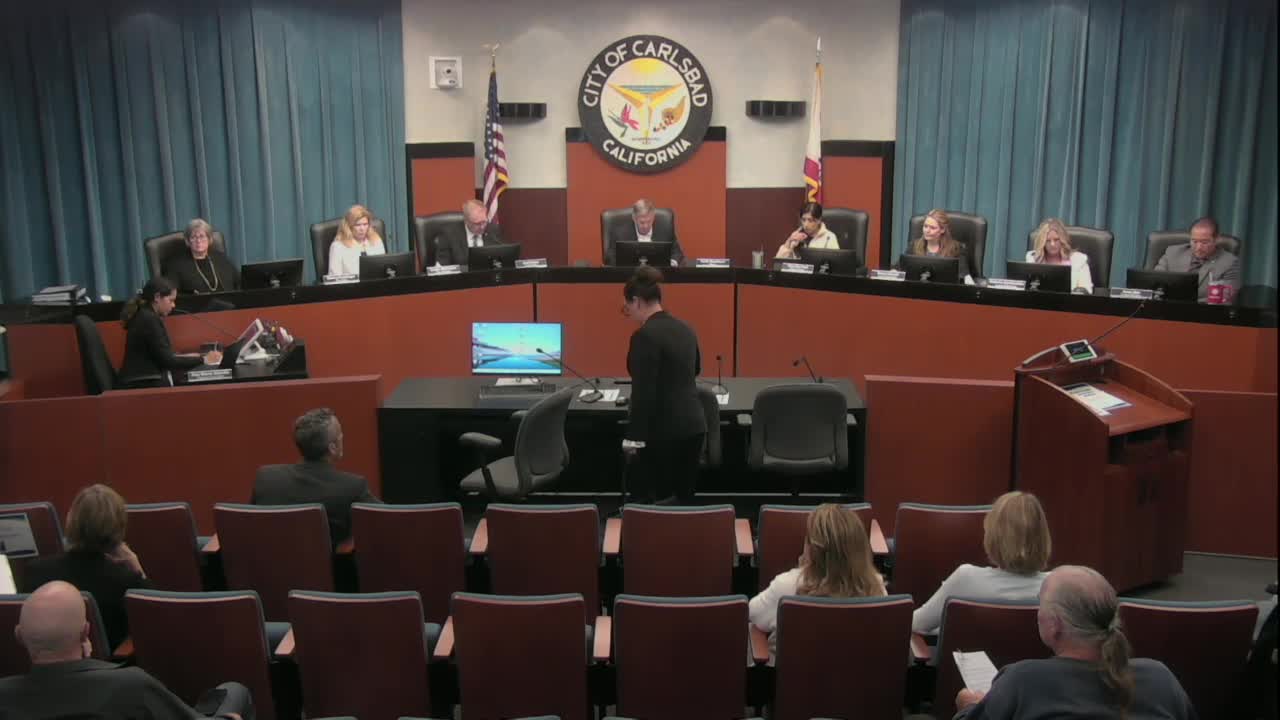
Carlsbad council approves three-year water, recycled and wastewater rate increases after public hearing
Summary
The Carlsbad City Council, acting as the Carlsbad Municipal Water District board, voted 4-1 to adopt three-year increases to potable water, recycled water and wastewater rates after a public hearing and a tabulation of written protests required by Proposition 218.
The Carlsbad City Council, acting also as the Carlsbad Municipal Water District (CMWD) board, approved a package of three-year rate increases for potable water, recycled water and wastewater services after a public hearing and a tally of written protests. The council voted 4-1 to adopt the resolutions; Council Member Burkholder voted no.
The increases, if implemented as proposed, would be phased over three steps beginning July 2025, raising the combined average single-family customer bill by about 49 percent by January 2027, from roughly $125 a month to about $187 a month, staff said. Utilities Director Amanda Flessy and Senior Management Analyst Shoshana Aguilar presented the proposal and the Prop 218 protest process.
Why it matters: The rate package is intended to fund ongoing operations, maintenance and capital investments for three separate systems (potable, recycled and wastewater) while reflecting substantial wholesale cost increases, notably a large pass-through share that the San Diego County Water Authority charges member agencies.
The city attorney opened the hearing by summarizing the legal requirements. “This public hearing is being held in compliance with the procedural requirements for adopting new or increased water and wastewater rates,” the city attorney said, referring to Article XIII D, Section 6 of the California Constitution (Proposition 218).
Shoshana Aguilar told the council the most common single-family customer uses about 11 units of water per month; under the proposed schedule the potable portion for that average home would rise by roughly $17 in July 2025 and then in subsequent steps to reach about $110 a month for potable water by 2027. Aguilar said about 35 percent of a typical bill covers internal city costs and 65 percent pays for water the City buys from the San Diego County Water Authority; she told the council that desalinated seawater is the county’s most expensive supply.
Public comment was substantial. Speakers included residents, retirees, engineers, and business owners who both opposed and supported the increases. Engineer Michael Drennan, who identified himself as a director of water resources at a local engineering firm and an American Society of Civil Engineers member, said he supported the staff recommendation to invest in infrastructure: “...I support the recommended rate increases that is needed to protect and continue to invest in the water and wastewater infrastructure here in Carlsbad,” he said. Other speakers — including Roseanne Bentley, Tom Rudin and Ted Carr — said the increases would be harmful to residents on fixed incomes and to small businesses.
Staff reported outreach extending beyond the minimum required by law: the city mailed notices to all 30,000 customer accounts, ran webinars for commercial accounts, presented to the Carlsbad Chamber of Commerce, and directly contacted the largest customers. The city clerk reported the written-protest tabulation: of 30,519 CMWD accounts subject to the proposed water increases, staff received 102 written protests (not a majority); of 24,140 parcels subject to the wastewater increases, staff received 61 written protests (not a majority). Because the protest counts did not reach a majority, the council could proceed to vote.
Council discussion emphasized the difficulty of timing amid inflationary pressures and the legal limits of rate design under Proposition 218. Council members asked staff about the cost-of-service study, the role of the San Diego County Water Authority in driving costs, the desalination plant's ownership and expenses, and customer-assistance programs. Staff said the CMWD does not own the Carlsbad Desalination Plant; the Water Authority and member agencies purchase its output. Staff also described customer programs (rebates, water-use audits, payment plans and a residential shutoff protection policy).
The council approved the rate resolutions by a 4-1 vote with Council Member Burkholder dissenting. The city clerk certified that there was not a majority protest for either the water or wastewater measures.
Ending: The rate increases take effect if implemented on the schedule adopted by the council; the city noted additional customer resources (billing assistance and conservation rebates) and that the new structure includes a pass-through mechanism so changes adopted by the Water Authority will be reflected in the Water Authority portion of Carlsbad bills. Staff said the increases were designed to fund both day-to-day operations and capital projects to avoid more costly emergency repairs in the future.