Get Full Government Meeting Transcripts, Videos, & Alerts Forever!
Get email alerts on the Education Middleschool Performance topic
No spam. Unsubscribe anytime.
Uniontown Middle leaders report midyear gains in reading, vocabulary and math interventions
Summary
Uniontown Middle School administrators told the Arlington Central School District board that midyear assessments show improved placement for many students after schedule and instructional changes focused on cross-curricular standards, targeted AIS regrouping and weekly PLC time.
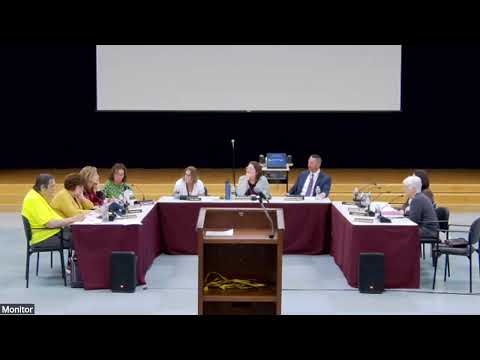
Uniontown Middle School leaders told the Arlington Central School District Board of Education on May 1 that midyear assessment data indicate more students have improved placement in reading and vocabulary, and that math foundational work shows positive early gains.
The presentation by Dr. Lisa Rolison, who introduced building changes and midyear results, focused on two instructional priorities: leveraging overlapping standards across content areas and reorganizing intervention time to give students more frequent, targeted support. "We start every faculty meeting with a review of our mission statement and the core values," Rolison said, describing a schoolwide effort to align adult practice with district priorities.
Board members were given the context for the goals: the school set three I-Ready academic goals measured by "improved placement" — meaning movement to a higher proficiency band, not merely year-to-year growth. Rolison said the school hoped a bit more than half of students below grade level would close a band by year end; midyear results showed 75% of targeted vocabulary students and 61% of students targeted for informational text met the midyear improved-placement benchmark. Math, she said, is harder to judge midyear because of curriculum sequencing, but 61% of below-grade-level math students already showed improved placement at midyear.
Rolison described program changes that she and staff credit for the results: training non-ELA teachers in vocabulary strategies (roots, Frayer models), a new AIS grouping model in sixth grade that pools students and regroups them every several weeks using common assessment data, and protected weekly PLC time for teachers to write assessments and analyze results. "We started thinking about the ways that we can focus on some of the ELA standards in the other non-ELA classes," Rolison said. She added that this year the school had higher state-test participation (94% on the ELA assessment taken before the break), which she said will make summer comparisons to I-Ready projected proficiency more informative.
Rolison also discussed student engagement and community connections: clubs that run food drives, service projects with local nonprofits, and student-led events that pair middle and elementary students. Board members asked whether the gains were uniform across students; Rolison said the most intensive interventions produced the largest gains for students who began multiple grade levels behind and that the reorganized AIS schedule for sixth graders was showing “significant growth." School staff and board members asked about pandemic-era impacts and noted progress in readiness for the next level.
The presentation closed with Rolison thanking building staff and the central office for support; she said final end-of-year data and state results will be available over the summer, and the school will compare those to I-Ready projected proficiencies.
Looking ahead, Rolison said the school will continue to refine interventions and use the midyear evidence to target supports in the second half of the year.