Get Full Government Meeting Transcripts, Videos, & Alerts Forever!
Get email alerts on the Search Warrants Cellphones topic
No spam. Unsubscribe anytime.
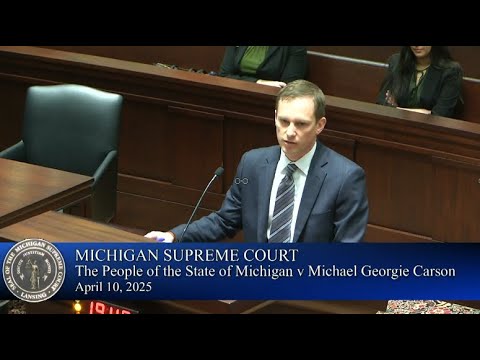
Michigan Supreme Court hears challenge to cellphone search warrant in People v. Carson
Summary
The Michigan Supreme Court heard oral argument in People v. Michael Carson about whether a warrant to image and search a cellphone met the Fourth Amendment's particularity requirement and whether parts of the warrant could be severed or saved by the good-faith exception.
The Michigan Supreme Court heard argument on a challenge to a warrant that allowed forensic imaging and searching of a cellphone in People of the State of Michigan v. Michael Carson, a case the court placed on its April calendar.
At issue was whether the warrant's description of "any and all data" and the absence of a temporal limitation rendered the warrant a constitutionally impermissible general warrant, and whether any overbreadth could be severed or excused by the good-faith exception.
The question matters because modern smartphones can contain a broad range of private information and because U.S. Supreme Court precedent has sharply limited warrantless searches of phones since Riley v. California. If the court finds the warrant insufficiently particular, it could require Michigan magistrates to adopt tighter drafting or rules for searching digital devices.
Assistant Solicitor General Chris Allen, arguing on behalf of the People, told the court that federal and state law provide "guardrails" that limit what examiners may review. "This warrant checks each of those boxes," Allen said, arguing the warrant identified the place to be searched, the types of evidence sought and the crimes to which that evidence must relate. Allen emphasized People v. Hughes as a state precedent that, in his view, constrains law enforcement from conducting unfettered searches across a phone's entire history.
Allen acknowledged technological concerns but argued they do not make the warrant unconstitutional. He said certain kinds of data'for example, password-protected third-party apps and information stored in remote cloud accounts'would typically be inaccessible from the phone image and would require separate process directed at third parties. Allen also told the court that severance of an overbroad warrant would require reversal in this case, and that other doctrines such as good faith and ineffective-assistance claims favored the State but need not be reached.
Jay Nicholas Bostick, counsel for Michael Carson, argued the search warrant lacked the heightened particularity that is necessary when searching electronic devices. "It should have a time limitation," Bostick told the court, calling temporal limits especially important because cellphone data can persist across device upgrades and migrations. Bostick pointed the court to the trial record, including a CellBright extraction he said produced roughly 1,000 pages of material and argued the report "by strong inference from the record, included the entire phone."
Bostick urged that paragraph structure in the warrant made the entire property clause so expansive that there was only "one category" of data sought and therefore nothing left that could be severed to save the warrant. He further argued that features of the warrant'including references to physical objects that cannot exist on a phone and the absence of a time limit'undercut a claim that an officer reasonably relied on the warrant in good faith.
Amicus counsel also pressed the court to recognize the risks of permitting broad phone searches. "The warrant at issue here is a general warrant as that term would have been understood at the founding," counsel Michael Sherry told the court, urging the justices to adopt a robust rule protecting digital privacy consistent with Stanford, Riley and Carpenter.
A separate amicus speaker with technology experience asked the court to consider practical drafting approaches that could reduce after-the-fact litigation, such as requiring magistrates to record limiting language in warrants or requiring officers to return to the court when investigations implicate exceptional issues (for example, encrypted apps or privileged material). That speaker also emphasized the difficulty of predicting what types of data will be relevant before examiners view a seized phone.
Several justices pressed counsel on remedies and doctrine. One justice asked what the court should do if it disagreed with the State's reading and concluded the warrant was defective: whether the proper inquiry would then be ineffective-assistance claims, severance, or the good-faith exception. The defense and amici argued the warrant's facial problems made good faith less likely to apply; the State urged restraint, citing precedent where broad warrants were upheld when read in context.
Counsel on both sides and amici cited a range of authorities during argument, including People v. Hughes (Michigan), Riley v. California (U.S. Supreme Court), Carpenter v. United States, Stanford v. Texas, Anderson v. Maryland, and other decisions the parties said shaped the particularity and nexus inquiries for digital searches. Counsel also debated the proper role of magistrates in supervising digital investigations'whether requiring search terms, temporal limits, or categories of files would improperly insert magistrates into the investigative process.
The justices took the case under submission after argument. The court did not announce a decision at the session; the clerk submitted the case and adjourned the April call.
The proceedings focused exclusively on the warrant issue; there were no votes or orders issued at the hearing. The court will issue a written opinion resolving the legal questions argued.