Get Full Government Meeting Transcripts, Videos, & Alerts Forever!
Get email alerts on the Ostensible Agency Hospital Liability topic
No spam. Unsubscribe anytime.
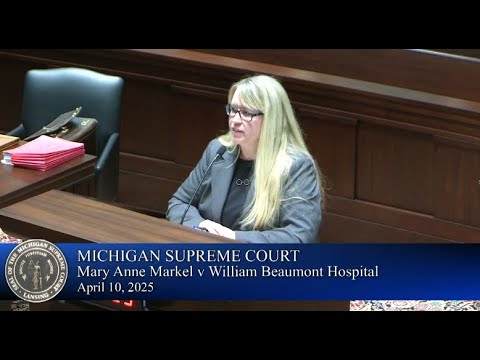
High court hears argument in Markle v. William Beaumont Hospital over ostensible-agency standard for hospitals
Summary
The State Supreme Court heard oral argument in Markle v. William Beaumont Hospital on an appeal over whether hospitals can be held liable under an ostensible-agency theory when physicians treating patients are independent contractors.
The State Supreme Court heard oral argument in Markle v. William Beaumont Hospital on an appeal over whether hospitals can be held liable under an ostensible-agency theory when physicians treating patients are independent contractors.
Mark Granzato, counsel for the plaintiff-appellant, told the court the Court of Appeals improperly recharacterized the claim and “was thumbing its nose at the decision of this court,” arguing the appeals court treated the dispute as “agency by estoppel” and added a requirement that a patient relied on a representation made by the hospital. Granzato said the court’s earlier precedents applying ostensible agency—he said he counted 11 such decisions—do not require an affirmative representation by the hospital in all circumstances.
The question at the center of argument was whether ostensible agency in a hospital setting requires a representation by the hospital that a treating physician is its agent, or whether a reasonable belief in a physician’s authority created by the hospital’s structure and practices can suffice. Granzato summarized the ostensible-agency principle as: “the plaintiff can hold the employer to the appearances he has created.” He urged the court to apply the same ostensible-agency standard to hospitals that it has applied in other contexts.
Jackie Klein, counsel for Beaumont, responded that hospitals seek equal treatment under the law, not special rules, and that the ordinary rule—that principals are not liable for independent contractors—applies unless the plaintiff shows the exception. Klein argued the case’s facts differ from emergency-room scenarios this court has previously found dispositive; here, she said, the patient had an ongoing relationship with a surgeon who was affiliated with a physician group, and Beaumont did not assign the doctor to treat the plaintiff. Klein told the court the record does not allege the plaintiff relied on Beaumont to provide the treating physician.
Justices questioned both sides about the scope of prior decisions the parties invoked and about how a hospital could practically “disabuse” a patient of an apparent agency when the patient is incapacitated or otherwise cannot receive affirmative notice. A justice asked, “What would satisfy a hospital who is trying to make it clear these folks are not our agents?” Granzato suggested possible forms or postings but emphasized that prior rulings decline to require an affirmative representation in all situations.
Counsel and the court discussed whether earlier precedent (referred to repeatedly in argument as Gru and other cases) treats the third element of ostensible agency—the plaintiff’s belief—as a kind of reliance on the agent’s authority rather than reliance on an express representation by the principal. Klein and opposing counsel disputed whether the Court of Appeals properly read the Supreme Court’s prior order in Markle and earlier precedent to require some showing of reliance, with Klein arguing reliance has long been part of the analysis and Granzato contending the reliance is on the agent’s authority, not on a principal’s explicit representation.
The parties also referenced drafts and restatements of agency law. Granzato pointed to a tentative draft of a Restatement addressing apparent authority in medical-malpractice contexts and to other restatement provisions he said support his position.
After questioning, the presiding justice announced the argument concluded and said the case would be submitted for decision.
The oral argument focused on legal standards and precedent rather than new factual development; no decision was rendered at argument.