Get Full Government Meeting Transcripts, Videos, & Alerts Forever!
Get email alerts on the Coastal Hazard Regulations topic
No spam. Unsubscribe anytime.
Monterey County presents strict draft coastal-hazard rules for Moss Landing; public comments due April 30
Summary
County staff outlined draft coastal implementation regulations tied to the Moss Landing Community Plan, including required coastal-hazard reports, limits on shoreline armoring and recorded deed restrictions; staff said the rules are strict to meet Coastal Commission standards and invited written comments by April 30.
Monterey County staff on a public meeting in Moss Landing presented a draft set of coastal-hazard regulations intended to implement the Moss Landing Community Plan and to meet certification by the California Coastal Commission. County assistant planner Katie Scarry said the draft regulations and slides are available to the public and "all public comment for the draft climate hazard policies are due by the end of the month, which will be April 30." She provided contact information for comments and for staff follow-up, including management specialist Mike Novo’s phone (831-755-5172) and email (novomcountyofmonterey dot gov).
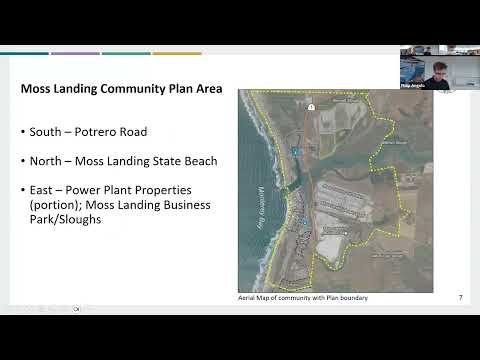
The presentation, led by senior planner Phil Angelo and management specialist Mike Novo, summarized where the new rules would apply, what kinds of projects would trigger a required coastal-hazard report, and two tiers of technical submittals: a full coastal-hazard report prepared by a qualified engineering geologist or coastal geotechnical engineer, and a shorter screening memorandum for lower-risk properties. Angelo noted the Moss Landing Community Plan originally was adopted in 1982 as a chapter of the North County Land Use Plan and said the draft plan policies focus on locating and designing development "to the maximum extent feasible" to avoid coastal hazards.
Why it matters: County staff said the regulations aim to balance local needs with Coastal Commission certification requirements. Mike Novo described the package as "a strict set of regulations" that include conditions of approval, deed restrictions, and limits on future shoreline-protection claims for some properties. He said the county expects the Coastal Commission to require strict measures and that the draft language draws on what the commission has recommended in other jurisdictions.
Key provisions described by staff - Scope and triggers: The regulations would apply broadly to industrial and commercial areas, public and quasi-public properties, and to projects within mapped floodplains, tsunami run-up zones or sites with geologic hazards. Staff said they intend to minimize burdens on the Potrero residential neighborhood by allowing a memo-level screening when appropriate. - Coastal-hazard reports: The report must be prepared by an appropriate specialist and evaluate hazards over the expected life of the project; the draft ordinance includes a table of sea-level-rise projections and risk categories (intermediate, intermediate-high, high) that the applicant’s engineer would use to pick scenarios for design analysis. - Development standards and conditions: Applicants must adopt "feasible mitigation measures" (consistent with CEQA), may be required to record deed restrictions or conservation easements that limit future development on portions of property subject to hazards, and must include notice recorded on title for properties in hazard areas. - Shoreline protective devices: The draft limits seawalls and other hard armoring to cases that meet Coastal Act tests (coastal-dependent use or existing use), emphasizes non-structural options and beach nourishment first, and incorporates requirements to avoid impacts to sand supply and public access. Staff noted the Coastal Commission treats "existing" uses narrowly in many recent decisions (dating to 1976) and that litigation over that standard is ongoing. - Nonconforming and post-damage rebuilding: The draft adds detailed rules on whether and how damaged or destroyed structures may be rebuilt; some members of the public raised concerns about a provision that refers to rebuilding "damaged by fire," arguing the language could allow industrial facilities that experienced non-hazard-related fires to rebuild without stricter review.
Public comment and concerns Residents, community organizations and interest groups spoke at the meeting. Key themes from public commenters included: requests for clearer language on rebuilding after catastrophic incidents (including the January battery-storage fire near Moss Landing), concern about how industrial facilities (PG&E, VISTA, Tesla) will be treated, and suggestions to prioritize dune restoration and native vegetation for multiple benefits.
Ed Mitchell, cofounder of the group Never Again Lost Landing, urged staff to avoid language that would let industrial facilities rebuild under the same standards after a fire. Mitchell read aloud section language and asked staff to exclude the January industrial battery-storage fire from the community-plan regulations for reconstruction. Mike Novo responded that the regulations as drafted would apply to industrial facilities when they fall within the designated hazard area and that larger industrial sites are included among triggers for a coastal-hazard report; he also said some of those facilities sit about 10 feet above sea level and would be evaluated under the rules.
Other commenters and community groups asked the county to: clarify how shoreline nourishment and soft-armoring approaches would be handled; incorporate recent state data (the California Ocean Protection Council updates) and federal tools (NOAA’s Sea Level Rise Viewer); and consider regional infrastructure impacts such as sewer, utilities and Highway 1. A member of the public noted a "worst-case" projection of 7.7 feet of sea-level rise cited in the presentation; staff said timing varies by scenario and that the county will rely on the best available science when projects are reviewed.
Next steps and how to comment County staff said the draft regulations and presentation will be posted online, the county is preparing a draft environmental review (draft EIR) for the update, and a shoreline-and-harbor adaptation study (funded by a grant Phil Angelo referenced) will begin in the coming months. Staff encouraged written comments by April 30 and gave contact details: email to Mike Novo at novomcountyofmonterey dot gov or mosslandingcpupdatecountyofmonterey dot gov, a mailing address listed on the handout, and phone (831-755-5172).