Get Full Government Meeting Transcripts, Videos, & Alerts Forever!
Get email alerts on the Climate Finance Polluters Pay topic
No spam. Unsubscribe anytime.
Assembly committee advances ‘polluters pay’ climate super fund bill after hours of testimony
Summary
The Assembly Natural Resources Committee gave AB 12 43 a due-pass recommendation after extended testimony from environmental groups, labor, and industry. Supporters said the bill would force large fossil‑fuel companies to contribute to climate resilience funds; opponents warned of job and cost impacts.
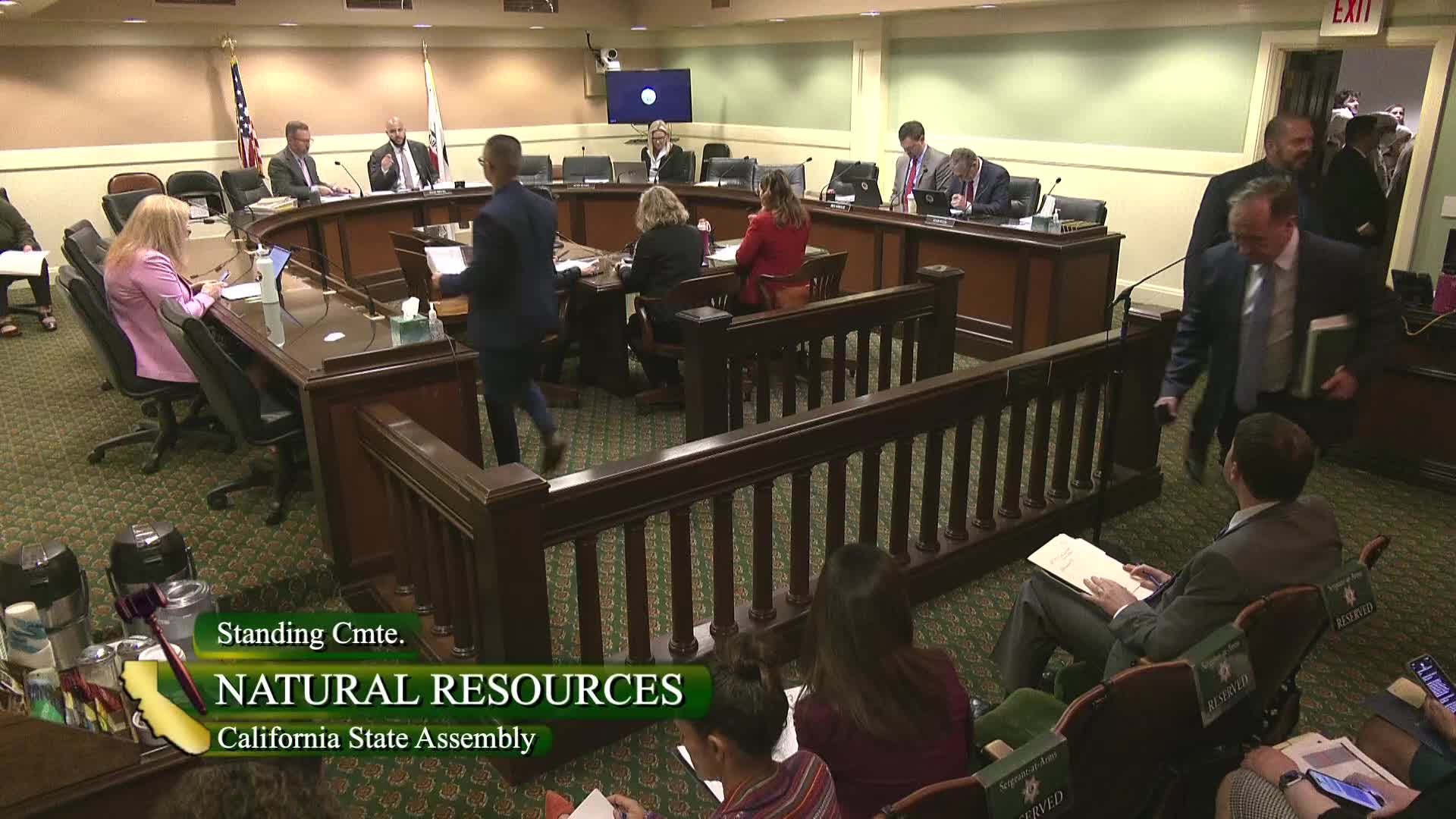
The Assembly Natural Resources Committee on May 20 advanced AB 12 43, the “Polluters Pay Climate Super Fund Act of 2025,” after several hours of testimony from environmental, labor and business representatives.
Assemblymember Addis, the bill’s author, told the committee the measure would require CalEPA to identify fossil‑fuel companies responsible for at least a billion metric tons of greenhouse‑gas emissions between 1990 and 2024, conduct a state climate‑cost study and assess fees on the largest polluters. “AB 12 43 is an equitable policy that ensures polluters contribute alongside taxpayers to cover the costs of climate damages,” Addis said.
Supporters said funds would be invested in resilience projects — energy upgrades, school hardening, infill housing and local emergency response — and prioritized for disadvantaged communities. “This bill requires the relatively small number of the largest multinational fossil‑fuel corporations … to pay a small portion of those profits to invest in our communities, businesses and workers,” said Maya Golden Krasner, deputy director and senior attorney at the Center for Biological Diversity’s Climate Law Institute. Mabel Tsai, political director for the California Environmental Justice Alliance, told the committee the bill dedicates at least 40% of funds to communities most affected by fossil‑fuel pollution.
Opponents — including representatives of the state building and construction trades and the California Chamber of Commerce — argued the measure could accelerate refinery closures, raise fuel and consumer prices, and cost jobs. “When confronted by economic reality, aspirational legislation such as AB 12 43 causes loss of jobs, increased costs for goods and services, and creates a stealth, regressive tax on every Californian,” Keith Dunn, representing the California Building and Construction Trades Council, told the committee. John Kendrick, speaking for the California Chamber of Commerce, said the bill’s retroactive approach could deter investment and pose legal risks.
Committee members pressed both sides on the bill’s scope and likely impacts. Supporters said the fee structure would focus on a relatively small set of multinational firms and include payment options to limit market disruption; they also argued the climate crisis itself harms jobs, public budgets and worker productivity. Several members called for additional technical work on definitions, legal exposure and workforce transition measures before later committees consider the bill.
After debate on economic and legal consequences and on how revenues would be applied, the committee recorded a due‑pass recommendation. The chair and supporters said they expect follow‑up amendments and further negotiation to refine definitions, jurisdictional questions and worker protections.
Votes at a glance
- AB 12 43 (Polluters Pay Climate Super Fund Act of 2025) — Committee action: due‑pass (to Judiciary). Outcome: due‑pass recommendation recorded. Motion moved and seconded on the floor; committee agreed to advance the bill for further consideration.
- AB 706 (Forest biomass / wildfire mitigation funding) — Committee action: due‑pass (to Utilities & Energy). Sponsors said the bill would create a fund to support projects that convert forest wildfire mitigation waste to beneficial uses; opponents raised concerns about forest removal and long‑term carbon outcomes. Motion passed as amended.
- AB 758 (Public‑land brush management assessments) — Committee action: due‑pass (to Emergency Management). The bill would require state and local governments to inventory and assess public lands for vegetation management and post plans publicly; some members described concerns about administrative burden and costs. Motion passed as amended.
- AB 1417 (Offshore wind community capacity and transparency) — Committee action: due‑pass (to Utilities & Energy). The bill, as amended, removes a developer fee and instead requires reporting by offshore wind developers on direct community and tribal capacity funding; industry urged further negotiation. Motion passed as amended.
- AB 1380 (Pathways for incarcerated CALFIRE hand‑crew members) — Committee action: due‑pass (to Public Safety). The bill would create a permanent pathway and certification for formerly incarcerated individuals who served on CALFIRE crews and reserve a percentage of entry‑level firefighter positions for qualified applicants; public‑safety stakeholders and labor raised concerns about set‑asides and hiring rules. Motion passed as amended.
- AB 839 (Sustainable aviation fuel / CEQA judicial review) — Committee action: due‑pass (to Judiciary). The bill would add certain sustainable aviation fuel projects to the list of infrastructure projects eligible for an expedited judicial review timeline under CEQA; supporters argued the change is needed to attract investment to produce SAF in California, while environmental justice and community groups opposed judicial streamlining. Motion passed as amended.
- AB 721 (Huron Hawk Conservancy) — Committee action: due‑pass (to Appropriations). The bill would establish a regional conservancy to coordinate conservation, recreation and community benefits near Huron in Fresno County. Motion passed as amended.
Why this matters
Committee debate made clear a central political tradeoff: supporters pitched AB 12 43 as a mechanism to shift climate recovery costs from taxpayers to major polluters while financing community resilience; opponents warned of near‑term economic dislocation for workers and consumers and urged re‑engagement with existing programs such as cap‑and‑trade. Committee members signaled they expect amendments and more data on legal exposure, economic impacts and workforce transition before the measure moves through subsequent committees.
What’s next
AB 12 43 and the other bills advanced by the committee will proceed to the committees identified above for further hearings and possible floor action. Committee members asked the bill’s authors and stakeholders to continue negotiations on definitions, legal exposure, workforce protections and funding priorities.
Ending note
Supporters urged the Legislature to create a funding stream that targets communities most harmed by fossil‑fuel pollution; opponents urged caution to avoid accelerating refinery closures and higher costs for working families. The committee’s recommendation advances those conversations to the next round of hearings.