Get Full Government Meeting Transcripts, Videos, & Alerts Forever!
Get email alerts on the Health It Ai Epic topic
No spam. Unsubscribe anytime.
DPH CIO outlines AI policy, EPIC roadmap and plan for generative tools under city safeguards
Summary
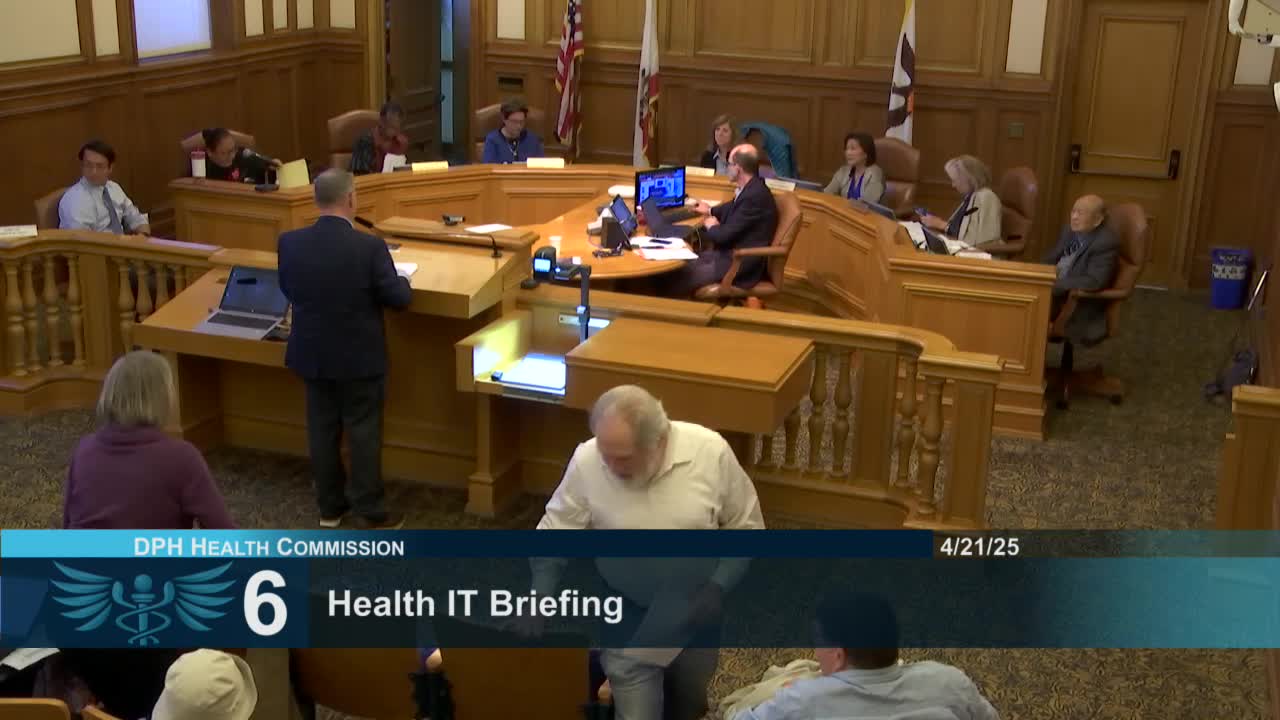
Department of Public Health CIO Eric Raffman and deputy CIO Jeff Scarfaria briefed the Health Commission on AI governance, a generative-AI pilot, upcoming Microsoft CoPilot Chat under enterprise terms, and EPIC priorities including sepsis detection and the Beaker laboratory integration.
San Francisco Department of Public Health Chief Information Officer Eric Raffman and Deputy CIO Jeff Scarfaria updated the Health Commission on health IT initiatives, including the departmentapproach to artificial intelligence, an enterprise generative-AI rollout, and EPIC electronic health record priorities.
Why it matters: The department is integrating new AI tools while emphasizing human oversight, HIPAA protections and city-level requirements for transparency. IT work also supports clinical goals such as earlier sepsis detection and consolidation of laboratory systems.
AI policy and legal context: Raffman summarized relevant legal and policy changes: a recently enacted California law (referred to in the briefing as AB 3030) requires attribution when AI generates healthcare communications that have not been reviewed by a licensed provider. The city also adopted an ordinance creating a public inventory of AI systems (chapter 22J) and DPH has been aligning its internal AI inventory with that requirement. Raffman said the departmenthas piloted generative-AI tools in an administrative context and is reviewing enterprise-level Microsoft CoPilot Chat under the city's BAA and data-protection terms before broader rollout.
Pilot work and clinical AI: DPH completed a pilot using OpenAI's ChatGPT for administrative tasks and found staff used it mainly as a productivity helper. Raffman and Scarfaria said clinical AI work will prioritize human review and start in lower-risk domains (for example, administrative summarization and automated claims appeals) before moving to higher-risk clinical decision support. They also described planned integration of AI-driven capabilities inside EPIC for sepsis early detection and other clinician-facing tools.
EPIC roadmap and projects: Scarfaria outlined EPIC priorities: ongoing support for CORE initiatives, onboarding additional clinical areas, a multi-year Beaker laboratory project to consolidate separate lab systems on EPIC, and other speciality modules. He said the department remains busy with competing priorities and that some positions remain vacant: IT vacancy rate is about 14%, with higher rates on teams central to strategic initiatives.
Privacy and HIPAA: Commissioners asked about PHI protections. Raffman said DPH will not place protected health information into unmanaged public generative-AI tools and will only deploy AI with PHI under business-associate agreements that limit retention and re-use. He described Microsoft CoPilot Chat safeguards, including a 30-day retention limit and contractual assurances that customer data will not be used to train vendor models. He also stressed "human warranty" principles requiring human oversight where AI influences clinical communication.
Ending: DPH said it will move carefully with generative AI, prioritize low-risk, high-value use cases and continue to brief the commission as pilots expand into clinical workflows and EPIC-integrated tools are deployed.