Get Full Government Meeting Transcripts, Videos, & Alerts Forever!
Get email alerts on the Behavioral Health Roadmap topic
No spam. Unsubscribe anytime.
DPH outlines behavioral-health roadmap: RESTORE program, unified street teams and bed-expansion targets
Summary
San Francisco DPH presented a behavioral-health update that consolidates street outreach into a neighborhood-based model, reported initial RESTORE pilot results and outlined a multi-year plan to expand treatment and shelter capacity as part of a mayoral 1,500-bed goal.
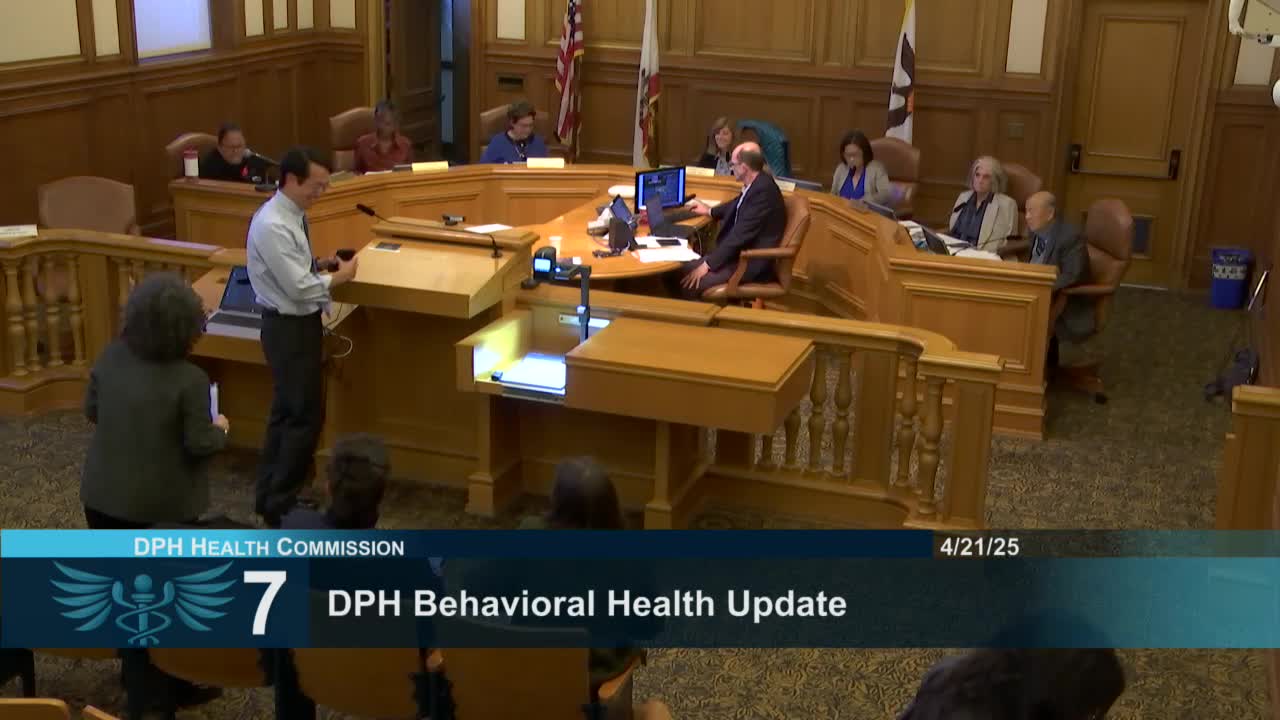
San Francisco Department of Public Health officials presented a behavioral-health roadmap to the Health Commission that emphasizes faster engagement on the street, low-barrier pathways into treatment and significant bed expansions.
Why it matters: The department said it aims to make it easier for people who are unhoused and living with substance use disorders or serious mental illness to move from street outreach into treatment and longer-term care. Officials described both programmatic and capacity changes intended to reduce fatal overdoses and improve treatment retention.
Street teams: DPH described a citywide consolidation of street outreach into a single, multidisciplinary, neighborhood-based model. The consolidated teams combine clinical behavioral-health staff, nurses, social workers, peers and public-agency partners (including HSH, Department of Emergency Management, Fire and Police) to stabilize people in place and create rapid, longitudinal pathways into services. Two teams (Tenderloin/Northern Station and Mission) have launched and operate with daytime hours and evening/night coverage via a night navigator team. The teams use shared-priority caseloads and data tools to focus resources on people with greatest need.
RESTORE program and immediate pathways: The RESTORE program offers a 24/7 bed plus a structured treatment plan and a requirement to start medication for opioid use disorder (MOUD). DPH reported the program has engaged approximately 380 clients to date; 88% of RESTORE clients started MOUD and about 50% exited to another stable location (including residential treatment or housing) after program participation. The department plans phased expansion of RESTORE to additional sites with a long-term target of roughly 200 concurrent slots across multiple locations.
Bed expansion and timeline: DPH said it expects to open between 135 and 285 new beds in 2025 across DPH-led and HSH-partnered projects, with about 37 beds identified as DPH-led in the current fiscal year. Additional projects are in planning for 2026 and beyond, including locked subacute beds and adult residential facilities. The department noted it has applied for state capital funding (about $140 million in Prop 1 infrastructure requests) and is pursuing a mix of city, state and federal funds to support construction and operations.
Staffing, data and outcome measures: Presenters said hiring remains a challenge but has improved relative to prior years; DPH is using batch recruitment and other strategies to fill clinical positions. The department also emphasized improved data sharing through a unified electronic health record and specialized data tools to help prioritize and track clients and service outcomes. Presenters said performance measures will include reductions in emergency services utilization for priority clients and increased linkage to stabilizing outpatient and residential care.
Commission and public reaction: Commissioners generally supported the consolidation and expansion, asked for continued focus on forensic and justice-involved populations, and pushed for clear performance metrics and ongoing reporting to the commission. Public commenters included neighborhood residents, providers and service agencies who both urged rapid progress and raised site-specific concerns (transportation, visibility, unit size and neighborhood impacts).
Ending: DPH will continue monthly updates to committee and commission bodies as projects move through site-selection, procurement and entitlement steps and as RESTORE and other pilots scale.