Get Full Government Meeting Transcripts, Videos, & Alerts Forever!
Get email alerts on the Wireless Permits Deemed Approval topic
No spam. Unsubscribe anytime.
Residents urge City of San Mateo to seek rescission of Crown Castle "deemed approved" letters for five wireless permits
Summary
At a special April 17 meeting, residents said city staff missed processing deadlines that led Crown Castle to issue a February "deemed approved" letter for five wireless permits and urged the City of San Mateo to get Crown Castle to withdraw the letter or face litigation; the council recessed to closed session and took no reportable action.
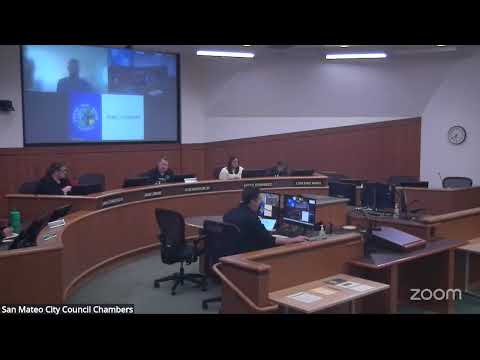
SAN MATEO, Calif. — Residents and permit appellants asked the City of San Mateo on April 17 to press Crown Castle to rescind a February letter the company says "deems approved" five wireless permits, arguing staff missed processing deadlines and that the letter creates legal and financial risk for the city.
At a special City Council meeting convened by Mayor Newsom, two organized public presenters — Jeff Adams and Ariel Strauss — told the council that Crown Castle’s letter, dated Feb. 18, effectively granted permits immediately and that the company later agreed only to extend the city’s deadline to sue, not to pause the permits’ legal effect. Adams urged the council to direct the city attorney to ask Crown Castle whether the company agrees the permits are not validly issued; if Crown Castle refuses, Adams urged litigation. "The city staff was negligent in performing one of its most basic duties with regard to the 5G application process," Adams said.
The presenters said the perceived failure to allow administrative review to complete before permits were deemed approved could expose the city to damages claims. Adams estimated that the five sites could affect dozens of nearby properties in San Mateo Park — he cited an approximate range of 25 to 40 properties — and said the average home value in San Mateo Park is "just under $4,000,000," which he used to illustrate potential exposure if property owners sue for diminution of value.
Ariel Strauss, who identified themself as chair representing Civil Wireless Permit Appellants, described the statutory mechanism appellants and Crown Castle have cited. Strauss read from the Crown Castle letters and from statute language as they understand it, saying, "the application and all other approvals necessary for installation work are now deemed approved," and that Crown Castle’s subsequent correspondence "agrees to toll the city's 30 day periods for challenging deemed approved status." Strauss told the council the tolling only delays the city's deadline to sue; it does not undo the letter's immediate legal effect as Crown Castle describes it.
Strauss warned that because the statute limits who may pursue immediate judicial review of a deemed-approval notice to the city, residents who later challenge SNI (site and installation) commission approvals could find their appeals moot if the deemed-approval letters remain in force. Strauss also cited permit indemnity language and California Government Code Section 815.6 as a possible pathway for claims against the city if staff error caused the loss of residents’ administrative remedies.
Both presenters asked the council to instruct the city attorney to request that Crown Castle withdraw or clarify the letters; if Crown Castle declines, they recommended the city sue to overturn the deemed-approval letters. Adams said pursuing that route would restore residents’ rights and reduce the city's litigation exposure, while Strauss said litigation on Crown Castle’s dime could clarify law the city administers.
Before public comment, the council voted 4–0 to allow Deputy Mayor Lorraine to participate remotely under the council’s just-cause rule because of a contagious illness; Council Member Fernandez moved the acceptance and the council took a roll-call vote. After the speakers, the council convened to closed session on two agenda items described as "conference with legal counsel — anticipated litigation." At the reconvening, the city attorney reported there was no reportable action from closed session but said they would follow up with Mr. Strauss on related matters.
No city council motion or vote directing the city attorney to seek rescission from Crown Castle was recorded on the public record during the meeting. Presenters and residents asked for explicit council direction and possible litigation; the city attorney’s report-out said only that no reportable action was taken and that follow-up with Mr. Strauss would occur.
The public comment and the legal questions raised center on the status and legal effect of Crown Castle’s Feb. 18 letter; the presenters referenced a March 9 letter from Crown Castle that they said tolled the city's 30‑day challenge period to April 21. The council set this matter as closed-session business to consult with legal counsel over anticipated litigation but did not announce any public decision following that consultation.
Moving forward, the council may choose to publicly direct the city attorney to seek written confirmation from Crown Castle that the letters are moot, or to authorize litigation if Crown Castle declines; neither step was taken on April 17.