Get Full Government Meeting Transcripts, Videos, & Alerts Forever!
Get email alerts on the Transportation Innovate680 topic
No spam. Unsubscribe anytime.
CCTA lays out Innovate 680 plan in San Ramon, from express-lane completion to shared mobility hubs and shuttle pilots
Summary
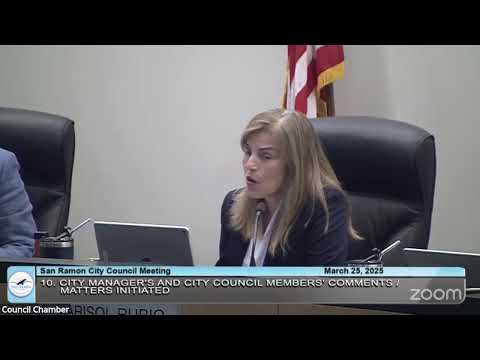
Tim Haley, executive director of the Contra Costa Transportation Authority, told the San Ramon City Council on March 25 that Innovate 680 combines infrastructure, technology and new services to manage congestion on the 680 corridor without major roadway widening.
Tim Haley, executive director of the Contra Costa Transportation Authority, told the San Ramon City Council on March 25 that Innovate 680 combines infrastructure, technology and new services to manage congestion on the 680 corridor without major roadway widening.
Haley said the program packages six project areas — including express-lane completion, coordinated adaptive ramp metering, adaptive traffic signals, bus-on-shoulder express service, shared mobility hubs and automated driving-system pilots — to reduce delay, improve transit reliability and provide first‑and‑last‑mile connections. “If we're not going to widen the roads, what are we going to do to really manage congestion? This is where we start using and leveraging data,” Haley said.
Why it matters: the 680 corridor remains constrained and heavily used by regional commuters. CCTA staff told the council the program is funded with a mix of local sales-tax returns (Measure J/Measure C), state and federal grants, and that a recent U.S. Department of Transportation award of about $166 million supports the express‑lane/braided‑ramp work that aims to reduce the mixing and weaving that creates bottlenecks.
Key elements presented - Express-lane completion and braided ramps: Haley said the express lanes currently end at LaVora Road and that braided ramps and lane continuity at the 242/24 mixing bowl are intended to reduce weaving and delay. He described a recent USDOT grant of roughly $166 million toward that work. CCTA staff said that alternative designs were evaluated and the recommended approach provided the best performance and cost-effectiveness for the corridor. - Coordinated adaptive ramp metering and smart signals: Haley described a next‑generation ramp‑metering pilot (imported concepts from Australia) and a countywide adaptive signal effort that would coordinate local signals with highway metering to smooth flows and reduce backups onto local streets. - Shared mobility hubs: CCTA has a countywide plan for roughly 36 shared mobility hubs. For San Ramon the study looked at two candidate hub locations: the San Ramon Transit Center and BR-3 in Bishop Ranch. Hubs would offer coordinated amenities (real‑time travel information, bike parking and charging, curbside management, EV charging, signage and space for retail) and act as transfer points between local and regional services. - Mobility-on-demand app and pilots: Haley said a mobility app (a one‑stop planning and payments platform) is expected to enter a beta test later this year, with a roughly 1,000‑user pilot beginning in November and an 8‑month evaluation that could lead to broader deployment in 2026–27. Automated shuttle pilots (Presto projects) are under way in the corridor for first‑/last‑mile service.
Council concerns and public feedback Council members pressed on affordability and equity. Council member Rubio said higher tolls can exclude lower‑income commuters: “There's people who work here at Whole Foods that are living all the way in Tracy ... I've even seen $12 sometimes. I'm like, that is not affordable for the everyday person.” Haley said MTC is piloting an income‑based discount program (Clipper/means‑tested discount) that could be applied in the 680 corridor and that CCTA is coordinating with the Metropolitan Transportation Commission and transit operators.
Other council questions focused on implementation and governance: Council member Adler asked about countywide coordination and whether a single traffic‑management center would coordinate signals, ramp metering and emergency response. Haley said the vision includes an integrated, regional traffic management approach that shares data and coordinates signals and ramp metering across local jurisdictions.
Funding and timeline Haley said many Innovate 680 actions are in design or early implementation; he described the program as moving from planning into delivery with construction and deployments continuing through 2028. He told the council the San Ramon shared mobility hub concepts are funded (regional Measure 3 and other transit capital grants) and that schedule and environmental work is underway; design would follow environmental clearance and construction would be staged through 2028. When asked for a cost figure for the San Ramon mobility‑hub concept, Haley and CCTA staff stated the project estimate at about $12 million and said funding sources were identified in regional grant programs.
CCTA proposals come with caveats. Haley repeatedly flagged technology and labor challenges for autonomous shuttles and emphasized the need to work with transit operators and unions to retrain and upskill staff rather than replace jobs.
What's next CCTA offered to hold public briefings and town halls in San Ramon; public comment during the council meeting included praise for Haley's presentation and requests for further public outreach. Haley said he would schedule follow‑ups and that CCTA planned public engagement as part of environmental and design work for the San Ramon hub.
Ending CCTA framed Innovate 680 as a coordinated package of projects intended to produce system‑wide improvements without large‑scale widening. Council members welcomed the briefing but repeatedly raised equity, funding sources and governance questions, and asked for further local outreach and detail on implementation and timelines.