Get Full Government Meeting Transcripts, Videos, & Alerts Forever!
Get email alerts on the Housing And Community Development topic
No spam. Unsubscribe anytime.
Hartford holds public hearing on HUD consolidated plan as nonprofits urge more housing, business and senior-meal funding
Summary
City staff outlined the draft five-year consolidated plan and first-year annual action plan for HUD entitlement grants; nonprofit speakers urged larger awards for affordable housing, small-business support and senior meals and requested clearer monitoring and drawdown information.
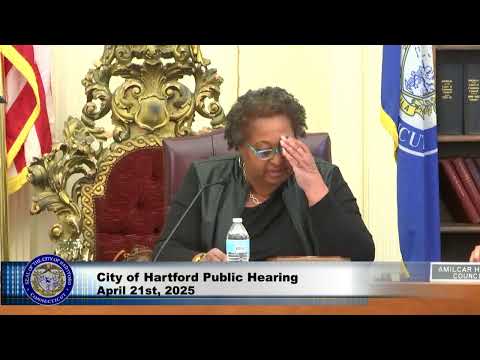
City of Hartford officials on April 21 presented a draft five-year consolidated plan and the city's 2025-26 annual action plan for U.S. Department of Housing and Urban Development entitlement grants and heard two hours of public comment from nonprofit and resident speakers urging more housing and service funding.
Cheryl Horowitz, director of the Office of Central Grants Administration, told the council the city will submit its annual action plan for the program year starting July 1, 2025 and ending June 30, 2026, "on or around 05/15/2025." She said the draft consolidated plan has been posted on the central grants department website since April 11 and is available for public review through May 12, 2025, and that allocation amounts would be posted on April 22. "Every five years is a new time; it's five years of which we're going to plan for what the funding that we get from HUD," Horowitz said, stressing the plan is based on resident input gathered at multiple meetings and outreach events.
The consolidated plan structures the city's use of HUD entitlement funds under four formula programs: Community Development Block Grant (CDBG), Emergency Solutions Grant (ESG), Housing Opportunities for Persons With AIDS (HOPWA) and HOME Investment Partnerships (HOME). Horowitz said the city is preparing for an assumed 3% funding cut from the prior year but will revise allocations if HUD awards differ by 25% or more, a threshold set in the city's citizen participation plan.
Public commenters used the hearing to press for larger awards to housing and supportive services and to highlight the local role of small nonprofits. Michelle Be Young, board chair of International Hartford, listed that organization's recent accomplishments and asked the council to increase its CDBG award from $115,000 to $125,000, saying the group helps immigrants and minority-owned small businesses with services ranging from business literacy to microgrants. "There is nothing like [International Hartford] anywhere," Be Young said, asking the council to "take into account the understanding of how important International Hartford is."
Art Filman, speaking for International Hartford, outlined a proposed asset-protection program for immigrants facing deportation and said the organization plans bilingual materials, legal and financial templates, and outreach to at-risk business owners. Filman cited census estimates and local research on immigrant-run businesses, saying many could abandon owner-occupied homes and local shops if immigration enforcement actions rise.
Multiple small-business owners credited International Hartford with supporting startup and expansion efforts. Evelyn Ruiz, owner of Astelluego Front, said her microgrant and lease assistance helped her move toward a brick-and-mortar site at 65 Wethersfield Avenue but added, "$5,000 isn't enough to open a cafe. It's a start, a meaningful one, but... small business owners still face deep challenges covering build-out costs, equipment, permits, and daily operating expenses." Other speakers, including Kevin Murray and Lori Perry, described technical-assistance, generator and site-placement help and urged the council not to cut funding for the nonprofit.
Several human-service providers described program needs tied to HUD program funding priorities. Nilda Morales, director of the Hispanic Senior Center and El Centro Family Center at Catholic Charities, said recent cuts to senior meal funding from the Elder Nutrition program will reduce hot meals from five days a week to three unless roughly $200,000 is identified for the city fiscal year beginning July 1. "If we do not identify the required fundings by July 1, we will have to make some changes," Morales said, adding that some seniors rely on the center's meal as their only daily hot meal and that reduced service would increase isolation and health risks.
Summer Sivetz, director of development and communications at the Chrysalis Center, asked the council to continue a $25,000 CDBG award for La Cocina, a culinary workforce program that plans to train about 40 Hartford participants and provide ServSafe certifications. "This funding will directly support the salary expense for training 40 Hartford participants," Sivetz said. She also urged continued HOPWA support for tenant-based rental assistance serving people living with HIV.
Sue Gonderman, program operations director at Community Partners in Action, described the Reentry Welcome Center's work providing wraparound services to returning residents and said the center has helped "over 2,700 returning residents" since 2018. Braden Ransom, community impact manager for the Health Collective, outlined a community health worker training program launched last December and asked the council to support community-rooted workforce development.
During council questioning Horowitz explained the city's evaluation approach for subrecipients: applications include objective sections about prior results and outcomes, and the city provides training and technical assistance rather than routinely penalizing smaller organizations with weaker administrative capacity. She said the city has set aside about $100,000 for training to help agencies and city staff comply with HUD rules. Horowitz also warned the council that HUD has added contract requirements, including a whistleblower clause and increased monitoring. "We will be doing more monitoring than we have done in the past," she said.
The hearing produced several operational clarifications from city staff: allocations are subject to City Council adoption and to HUD releasing funds; the draft plan and slides remain available on the central grants website and at Hartford Public Library branches; and the public comment period on the draft runs through May 12. Horowitz said staff can provide the council with a list of subrecipients with drawdown or reporting issues next week.
Speakers represented immigrant-serving and workforce programs, senior services, reentry supports and housing-related assistance. No formal votes or decisions on specific awards were taken at the hearing; the council will consider adoption of allocations after staff posts proposed distribution amounts and after the public comment period closes.
The City of Hartford is accepting written comments on the draft consolidated plan through May 12, 2025; Horowitz said the draft and related slides are posted on the central grants department website and available at the Hartford Public Library, Park Street and Albany branches.