Get Full Government Meeting Transcripts, Videos, & Alerts Forever!
Get email alerts on the Rezoning Infrastructure topic
No spam. Unsubscribe anytime.
Staff warns that rezoning Eastport Farms to C‑4 could strain Spring Hill sewer and contradict comprehensive plan goals
Summary
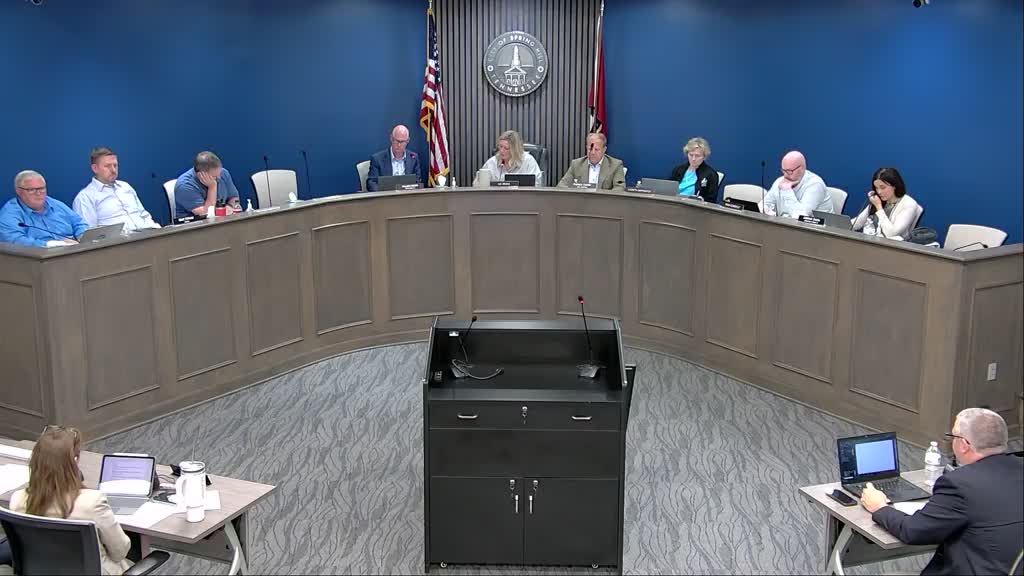
At an April 28 work session, City of Spring Hill staff recommended caution on a requested AG→C‑4 rezoning for Eastport Farms, citing sewer and water capacity constraints and potential conflict with the comprehensive plan; the applicant said C‑4 best fits the plan and intends to pursue a planned development with phased commitments.
The Planning Commission on April 28 heard competing arguments over a rezoning request to change a 1.97‑acre parcel on Port Royal Road from agricultural to C‑4 (general commercial) to enable a planned development called Eastport Farms.
Senior planner Mr. Moran and planning staff advised the commission the rezoning is not consistent with the Spring Hill comprehensive plan when viewed in full context because of existing utility and transportation constraints. Staff pointed to a June 12, 2024 city memorandum to the Board of Mayor and Aldermen urging discretionary denial of annexations and rezonings that would increase sewer demand until the city completes wastewater treatment and reservoir projects. Staff said existing water use has exceeded 80% of capacity and there is an overcommitment of sewer capacity.
Ms. Sanders and other staff explained that rezoning the parcel to C‑4 would allow higher‑intensity, by‑right uses that could be inappropriate along an unimproved Port Royal Road (a two‑lane rural arterial with open ditches and no curb or sidewalk) and that the small size of the parcel (approximately 1.97 acres) raises questions about developability for intense mixed‑use under C‑4. Staff recommended the applicant consider lower‑intensity interim districts such as RA or RR and then pursue a C‑4 planned development (PD) if appropriate; staff emphasized that conditions and phasing in a PD enable limitations on timing and utility demand that a straight rezoning would not.
Greg Gamble, representing Gamble Design Collaborative, said C‑4 aligns with the comprehensive plan’s “community commerce” character area and argued that the parcel’s size and frontage make C‑4 a reasonable request. Gamble said his client intends to advance a PD with triggers and milestones to limit impacts. He also corrected an earlier misstated acreage to 1.97 acres during his presentation.
Commissioners and the mayor expressed mixed views. Mayor Fitterer and several commissioners said they believed C‑4 could be an appropriate long‑term fit but that current infrastructure constraints counsel caution. City attorney Patrick Carter reminded the commission that its role is to act on the application submitted — the body may recommend approval or denial — and that the elected Board of Mayor and Aldermen has broader discretion at the rezoning stage.
Because staff and several commissioners expressed concern about immediate approval given the city’s sewer and water capacity limits, the chair left the rezoning request off consent for additional review and discussion before a formal recommendation to BOMA.
Next steps: staff and the applicant will continue discussions; commissioners may recommend denial or conditional approval with an alternative zoning suggestion to BOMA; final action will be decided by BOMA at a later meeting.